4.7/5


A vanitas painting is a still life set up as a warning: a skull, a ticking watch, a candle just blown out and a heap of coins, books and instruments, all telling you that life is short and that what you gather in it will not last. Dutch and Spanish painters of the 1600s turned the quiet table of still life paintings into a moral lesson, and every object on it was chosen to be read. A chart further down pairs ten of those warning objects with what each one means and the painting where you can spot it.
Below, the symbols come first, each with a painting where you can find it, and then eight vanitas works examined object by object, from the earliest known example in New York to a skeleton snuffing out a candle in Seville.
What the word means
Vanitas is the Latin word for vanity, in the old sense of something hollow. It comes from the second verse of Ecclesiastes, which the Latin Vulgate gives as "Vanitas vanitatum, dixit Ecclesiastes; vanitas vanitatum, et omnia vanitas" and the King James Bible as "Vanity of vanities, saith the Preacher, vanity of vanities; all is vanity" (both versions side by side). Merriam-Webster sums up the shortened Latin motto in five words: "earthly life is ultimately empty."
In English the word also names a type of picture. Dictionary.com defines it as a still life "characterized by objects symbolic of mortality and the meaninglessness of worldly pleasures," and places the genre's flowering in the Netherlands from about 1620 to 1650.
That intent is what separates a vanitas from other still lifes. A bowl of fruit by Chardin can simply celebrate light and texture; in a vanitas, each object stands in for an idea, and the painter expects you to decode it. For the painters who made still life a genre of its own, from Clara Peeters to Van Gogh, see our list of famous still life artists.
Where and when it began
Within a generation of De Gheyn's 1603 panel, described below, the genre had a home town. The Met's survey of northern still life calls vanitas pictures "a specialty of Leiden artists such as the young Jan Davidsz de Heem and David Bailly," and the National Gallery adds that Bailly is often credited with inventing the type. Bailly trained his nephews Harmen and Pieter Steenwyck in Leiden. Harmen, born in Delft in 1612, became the genre's leading exponent. For the rest of that era, from Hals's portraits to Vermeer, see our guide to Dutch Golden Age paintings.
Spain built a louder version. As TheCollector's look at Spanish vanitas shows, Spanish painters brought figures into the scene, from angels to skeletons, and aimed the warning at dynasties and high office as much as at private luxury. In Leiden the message lies still on a tabletop; in Seville it gets up and moves. Our list of famous Spanish paintings covers the wider Golden Age those painters belonged to, and both branches share the habits described in Baroque painting characteristics.
How to read the objects
Vanitas painters drew on a shared stock of objects, and the museums that own the paintings spell out what they meant. Here is that vocabulary, with a painting in this guide where you can check each object for yourself.
| Look for | The warning it carries | Find it in | Where in the picture |
|---|---|---|---|
| 💀 A skull | Death comes for everyone. |  Young Man holding a Skull (Vanitas) |
In the young man's hand, built from coarse hatching |
| ⌚ A watch or an hourglass | Time is running out. | Vanitas Still Life with Self-Portrait | On the table, among the violin, the toppled glass and the cracked walnut |
| 💨 A lamp still smoking | A life has only just ended. | Still Life: An Allegory of the Vanities of Human Life | A thin trail of smoke rises from the wick |
| 🫧 A soap bubble | A life is as fragile as a bubble. |  Vanitas Still Life |
The huge bubble floats above the skull, under the stone arch |
| 🌷 A cut flower | Beauty and youth will wilt. | Vanitas | A single tulip stands in a glass of water |
| 🪙 Coins and pearls | Riches stay behind when their owner dies. |  Vanitas Still Life with Portrait of a Young Painter |
Gold ducats and pearls lie on the table |
| 📚 Books | Even learning ends with a life. | Allegory of Vanitas | Skulls are piled on top of them at the left |
| 🎶 A flute, a full glass and a pipe | The pleasures of the senses are brief. | Vanitas Still Life with Portrait of a Young Painter |
On the table, standing for hearing and taste |
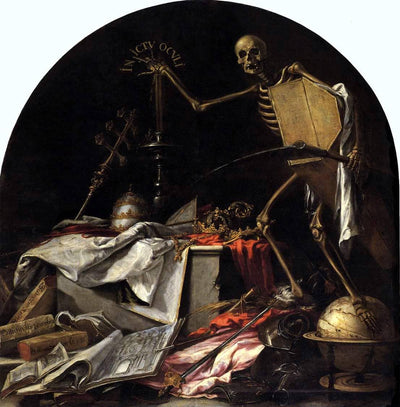
| 👑 A crown, a papal tiara and a globe | Death beats power and fame. |  In Ictu Oculi |
Thrown on the ground, with Death's foot on the globe |
| 🐚 A sea shell from far away | Wealth from far-off trade, held in the shell of a creature now gone. | Still Life: An Allegory of the Vanities of Human Life | At the left side of the table |
Each meaning follows the museum or church that owns the painting.
Not every watch on a table is a sermon. The Met notes that in Abraham van Beyeren's lavish Still Life with Lobster and Fruit of the 1650s, the pocket watch may be "more of an intellectual conceit than a sober warning." So read the whole table: a skull or a written motto makes the warning explicit. Single creatures could carry meanings as well, as our piece on what the goldfinch means in art shows.
Eight vanitas paintings, object by object
Vanitas Still Life, Jacques de Gheyn II (1603)

Zoom
The Met calls this panel "generally considered to be the earliest known independent still-life painting of a vanitas subject." De Gheyn, born in Antwerp in 1565, set a skull under a stone arch, with an enormous soap bubble above it, cut flowers in a glass vase to one side and a smoking urn to the other. The museum reads all four as reminders of how brief life is.
Look inside the bubble: among the reflections are a wheel of torture and a leper's rattle, images of human folly. The two figures at the top are Democritus and Heraclitus, the laughing and the weeping philosophers of ancient Greece, one mocking the world and one mourning it. The panel is oil on wood, 82.6 × 54 cm (32.5 × 21.3 in).
Vanitas Still Life with Self-Portrait, Pieter Claesz (about 1628)

Zoom
Claesz worked in Haarlem, and the Met's survey names him among the city's painters of monochrome "breakfast" pieces, with ham, cheese and glasses of wine or beer on a wooden tabletop. Here he turned the same kind of table toward death. The Germanisches Nationalmuseum in Nuremberg, which owns the panel, lists a violin and bow, a skull, a toppled wine glass, a cracked walnut, an oil lamp, a watch, a key, an inkpot and a quill. It is oil on oak, 35.9 × 59 cm (14.1 × 23.2 in).
The key is the glass ball on the left. It reflects the painter's room, with Claesz at work in front of his easel. The museum reads it two ways: the reflection is as fleeting as the artist's own life, yet the painting that holds it is meant to outlast him and keep his name alive.
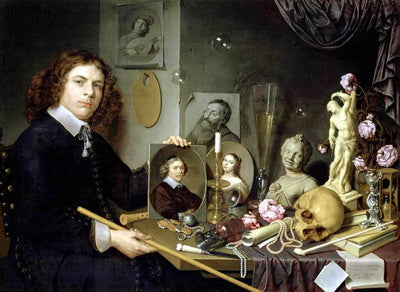
Vanitas Still Life with Portrait of a Young Painter, David Bailly (1651)

Zoom
This picture, also known in English as Self-portrait with Vanitas Symbols, belongs to Museum De Lakenhal in Leiden, which bought it in 1967. A young man holding a mahlstick shows us an oval portrait of an older man: that oval is Bailly's self-portrait. Whether the young man is a younger Bailly or a fellow painter is still uncertain. It is painted in oil on panel, 89.5 × 122 cm (35.2 × 48.0 in), signed and dated 1651 on a sheet of paper at lower right.
The museum sorts the table into two groups. An extinguished candle, soap bubbles, a skull, withering flowers and an hourglass speak of passing life; a silver tankard lid, gold ducats and pearls speak of possessions that end. The senses are here too: the flute and the lute player in the print on the wall for hearing, flowers for smell, the shining bubbles for sight, a full glass and a pipe for taste. A note at the lower right copies the Ecclesiastes line in Latin, as "Vanitas vani(ta)tum et omnia vanitas."
You can order this Bailly as a hand-painted copy.
Still Life: An Allegory of the Vanities of Human Life, Harmen Steenwyck (about 1640)

Zoom
This small panel, 39.2 × 50.7 cm (15.4 × 20.0 in), belongs to the National Gallery in London, and the gallery reads it object by object. The skull at the table's edge confronts you with death. Of the two books, one looks new and unread and the other well thumbed: learning, and growing old. A recorder, an upturned lute and a shawm are the passing pleasures of music; the flask is wine. The Japanese sword, an expensive import, stands for luxury and power, and the sea shell was a collector's piece from a distant shore. A thin trail of smoke says the lamp has only just gone out, and the pocket watch keeps ticking.
The layout is part of the message. Everything is heaped on a diagonal at one side, while the other half stays nearly empty, a contrast the gallery reads as riches against nothingness. X-rays show that Steenwyck first painted a bust of a man in a wreath, probably a Roman emperor, where the flask now stands.
Young Man holding a Skull (Vanitas), Frans Hals (1626–1628)

Zoom
Not every vanitas is a table of objects. The National Gallery stresses that this life-size young man is not a portrait: the picture is a vanitas, a reminder of how short life is. He holds a skull in one hand and gestures at us with the other, his foreshortened fingers seeming to cross into our space. His beret, ostrich feather and drapery are a fanciful version of 16th-century dress, the costume of an allegory. Hals painted him fast, without the usual underpainting, so the reddish ground shows through and the skull is built from coarse hatching. Oil on canvas, 92.2 × 80.8 cm (36.3 × 31.8 in).
The picture was long called Hamlet with Yorick's skull, but the gallery points out there is no evidence the play was performed or translated in the Dutch Republic in Hals's lifetime. Our studio artists paint the Hals young man with the skull by hand in oil.
Allegory of Vanitas, Antonio de Pereda (about 1634)

Zoom
Pereda, born in Valladolid in 1611, worked on a grand scale: oil on canvas, 139.5 × 174 cm (54.9 × 68.5 in), now in the Kunsthistorisches Museum in Vienna. A winged genius personifies Vanitas, and the objects in front of the figure point to fleeting time, the emptiness of power and the brevity of pleasure. On the table beside the hourglass, two Latin words, NIL OMNE, which the museum translates as "all is trivial," give the verdict.
Find the small cameo in the genius's left hand: it is a portrait of Emperor Charles V. The museum takes it, with other Habsburg references in the picture, as a sign that the court commissioned the painting, which turns a still life into a comment on an empire. The genius rests a hand on a globe, and the right side of the table is strewn with coins, pearls and playing cards.
In Ictu Oculi, Juan de Valdés Leal (1670s)

Zoom
Hand-painted oil reproductionSee sizes ›
Here the warning has a body. A skeleton, Death itself, reaches out and snuffs the flame of a candle, the flame of life, as the Hospital de la Santa Caridad in Seville describes it. Symbols of power, glory and wealth lie thrown on the ground, among them a papal tiara, a crown and heaps of books, and Death plants a foot on a globe. Above the candle runs the title, In Ictu Oculi, "in the twinkling of an eye," from Saint Paul's line about the dead rising at the last trumpet in 1 Corinthians 15:52.
Valdés Leal painted it in the 1670s for the church of the Caridad brotherhood, which Miguel Mañara was then renewing, together with a second canvas, Finis Gloriae Mundi, according to the University of Seville's record. That companion shows a crypt with the corpse of a bishop and the remains of a knight, while a hand holds a scale weighing the deadly sins against works of mercy. Both still hang in the church. Valdés Leal's In Ictu Oculi is available as a hand-painted oil.
Vanitas, attributed to Philippe de Champaigne (mid-1600s)

Zoom
Hand-painted oil reproductionSee sizes ›
The French version strips the genre down to three objects. The French national museum database records this small oil on oak, 28.4 × 37.4 cm (11.2 × 14.7 in), as attributed to Philippe de Champaigne (Brussels 1602, Paris 1674) and dates it to the second or third quarter of the 1600s. The Musée de Tessé in Le Mans bought it at a public sale in April 1884.
There is no luxury to renounce here: a tulip in a glass of water, a skull, an hourglass. The cut flower will wilt, the sand will run out, and the skull shows where both lead. Champaigne's skull, tulip and hourglass can be painted for you in oil.
Vanitas versus memento mori
Memento mori, Latin for "remember that you will die," is the older and broader idea; TheCollector notes the motto on the backs of paintings as early as the 1400s. A vanitas uses still life objects to make the same point and adds a second one: the things people chase are hollow. A skull on its own works as a memento mori. Once the painter adds the things people collect, or the flowers and sand that measure out a life, the picture becomes a vanitas.
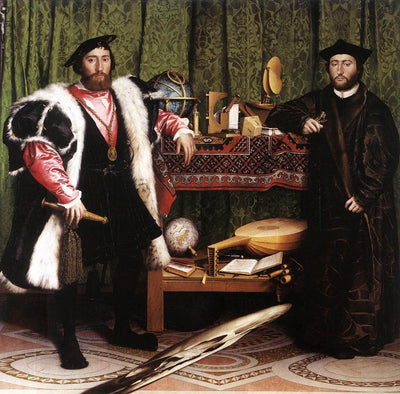
Hans Holbein the Younger slipped a skull into a double portrait, The Ambassadors (1533), oil on oak, 207 × 209.5 cm (81.5 × 82.5 in). Between the two men's feet floats a stretched, smeared shape that resolves into a skull only when seen from a sharp angle, close to the right of the panel. The National Gallery ties it to memento mori and reads the half-hidden crucifix at top left as a hint of hope of redemption. Our list of famous German paintings tells the full story of the two diplomats and the objects on their shelves.
The skull never quite left painting. In early 1886, while studying at the academy in Antwerp, Van Gogh painted a skeleton with a lit cigarette in its mouth, which the Van Gogh Museum calls "a juvenile joke." Drawing skeletons was a standard academy exercise, but painting them was not part of the course, so he must have painted it between or after lessons. It is oil on canvas, 32.3 × 24.8 cm (12.7 × 9.8 in), and Van Gogh's smoking skeleton can be ordered as a hand-painted copy.
One object at a time
A vanitas rewards slow looking, and its details keep surfacing long after the first glance. Browse our still life collection for more tables of meaning, step back to the wider canon with the most famous paintings in the world, and go further back to the religious art of the Middle Ages with famous Gothic paintings.
Sources
- Still Life: An Allegory of the Vanities of Human Life, Harmen Steenwyck, National Gallery, London
- Harmen Steenwyck, artist biography, National Gallery, London
- Young Man holding a Skull (Vanitas), Frans Hals, National Gallery, London
- The Ambassadors, Hans Holbein the Younger, National Gallery, London
- Vanitas Still Life with Portrait of a Young Painter, David Bailly, Museum De Lakenhal, Leiden
- Vanitas Still Life with Self-Portrait, Pieter Claesz, Germanisches Nationalmuseum, Nuremberg
- Vanitas Still Life, Jacques de Gheyn II, The Metropolitan Museum of Art
- Walter Liedtke, Still-Life Painting in Northern Europe, 1600–1800, Heilbrunn Timeline of Art History, The Met
- Allegory of Vanitas, Antonio de Pereda, Kunsthistorisches Museum, Vienna
- Capilla y obras (In ictu oculi and Finis gloriae mundi), Hospital de la Santa Caridad, Seville
- Juan de Valdés Leal, heritage record, Universidad de Sevilla
- Vanité, attributed to Philippe de Champaigne, Musée de Tessé, POP database, French Ministry of Culture
- Head of a Skeleton with a Burning Cigarette, Vincent van Gogh, Van Gogh Museum
- vanitas, Dictionary.com
- vanitas vanitatum, omnia vanitas, Merriam-Webster
- Ecclesiastes 1:2, King James Version and Vulgate, Bible Gateway
- 1 Corinthians 15:52, King James Version and Vulgate, Bible Gateway
- The Fascinating Traits of Spanish Vanitas Paintings, TheCollector