4.9/5
4.9/5


Ask what are some of Van Gogh's most famous flowers and nearly everyone answers with one word: sunflowers. Fair enough. He painted them in Paris lying on a table, then in Arles standing in a jug, then again from memory in the middle of winter. But the flower pictures people actually stop in front of in museums form a longer list, and it stretches from a cheap majolica jug in Arles to a blossoming almond branch painted for a newborn baby.
Most of these pictures come from a short, hard stretch: August 1888 to May 1890, Arles and then the asylum at Saint-Rémy. Flowers were the subject he could always get hold of, even when he wasn't allowed to wander far. They're also the part of the Van Gogh paintings people most want copied by hand, which tells you how well they hold a room. Here are the ten that matter most, with where each one hangs.
Van Gogh's most famous flower paintings, ranked
The order below is about fame, meaning how instantly a stranger would recognize the picture, and not about which one is best painted. That second argument could run all night.
1. Sunflowers, the London canvas (1888)

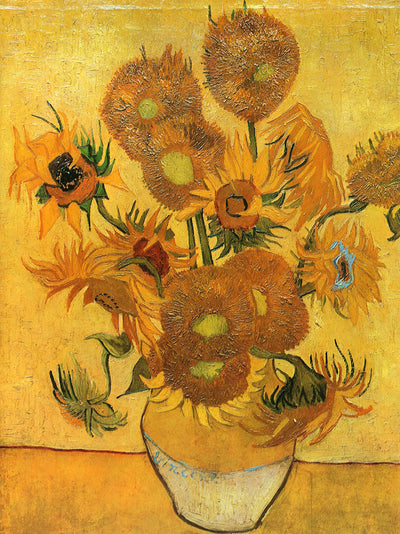
If one flower painting stands for Van Gogh, it's this one. It hangs at the National Gallery in London, measures 92.1 × 73 cm, and holds fifteen sunflowers at every stage of life, from buds to full bloom to heads already dropping their petals. That spread from fresh to dying ties it to the old Dutch vanitas habit of reminding you that everything fades.
He painted it for a guest. Paul Gauguin was coming to share the Yellow House, and Vincent wanted the studio dressed for him. In a letter to Theo in August 1888 he wrote: ‘I’d like to do a decoration for the studio. Nothing but large Sunflowers.’ In the same letter he added that he was ‘painting with the gusto of a Marseillais eating bouillabaisse.’ You can see the speed in it. The background is yellow, the jug is yellow, the table is yellow, and it still doesn't blur into one color. If you want to see how that works up close, the London canvas with its fifteen blooms is the one to study.
2. Almond Blossom (1890)

The gentlest picture he ever made, and the one his family loved most. Early in 1890 Theo and Jo had a son and named him Vincent Willem, after his uncle. Vincent answered with a present: big branches of white blossom against a sky-blue ground, painted in Saint-Rémy in February 1890. Almond trees flower early in the spring, which made them an easy symbol of new life.
The flat blue, the hard outlines and the way the branches cut across the picture with no ground and no horizon all come from Japanese woodblock prints. It's 73.3 × 92.4 cm and belongs to the Van Gogh Museum in Amsterdam. The baby it was painted for grew up to found that museum. Of every flower picture on this list, the branches against that blue sky is the one that works best over a bed, and it was painted to hang in a family home.
3. Irises, the garden at Saint-Rémy (1889)
He entered the asylum at Saint-Rémy in May 1889 and, within the first week, started painting the irises growing in its garden. No sky, no horizon, just a field of blue flowers pushed right up against the frame, with one white iris on the left as a jolt. He thought of it as a study. Theo disagreed and sent it to the Salon des Indépendants in Paris that September, then wrote back: ‘[It] strikes the eye from afar. It is a beautiful study full of air and life.’
The painting is 74.3 × 94.3 cm and is now in Los Angeles at the Getty. It sold at Sotheby's in New York on November 11, 1987, and the museum bought it by private sale in 1990. At Saint-Rémy, in the last year before his death, he made almost 130 paintings, and this was the first great one.
4. Sunflowers, the Amsterdam repetition (1889)
In January 1889 Van Gogh went back to his sunflowers and repeated them. The version that stayed with the family is 95 × 73 cm, and it's close to the London picture but not a tracing: the whole thing is built from three shades of yellow and nothing else. Gauguin later asked for one of these as a gift, and Vincent didn't want to part with it.
5. Twelve sunflowers on turquoise (Munich, 1888)
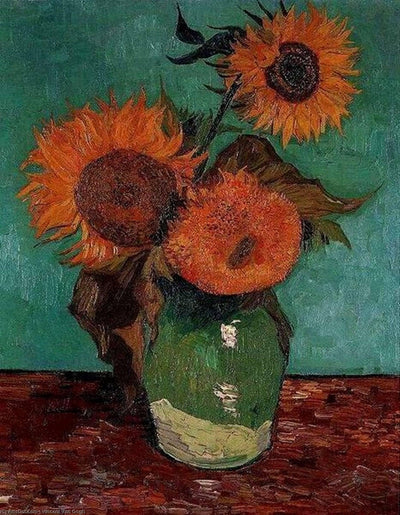
The first Arles batch included a jug of twelve sunflowers set against a turquoise ground. It's 92 × 73 cm, and Munich's Neue Pinakothek has owned it since 1912. Next to the yellow-on-yellow canvases it looks almost cool, and that's why some people prefer it. The same week produced the first of them, three big heads in a green vase, the smallest idea in the series.
6. Irises in a vase, pink gone white (New York, 1890)

In May 1890, just before leaving Saint-Rémy, he painted four big bouquets of spring flowers: two of irises and two of roses. The irises now in New York were meant to be soft, violet flowers against a pink background. The pink came from a red pigment that didn't last, so the wall behind the flowers has faded to a pale off-white. It's 73.7 × 92.1 cm, and it belonged to his mother until she died in 1907. The Met has kept it since 1958.
7. Irises on yellow (Amsterdam, 1890)
Its companion from the same week went the other way: purple flowers against a loud yellow ground, set out as an exercise in color contrast. It's taller than the New York picture, 92.7 × 73.9 cm, and it hangs in Amsterdam. The same fading hit this one too. The irises were painted purple, but the red in the mix has faded and they now read as blue.
8. Sunflowers lying on a table (Paris, 1887)
Before the jugs, there were cut heads. In Paris in late summer 1887 he painted four still lifes of sunflowers lying flat, stems cut, seeds showing. The one in New York is small, 43.2 × 61 cm, and it has a good story. Gauguin acquired the two smaller pictures of the group and hung them above his bed in his Paris apartment, where they stayed until the mid-1890s, when he sold what he owned to pay for his trip to the South Seas. These paintings are why Van Gogh knew Gauguin would like a room full of sunflowers.
9. Oleanders (Arles, 1888)
Pink oleanders crammed into a majolica jug, painted in Arles in August 1888, with a yellow paperback lying in front: Émile Zola's La joie de vivre. He'd painted the same novel once before, in Nuenen in 1885, next to an open Bible. Here it sits beside a flower he admired because it never stopped blooming and kept throwing out new shoots. It's 60.3 × 73.7 cm and hangs at the Met in New York.
10. Plum blossom copied from Hiroshige (1887)

He owned a pile of Japanese prints and made three paintings after them in Paris in October–November 1887. This was the first, based on Utagawa Hiroshige's Plum Garden in Kameido. He kept the composition but pushed every color harder, turned Hiroshige's black and grey trunk red and blue, and added orange borders with Japanese characters. It's 55.6 × 46.8 cm, in Amsterdam. It explains the almond blossom better than any essay: the flat sky, the branch cutting across the frame, the blossom as the whole subject.
What was his favorite flower?
The sunflower, and he said so. In a January 1889 letter he told Theo: ‘You know that Jeannin has the peony, Quost has the hollyhock, but I have the sunflower, in a way.’ Those were two French flower painters well known in their day, and he was staking his own claim. It worked. Friends brought sunflowers to his funeral in 1890.
He didn't start there. In Paris in 1886 he painted mixed bouquets to practice color, laying the paint on thick after seeing Adolphe Monticelli's crusted flower pieces that June. Vase with Chinese Asters and Gladioli, 61.1 × 46.1 cm, is a good example. The real vase in it survives in Amsterdam, and it's much smaller than the painted one: that bouquet would never have fit. If you want his own voice on all this, start with a guide to reading the letters.
Where are the twelve sunflowers?
The “12 sunflowers” people search for are two pictures. The original, with twelve flowers against turquoise, is in Munich. In the winter of 1889 he painted a variation from memory, and that one is in Philadelphia; the winter repetition in Philadelphia gives each flower more of its own personality rather than copying the Munich canvas line by line.
Across the whole series he made seven jugs of sunflowers: four in one week of August 1888 and three repetitions in January 1889. Five are in public museums, in London, Amsterdam, Munich, Philadelphia and Tokyo. One is privately owned and not exhibited. The seventh was destroyed during the Second World War.
| Sunflowers in a jug | Painted | Where it is |
|---|---|---|
| Twelve sunflowers, turquoise ground | August 1888 | Neue Pinakothek, Munich |
| Fifteen sunflowers, yellow ground | August 1888 | National Gallery, London |
| Repetition, yellow ground | January 1889 | Van Gogh Museum, Amsterdam |
| Twelve sunflowers, variation | Winter 1889 | Philadelphia Museum of Art |
| Repetition | 1889 | Sompo Museum of Art, Tokyo |
What purple flower did Van Gogh paint?
Irises, over and over. The Getty's garden picture from 1889 and the two vases from May 1890 are the famous ones. The catch is that his purples rarely look purple now. He mixed them with red pigments that fade in light, so the flowers have cooled toward blue, and the pink wall behind the New York bouquet has gone almost white. When you look at them today, imagine them warmer.
One more, for the doctor
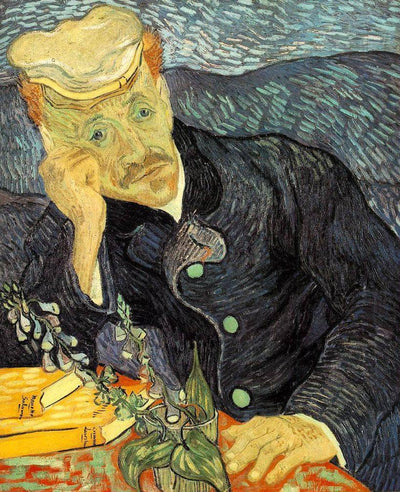
Blossoming chestnut branches filled a 73 × 92 cm canvas in 1890. After his death the family gave it to Dr. Paul Gachet, the doctor he also painted at Auvers, and Emil Bührle bought it in 1951; it's still with the Zurich foundation that carries his name. It isn't famous enough for the top ten, but it's a better picture than some that are. For the rest of his career beyond flowers, see his ten best-known pictures overall, or browse the hundred-odd paintings everyone seems to recognize.
Bringing the blossom home
Flower paintings are where Van Gogh's brushwork is easiest to feel, because the paint is thick and the subject is simple. A printed poster flattens that. An oil copy painted by hand keeps the ridges on the petals and the drag of the brush through the background. If one of these ten is the one for you, start with the full Van Gogh room at Art & See.