4.9/5
4.9/5


If you want the short answer to how many paintings did Van Gogh paint: more than 850, and complete catalog listings land at around 860 oils. He made them in roughly ten years. Vincent decided to become an artist in 1880, at 27, and died on 29 July 1890. Add almost 1,300 works on paper and you get a man who finished something nearly every day of his working life.
That pace is the real story. Most painters take a lifetime to fill a catalog of that size. He did it in a decade, and he packed a big share of it into the final stretch in France.
You probably know a few dozen of these pictures by sight. If you've looked through the Van Gogh paintings people hang at home, you've seen the famous ones: sunflowers, a night sky, a bedroom, a few portraits. They're a thin slice of the whole. The other eight hundred or so are peasants in dark kitchens, Paris street corners, orchards, wheat, olive trees and a lot of his own face.
Why there's no single exact figure
Nobody hands you one clean number, and there are good reasons for that.
First, the line between a painting and a study was blurry for Van Gogh himself. On or about 18 June 1889 he told Theo in a letter that June that he had "a new study of a starry sky." That study is the canvas now known as The Starry Night. If he called that a study, you can imagine how many quick oil sketches sit on the edge of the count.
Second, attributions move. A work gets accepted, another gets doubted, and a self-portrait that experts rejected for years turned out to be his after all. Every accepted painting carries two catalog numbers, an F number and a JH number (the second named for Jan Hulsker). Almond Blossom, for instance, is F671 and JH1891; The Starry Night is F612 and JH1731. When a work is added or dropped, those lists shift a little, and the total drifts between the low 850s and the mid 860s.
So "over 850" is the careful figure, and "about 860" is what you get when you count every listed canvas. Either way, you're in the right place.
Ten years, place by place
The output wasn't steady. It grew as he moved, and it grew fastest when he was least well.
The Netherlands, 1881–1885: learning in the dark
The early years were mostly drawing. He practiced obsessively in Etten and The Hague, took lessons in watercolor and oils from his cousin-in-law Anton Mauve, and only slowly moved to paint. In Nuenen, where he lived with his parents from December 1883, he painted weavers and farm workers in earth colors.
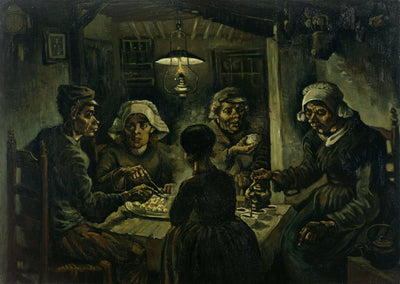
That period ends with The Potato Eaters, his first big showpiece, painted in April and May 1885. It's 82 by 114 cm, five figures around a dish of potatoes, in colors he compared to "a really dusty potato, unpeeled of course." It drew heavy criticism for being too dark. He was proud of it anyway.
Paris, 1886–1888: color arrives
He turned up in Paris unannounced at the end of February 1886 and moved in with Theo. Two years there changed everything. He met Toulouse-Lautrec and Emile Bernard, saw the Impressionists, started collecting Japanese prints, and his palette brightened fast.
Models cost money, so he painted himself. Thirty-nine self-portraits survive, drawings and paintings together, and most of them come from Paris. If you're wondering why the count of his paintings is so high for such a short career, part of the answer is that he never waited for a sitter.
Arles, 1888–1889: the famous stretch
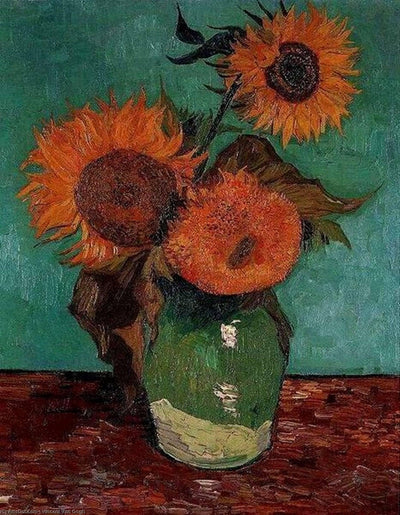
He arrived in Arles on 20 February 1888 and set to work on orchards in blossom, the harvest and boats on the beach at Les Saintes-Maries-de-la-Mer. He rented rooms in the Yellow House and planned a series of twelve sunflower canvases to decorate it. He finished five. They're now in Amsterdam, Munich, London, Tokyo and Philadelphia, and a hand-painted copy of the sunflowers is still the easiest way to see why Gauguin wanted one.
Gauguin moved in late in October 1888. By Christmas the arrangement had collapsed, Vincent had cut off his ear, and in early January 1889 he left the hospital and went straight back to painting.
Saint-Rémy, 1889–1890: about 150 in a year
In May 1889 he had himself admitted to the asylum of Saint-Paul-de-Mausole at Saint-Rémy. This is the part people find hardest to believe. Locked in, ill on and off, at one point restricted to drawing after he ate some of his paint, he still completed around 150 paintings in the space of a year. That works out to one every two or three days.

He painted the walled garden, olive groves and cypresses, and copied prints after Millet and Rembrandt when he couldn't go out. In February 1890, after Theo and Jo named their baby Vincent Willem, he made large branches of almond blossom against a blue sky to hang in their bedroom. That canvas, 73.3 by 92.4 cm, stayed with the family, and the boy grew up to found the Van Gogh Museum.
Auvers-sur-Oise, 1890: faster than a canvas a day
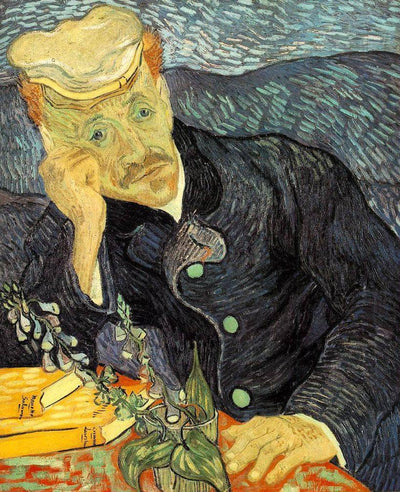
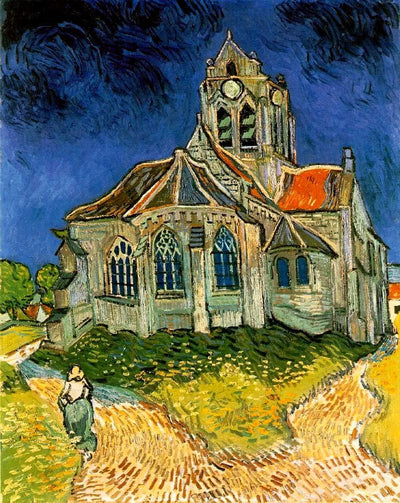
He arrived in Auvers on 20 May 1890 and died there on 29 July. Seventy days. In that time he often finished more than one painting a day, including his portrait of Doctor Gachet, the doctor who told him to throw himself into his work, and the church of Auvers itself.

Around 10 July he wrote to Theo and Jo that he had painted "another three large canvases" since visiting them in Paris, "immense stretches of wheatfields under turbulent skies." The full text of that July letter is worth reading slowly. It's also one reason the question of which canvas really came last is harder than it looks.
He shot himself on 27 July and died two days later. He left over 850 paintings and almost 1,300 works on paper.
Did he make more drawings than paintings?
Yes, if you count everything on paper. The almost 1,300 works on paper include drawings, watercolors and the small sketches he put inside letters. For his first few years he was a draftsman first, and painting came later.
And then there are the letters. He wrote 820 that survive, 651 of them to Theo, and they're the reason we can date so many pictures to the week. If you want a good way into the letters, start with the ones from Arles.
As for sales, there were few. The Red Vineyard was bought by Anna Boch in 1890, his uncle Cor commissioned cityscapes of The Hague, and plenty more changed hands as trades for food and paint.
Where the 850 ended up
Two Dutch museums hold roughly a third of them. The Van Gogh Museum in Amsterdam has over 200 paintings and almost 500 drawings. The Kröller-Müller Museum in Otterlo holds 88 paintings and 172 works on paper, bought by Helene Kröller-Müller starting in 1908, when she paid 110 guilders for Edge of a Wood.
The rest are spread across museums and private homes on several continents. That scattering is why seeing even a tenth of his output means a lot of travel, and why so many people start with the paintings people come back to most, the short list every museum-goer knows.
A canvas from those ten years, painted again
Our studio paints Van Gogh by hand in oil on canvas, one brushstroke at a time, the way he built his surfaces. If one of the 850 has stayed with you, from a Nuenen kitchen to a wheatfield in Auvers, you can browse the full run of his work we reproduce and choose a size for your wall.