4.9/5
4.9/5


Leonardo da Vinci sketches are the closest you can get to watching him think. Fewer than 25 major works are attributed to him, yet the Codex Atlanticus in Milan alone binds 1,119 leaves of his notes and drawings into 12 volumes. The fifteen sheets below run in date order, from a valley he drew at 21 to the floods he imagined in France at the end of his life, and each comes with the one detail worth hunting for.
Many were working steps, and a good number of them lead straight into the da Vinci paintings they turned into. Read them that way and the finished pictures start to explain themselves.
Where each sheet lives
| # | Drawing | Date | Where it is |
|---|---|---|---|
| 1 | The valley dated 5 August | 1473 | Uffizi, Florence |
| 2 | The hanged Baroncelli | 1479 | Musée Bonnat-Helleu, Bayonne |
| 3 | Head of a Bear | about 1480 | Private collection |
| 4 | Perspective study for the Adoration | about 1481 | Uffizi, Florence |
| 5 | The skull sectioned | 1489 | Royal Collection, Windsor |
| 6 | Vitruvian Man | about 1490 | Gallerie dell'Accademia, Venice |
| 7 | The head of Judas | about 1495 | Royal Collection, Windsor |
| 8 | Map of Imola | 1502 | Royal Collection, Windsor |
| 9 | Drapery for the Salvator Mundi | 1504–1508 | Royal Collection, Windsor |
| 10 | Codex on the Flight of Birds | 1505–1506 | Biblioteca Reale, Turin |
| 11 | Burlington House Cartoon | 1506–1508 | National Gallery, London |
| 12 | Portrait of a Man in Red Chalk | about 1510 | Biblioteca Reale, Turin |
| 13 | Head of the Virgin | 1510–1513 | The Met, New York |
| 14 | The fetus in the womb | about 1511 | Royal Collection, Windsor |
| 15 | A deluge | 1517–1518 | Royal Collection, Windsor |
Four habits repeat across them. His notes run in mirror script, right to left, written with his left hand. He liked tinted grounds, pale pink-beige for the bear and orange-red for the drapery studies. He measured constantly, from the grid over a sawn skull to the paced-out streets of Imola. And not every line is his: his pupil Francesco Melzi added notes to the fetus sheet, and an assistant probably drew part of a drapery study.
Florence, 1473–1481: drawing what he saw
1. The valley dated 5 August 1473

This is his first dated work. At the top left, in mirror script, he wrote the feast of Santa Maria della Neve and the date, 5 August 1473. He was 21. Castles sit on two steep outcrops above a river valley, and the land is the whole subject. Infrared study announced by the Uffizi in 2019 found two versions of the view on the front and two unrelated landscapes on the back, all on one sheet.
2. The hanged Bernardo di Bandino Baroncelli, 1479
Baroncelli helped stab Giuliano de' Medici to death in Florence Cathedral in 1478, fled to Constantinople and was hanged at the Palazzo del Bargello on 29 December 1479, still in his Turkish robes. Leonardo drew the body in brown ink and listed the colors of the clothes in mirror writing, like a witness taking notes for later. The sheet is one of nine Leonardo drawings owned by the Musée Bonnat-Helleu in Bayonne, France.
3. Head of a Bear, about 1480
Just 7 centimeters square, in silverpoint on pale pink-beige paper. On 8 July 2021 it sold on a single bid at Christie’s in London for £8.8 million with fees, a record for a Leonardo drawing, beating the £8.1 million paid for Horse and Rider in 2001. It's one of eight known Leonardo drawings still in private hands, leaving aside the Royal Collection and the Devonshire Collections at Chatsworth.
4. Perspective study for the Adoration of the Magi, about 1481
In July 1481 the monks of San Donato in Scopeto commissioned an altarpiece, and Leonardo started with the empty space. On this sheet, now in the Uffizi's prints and drawings department, he drew the ground first, then the buildings, and only then the people and animals, setting the grid with a ruler and a pointed stylus. The drawing crossed to Washington for its first American showing. The altarpiece itself, the unfinished Adoration he left behind when he moved to Milan, hangs in the Uffizi.
Milan, 1489–1498: measuring the body
5. The skull sectioned, 1489
"On the 2nd day of April 1489," Leonardo wrote at the top of the first sheet of his skull notebook. He was sawing a human skull into sections, and a companion drawing uses a grid to place the senso comune, where he believed the senses met, at the crossing of two lines halfway up the skull. The back of the dated sheet holds his to-do list: what is sneezing, what is yawning, on laughing, on wonder. He studied the brain so he could paint emotion better.
6. Vitruvian Man, about 1490

A nude man fills a circle and a square in two overlapping poses, arms level in one, arms raised and legs apart in the other. The notes, headed The proportions of the human body after Vitruvius, set out the Roman architect's ratios. The pen and ink sheet belongs to the Gallerie dell'Accademia in Venice, which keeps it in a locked room and rarely shows it because it is fragile.
7. The head of Judas, about 1495
This red study at Windsor matches the head of Judas in The Last Supper, the mural in the refectory of Santa Maria delle Grazie in Milan, begun around 1494 and complete by 1498. The scene is all reaction, the disciples hearing that one of them will betray Christ. His experimental technique soon began to fail on the wall, and what survives there is a ghost of what he meant. The drawing keeps the face as he planned it.
1502–1508: maps, machines and a full-size plan
8. A map of Imola, 1502
In August 1502 Leonardo became General Architect and Engineer to Cesare Borgia, and that autumn he mapped Imola as a flat plan inside a circle marked with eight compass points, each labeled with the name of a wind. He paced the streets and took bearings from the tower of the Palazzo Comunale. The result is a city seen straight from above, and the plan is accurate enough to find your way around Imola today.
9. Drapery studies for the Salvator Mundi, 1504–1508
Two chalk studies at Windsor work out the cloth over Christ's chest and right arm in the Christ as savior of the world. In the sleeve study, on orange-red prepared paper, a loop of fabric falls from a raised forearm. The stiff lower drawing on the second sheet is probably an assistant's, because the white highlights were added by a right-handed artist and Leonardo wrote with his left. The painting sold at Christie's New York in 2017 for $450.3 million, a record for any artwork, though its attribution is still debated.
10. Flying machine sketches, Codex on the Flight of Birds, 1505–1506
Leonardo gave one whole notebook to flight: 18 folios, now in the Biblioteca Reale in Turin, that study how birds fly and propose mechanisms for flying machines. One note records that a bird's center of gravity does not coincide with its center of pressure. In all he produced more than 35,000 words and 500 sketches on flying machines, the nature of air and bird flight, and the codex spent 40 days in Washington in 2013, next to the Wright brothers.
11. The Burlington House Cartoon, 1506–1508
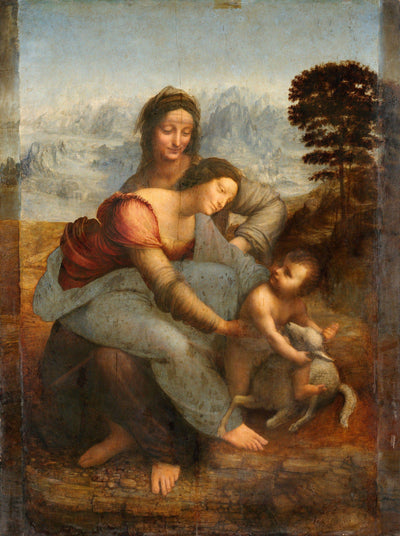
This is the only large-scale drawing of his that survives: 141.5 by 104.6 centimeters of charcoal and white chalk on eight sheets of paper glued together, now in London. The Virgin sits on her mother's lap while Saint Anne points upward, a sign of the child's divinity. It may be the only record of a lost painting, and it's a different composition from the Louvre's Saint Anne, which leaves out the young Baptist. In 1987 someone fired a sawn-off shotgun at it.
1510–1518: the late sketches
12. Portrait of a Man in Red Chalk, about 1510
If you carry a mental picture of Leonardo, it probably comes from this red chalk sheet in the Biblioteca Reale in Turin, widely though not universally accepted as his own face. Skeptics point out that the man looks older than Leonardo ever got; he died at 67. Brown fox marks from iron salts and moisture spot the paper, so the drawing isn't generally shown to the public.
13. The Virgin's head, 1510–1513

The Metropolitan Museum of Art bought this small chalk study in 1951. It prepares the Virgin's head in the Louvre picture of Mary on Saint Anne’s lap, but the hairstyle doesn't match the finished painting. The drawing's arrangement shows up in studio copies instead, which points to a late change decided by Leonardo himself.
14. The fetus in the womb, about 1511

This may be the best known of all his anatomical drawings. A fetus curls in the breech position inside an opened uterus, in red chalk under dense, curved pen hatching. The placenta is wrong in a revealing way: its many lobes come from his dissection of a cow. A note at lower left reasons that the child does not breathe "because it rests continually in water, and if it breathed it would drown."
15. A deluge, 1517–1518
Leonardo spent his last years in France at the court of Francis I, and the deluge drawings belong to that time. In this pen-finished flood, the air above a wooded hill bursts open and square blocks of stone tumble from the sky. Then find the note hidden among the clouds: "Of rain. You will show the degrees of falling rain at various distances and of varying degrees of obscurity." Vision and drawing lesson sit on the same sheet.
Seeing the drawings in person
Most originals live in boxes. Light damages drawings, so the Royal Collection keeps its Leonardos in the Print Room at Windsor Castle and brings them out for exhibitions and loans; in 2019, the 500th anniversary of his death, 144 of them went on show at 12 venues around the UK. The Uffizi holds the 1473 valley and the Adoration study. Milan's Biblioteca Ambrosiana has the Codex Atlanticus, 1,119 leaves from 1478–1519. Turin has the red chalk head and the flight codex, the Louvre has 22 drawings, and Bayonne has nine. In the United States, look for the Met's chalk head and for the Codex Leicester, bought by Bill Gates in 1994 for $30,802,500 and shown once a year in a different city.
Which of his paintings are the most famous?
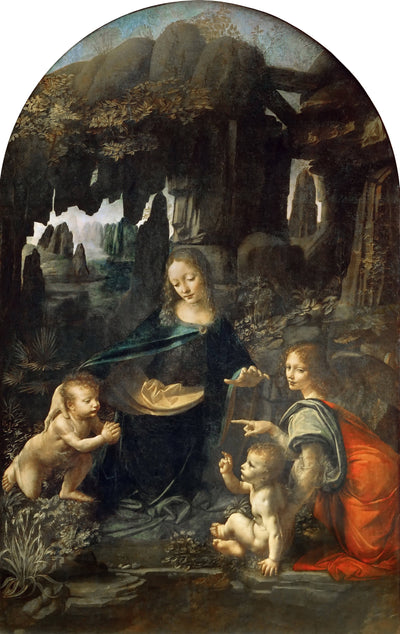
The Mona Lisa is regarded as the world's most famous painting, and The Last Supper is the most reproduced religious painting of all time. Other well-known works include Cecilia Gallerani holding her ermine in Kraków, one of only four surviving portraits of women he painted, the altarpiece of the Virgin in a rocky grotto in its Paris and London versions, the Salvator Mundi and Ginevra de' Benci in Washington.
Where do his paintings hang?
Mostly in European museums. Paris has five at the Louvre, the largest group of his paintings anywhere. Milan has The Last Supper at Santa Maria delle Grazie and his only known portrait of a man at the Pinacoteca Ambrosiana. Florence has the Adoration at the Uffizi, Kraków has the Lady with an Ermine, and London has the second Virgin of the Rocks at the National Gallery. Ginevra de' Benci, at the National Gallery of Art in Washington, is the only Leonardo painting on public view in the Americas.
From the sketchbook to your wall
The drawings stay in museum boxes and come out only now and then, but the pictures they fed can hang at home. Art & See paints every da Vinci in its catalog by hand, from the portraits to the altarpieces. If you want to compare him with other masters first, start with the paintings people ask us for most.
Sources
- Uffizi Galleries, Leonardo's first landscape (8P)
- Royal Collection Trust, Leonardo in the Royal Collection
- Royal Collection Trust, Anatomical Manuscript B, 2 April 1489
- National Gallery, London, The Burlington House Cartoon
- Library of Congress, Share the Perspective of Genius
- National Air and Space Museum, Codex on the Flight of Birds
- The Art Newspaper, Head of a Bear sale, 8 July 2021
- Musée du Louvre, Leonardo da Vinci exhibition