4.9/5
4.9/5


Most painters who took on the prodigal son in art chose the ending. The boy comes home, the father runs to him, and everyone forgives everyone. A few chose the part nobody likes to picture: the young man broke, hungry, and staring at the pigs he's been hired to feed. Follow the story from Albrecht Dürer's farmyard around 1496 to the huge canvas Rembrandt left in his studio in the late 1660s, and you watch European painting learn how to show a feeling instead of an event. The trail ends at Rembrandt's last word on the parable, and it's worth walking the whole way there.
Twenty-two verses, five pictures
The parable sits in Luke 15:11–32. A man has two sons. The younger asks for his share of the estate early, travels to "a far country," and spends it all on what the King James Bible calls riotous living. Famine hits. He takes a job feeding swine and envies the husks the animals eat. Then he comes to himself, rehearses an apology, and walks home.
His father sees him "yet a great way off," runs, and kisses him before the speech is even finished. Out come the best robe, a ring, shoes, and the fatted calf. The older brother, back from the fields, hears the music and refuses to go in. The father's answer closes the chapter: "this thy brother was dead, and is alive again; and was lost, and is found."
That's a story with at least five paintable moments, and the choice of moment tells you what each artist cared about.
Which scenes from the parable do artists paint?
The return wins by a mile. It has the embrace, the robe and the calf, and it lets a painter put the whole moral in a pair of hands. The swineherd scene comes second, mostly in prints. The departure and the tavern are rarer as stand-alone subjects; they tend to show up inside a series, where an artist has room to tell the story in order. The older brother almost never gets a picture of his own, though Rembrandt, as you'll see, gave him a place at the edge of one.
If you're looking at the rest of Rembrandt's paintings in the collection, keep that ranking in mind. He tried the return first as a small print and came back to it at the end of his life as a painting larger than a man.
Dürer kneels him down among the pigs

Dürer's engraving is about 24 by 19 centimeters, small enough to hold in one hand. He made it around 1496, and the Met's impression of the print came in with the Fletcher Fund in 1919. Several other museums own impressions too, which is the point of a print.
Look at where he puts the son. There's no far country here. The setting is a cluttered farmyard of steep roofs and half-timbered barns that could be any village near Nuremberg, and the young man kneels in the mud with his hands clasped while the hogs push their snouts into the trough beside him. Dürer picked the lowest moment of the parable, verse 17, when the boy "came to himself." It's a conversion scene dressed as a farm picture.
Bosch sends a stranger down the road
Around 1500, Hieronymus Bosch painted a traveler bent under his pack, wearing mismatched shoes, with a run-down house behind him. In Rotterdam the panel hangs as The Pedlar, but it has long been read as the prodigal son on the way home. Bosch loaded it with signs: pigs at a trough (a Dutch proverb warns that too many pigs make the slop thin, a jab at waste and greed), a dog whose bark means nothing, a magpie whose black and white stands for the choice between heaven and hell.
Is he the prodigal? Maybe. He's certainly an everyman on the road of life, and the panel once covered the outside of a triptych's wings. The ambiguity is useful. Bosch shows the son as anyone who has made a mess and has to decide which way to walk.
Callot and Murillo tell it in chapters
In 1634 the French printmaker Jacques Callot published a tiny set of etchings on the life of the prodigal son. In Seville, Bartolomé Esteban Murillo (1617–1682) used them as a starting point for six large canvases in the 1660s. He was the first Spanish painter to tell the story as a series, and it's the only cycle of his that survives intact.

Murillo sets the parable in the Seville he knew. In the scene where he is driven out, an old crone, a madam at the door, a cavalier with a sword and a courtesan swinging a broom chase the young man into the street, and a dog joins in. It's almost comedy. The six canvases have been in Dublin since 1987, a gift of Sir Alfred and Lady Beit, and after their restoration they crossed the Atlantic for the first time for a 2022 show in Dallas, where Murillo's separate Return of the Prodigal Son from Washington hung beside them.
That Washington picture, painted 1667/1670, packs every detail of verses 22 and 23 into one frame: the robe and ring carried on a tray, the calf led in by a servant, a small white dog jumping at the son's knees. Murillo wants you to read the whole happy ending at once.
Guercino and Batoni: the embrace, up close
The two Italians here skip the misbehavior. Guercino painted the return around 1619 with the figures jammed close, lit unevenly, moving hard against each other; his Vienna canvas catches the father receiving the ragged boy with affection and fresh clothes.
A century and a half later Pompeo Batoni did the opposite. His version, signed P. BATONI PINXIT ROMAE 1773, is calm and polished: a naked, bowed son and a father who wraps his cloak around the boy's shoulders. The imperial picture gallery in Vienna bought it from Batoni as soon as it was done, and the Batoni belongs to the same museum as the Guercino. Both are beautiful. Neither makes you feel the weight of the thing the way the next painter did.
Rembrandt comes back to the story
Rembrandt first worked through the parable in 1636, in a small etching dated that year, about 15.5 by 13.6 centimeters. The father leans down the steps to grab his son, a servant hurries out with clothes, and someone peers from a window. It's busy and a little theatrical, typical of the young Rembrandt who painted the storm-tossed boat full of apostles around then. If prints are your way in, his etchings are worth their own look.
Around the same time he painted himself as a laughing reveller with a glass raised and Saskia on his lap, the canvas now in Dresden and usually read as the son in the tavern (a separate article covers it). Some thirty years later he came back to the story from the other end.
When did Rembrandt paint The Return of the Prodigal Son?

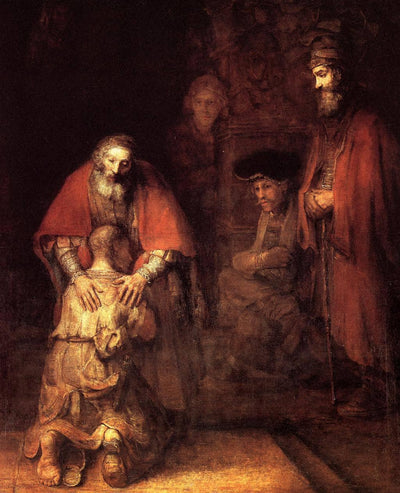
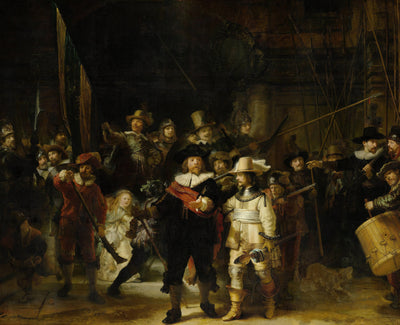
Around 1668, within months of his death in 1669. The canvas is 262 by 205 centimeters, and nobody commissioned it. That matters. In Protestant Holland churches had no painted altarpieces, and big religious pictures were rarely made at all. Rembrandt painted one anyway, for no client, near the end of a career that had also produced the crowded militia portrait in Amsterdam.
Everything is stripped down. The son kneels with his back to you, head shaved, clothes in tatters, one sandal slipped off his heel. The father bends over him with his eyes nearly closed, and his two hands rest on the boy's shoulders. The red cloak falls over both men like a tent. On the right, a tall figure stands apart with his hands folded; he is usually taken for the older brother, the one who stayed home and can't bring himself to celebrate. A seated man and two faces in the dark just watch.
There's no calf, no ring on a tray, no dog. What's left is the moment in verse 20 and the question hanging over verses 28–32. If you've looked at the old man's face in his late self-portraits, the father will feel familiar.
It came to the Hermitage in 1766 with the collection of Catherine the Great. It hangs in Room 254 of the New Hermitage in St. Petersburg.
A copy for the wall at home
A reproduction of this painting asks more of a painter than most. The browns have to stay warm without going muddy, and the light on the father's face has to glow out of near-black. If you'd like one painted by hand, the studio's copy of the St. Petersburg canvas is made in oil to your size, and the other paintings people come back to are gathered on one page.
Sources
- State Hermitage Museum, Return of the Prodigal Son
- Rijksmuseum, The Return of the Prodigal Son (etching, 1636)
- The Met, Dürer, The Prodigal Son
- Museum Boijmans Van Beuningen, The Pedlar
- National Gallery of Ireland, The Prodigal Son Driven Out
- Meadows Museum, Murillo: Picturing the Prodigal Son
- Kunsthistorisches Museum, Batoni, The Return of the Prodigal Son