4.7/5
4.7/5


Raphael died in Rome in 1520 at 37, and he spent only twelve of those years there. Yet the famous Raphael paintings below cover an absurd amount of ground: papal frescoes, altarpieces that Napoleon's men carted off to Paris, a pope's portrait that set the pattern for church portraits for 200 years, and a panel of three nudes small enough to sit on a desk. He was born in Urbino in 1483, the son of the court painter Giovanni Santi, and by 1500 he was already working as an independent master across central Italy.
Fifteen works make the cut here, roughly in order of fame. If one of them grabs you, every Raphael painting the studio copies by hand starts from the same originals you'll read about below.
What is the most famous Raphael painting in the Vatican?
The School of Athens. It covers a wall of the Room of the Segnatura, the first room Raphael decorated after Pope Julius II called him to Rome in 1508, at 25. Julius used the room as his library and private study, and the frescoes went up between 1508 and 1511. The Transfiguration, in the Vatican Pinacoteca, is the runner-up, and the better answer if you mean a painting on panel rather than on a wall.
Fifteen works, from the Vatican to Washington
1. The School of Athens, 1508–1511 (Vatican City)
Plato stands in the middle, pointing up, with his Timaeus in his hand. Aristotle walks beside him holding the Ethics. Around them you'll find Pythagoras explaining a musical ratio, Euclid teaching geometry to a huddle of students, and Diogenes sprawled on the steps with a dish. The brooding man leaning on a marble block and writing is Heraclitus, and he has Michelangelo's face, a nod to the rival painting the Sistine Chapel ceiling nearby. Raphael put himself in too: the young man in the black beret at the far right edge. The vaulted hall behind them borrows from Bramante's plan for the new St. Peter's. You can read the Vatican's own account of the room Julius used as a library before you go.

2. The Sistine Madonna, 1512/13 (Dresden)
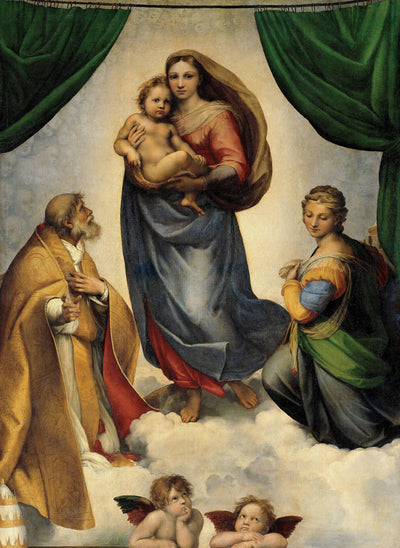
Julius II ordered it for the monastery church of San Sisto in Piacenza, and for almost 250 years it hung there without much fuss. Then Augustus III of Saxony bought it in 1752/54, and when it arrived in Dresden he supposedly cried "Make room for the great Raphael!" Adolph Menzel later drew the scene in pastel. The Madonna walks toward you on clouds, but the two cherubs leaning on the ledge at the bottom have been copied so many times that they're better known than she is. Seeing the whole Sistine Madonna with the cherubs in place changes them: they're looking up at her. The Dresden gallery tells how the painting got to Saxony in detail.

3. The Transfiguration, 1516–1520 (Vatican City)
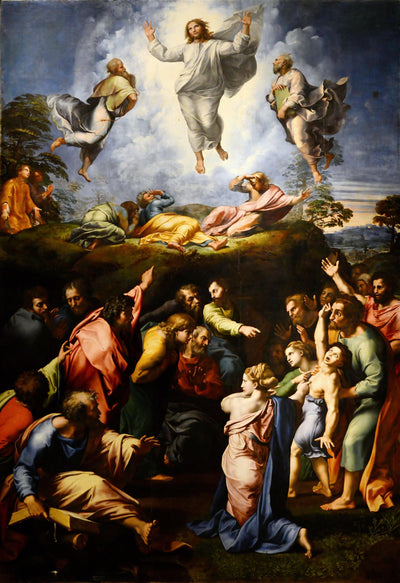
His last great picture, and the one Vasari called "the most famous, the most beautiful and most divine." Cardinal Giulio de' Medici, later Pope Clement VII, ordered it for his cathedral in Narbonne, but after Raphael's death he kept it and gave it to San Pietro in Montorio in Rome instead. It's huge, 410 by 279 cm, and split in two: Christ lifted in light above, the apostles below failing to heal a possessed boy. The French took it to Paris in 1797 and it came back in 1816. The altarpiece the Medici cardinal never sent to France now hangs in the Pinacoteca, and the Vatican's short entry covers its trip to Paris and back.
4. La Fornarina, c. 1520 (Rome)
A half-dressed young woman, a myrtle bush and a quince branch behind her, and a band on her upper arm that reads RAPHAEL URBINAS. Tradition names her Margherita Luti, a baker's daughter from Trastevere, and makes her his lover. Nobody knows who ordered the panel, which is part of why people think he painted it for himself. It has belonged to the Barberini collection since 1642 and hangs in Palazzo Barberini.
5. Portrait of Pope Julius II, 1511 (London)
That beard was a vow. Julius grew it in October 1510 as penance after losing Bologna, and swore not to shave until the French were chased out of Italy, which happened in March 1512. Raphael caught him seated and inward, with golden acorns on the chair for the della Rovere family (rovere means oak). It became the model for church portraits for the next 200 years. The National Gallery bought it in 1824, and its page on the painting points out the reflections in those acorns.

6. Portrait of Baldassare Castiglione, c. 1514–1515 (Paris)
Castiglione was a writer and diplomat, and this is how a Renaissance gentleman wanted to be seen: grays and blacks, a soft beret, a level gaze, nothing flashy. The portrait stayed with the Castiglione family in Mantua, passed to Cardinal Mazarin, and Louis XIV bought it from Mazarin's heirs in 1665. It's 82 by 67 cm and hangs in Room 712 of the Louvre, which keeps the full record of the portrait online.
7. Madonna of the Goldfinch, before 1506 (Florence)
Painted for the wedding of Lorenzo Nasi and Sandra Canigiani on 23 February 1506. The young John the Baptist hands the Christ Child a goldfinch, a small bird with red markings, the color of the Passion. In 1547 the Nasi house collapsed and the panel broke into seventeen fragments. It was pieced back together soon after, and it's still whole today, which feels like luck when you read what happened to the Nasi house.
8. The Marriage of the Virgin, 1504 (Milan)
Raphael signed it RAPHAEL URBINAS MDIIII, as if announcing himself. He had clearly been looking at Perugino's version of the same subject, now in Caen. He kept the layout and made it cleaner and more geometric: a many-sided temple on a sloping piazza, a rejected suitor snapping his rod in the foreground. Painted for San Francesco in Città di Castello, it moved to Milan in 1805, and his Marriage of the Virgin with the domed temple is still the star of the Brera, whose catalog entry sets it beside Perugino's.
9. The Triumph of Galatea, 1512 (Rome)
A fresco for Agostino Chigi's suburban villa in Rome: the sea nymph riding a shell pulled by dolphins, twisting back toward cupids with drawn bows. It's pagan, fast and funny, and it spread across Europe through engravings by Marcantonio Raimondi and Marco Dente, prints Raphael himself encouraged as a way to get his work around.
10. La Belle Jardinière, 1507 (Paris)
The Madonna seated outdoors with the Child leaning on her knee and the infant John kneeling. It's an arched poplar panel, 122 by 80 cm, painted the year before he left for Rome. It may have belonged to Taddeo Taddei in Florence and later entered the French royal collection at Fontainebleau. Today it hangs in the Louvre's Grande Galerie.
11. Portrait of Agnolo Doni, c. 1504–1507 (Florence)
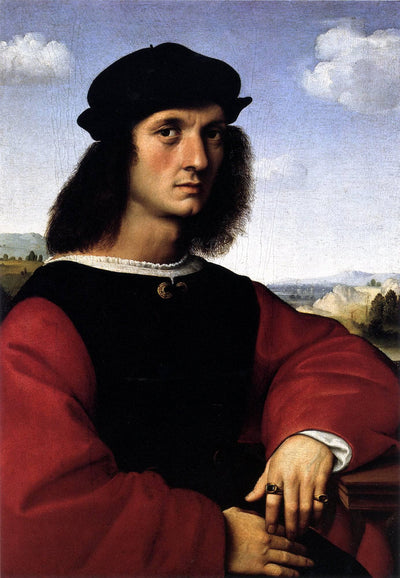
Agnolo Doni was a rich fabric merchant who married Maddalena Strozzi on 31 January 1504, and Raphael painted the two of them as a pair. Agnolo's pose borrows from the Mona Lisa, which Raphael could study in Florence toward the end of 1504, though he keeps the landscape crisp where Leonardo blurs it. The back of the panel carries a gray scene of the Flood from Ovid by another painter, a wish for a fertile marriage. His portrait of the merchant Agnolo Doni is shown with his wife's and with Michelangelo's Doni Tondo, the round Holy Family the couple also paid for.
12. The Three Graces, c. 1503–1504 (Chantilly)
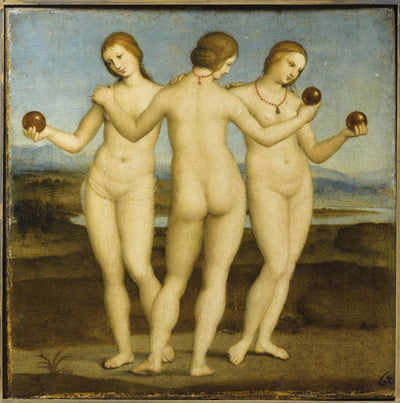
One of his first paintings with no religious subject, and tiny. Three nudes hold golden apples. At first only the Grace on the left held one; he gave the other two theirs for balance. The little panel of the Three Graces belongs to the collection the Duc d'Aumale built, and it's shown in the Santuario of the Château de Chantilly.
13. The Deposition, 1507 (Rome)
Atalanta Baglioni of Perugia ordered it to mourn her son Grifonetto, killed in a family feud in 1500. The body of Christ is carried, heavy and slack, while his mother collapses behind. In 1608 Cardinal Scipione Borghese had it taken from its Perugia church by force, and it has hung in the Galleria Borghese ever since, apart from a stay in the Louvre after the French seized it in 1797.
14. The Alba Madonna, c. 1510 (Washington)
A tondo, 94.5 cm across. It belonged to the Dukes of Alba in Spain, went to Czar Nicholas I for the Hermitage, and left Russia for Andrew Mellon in 1931. It reached the National Gallery of Art in 1937, which makes it the one famous Raphael on this list you can see without a passport if you live in the US.
15. St. Michael, c. 1504 and 1518 (Paris)
The Louvre owns two. The small one, 30.9 by 26.5 cm on poplar, dates from around 1504 and was probably made for the court of Urbino. The large one, 2.68 meters tall, was painted in 1518 for Francis I, with the archangel landing on the demon almost weightless. If you want a hand-painted St. Michael on your own wall, check which of the two the listing follows.
How many works did he actually paint?
Fewer than his fame suggests, and there's no fixed count. He worked for barely twenty years, roughly 1500–1520, and in Rome a lot of his time went to frescoes and, from 1514, to St. Peter's, where he took over as architect after Bramante died. So the list of panels by his own hand is short, and the fifteen above are the core of it.
Picking one for a room
A quiet study suits the Castiglione or the Julius II; a bright living room can take the Galatea or the Sistine Madonna. You can browse the full run of Raphael paintings we copy, each one painted by hand in oil, or look further at the masterpieces most people want on a wall.
Sources
- Vatican Museums, Room of the Segnatura
- Vatican Museums, The Transfiguration
- Gemäldegalerie Alte Meister Dresden, The Sistine Madonna
- National Gallery London, Portrait of Pope Julius II
- Musée du Louvre, Balthazar Castiglione
- Uffizi Galleries, Madonna of the Goldfinch
- Pinacoteca di Brera, The Marriage of the Virgin
- Château de Chantilly, Raphael at the Musée Condé