4.9/5
4.9/5


For Christmas in paint, start with five pictures: Giotto's Adoration of the Magi on a chapel wall in Padua, Geertgen tot Sint Jans's Nativity at Night and Botticelli's Mystical Nativity in London, Pieter Bruegel's snowbound Census at Bethlehem in Brussels, and Caravaggio's Adoration of the Shepherds in Messina. They are the Christmas chapter of the most famous paintings in the world.
Read in date order, from the early 1300s to 1609, they show painters making a story everyone knew feel close enough to step into: first a comet, then a glowing baby, then dancing angels, then a village in the snow and finally a dark stable full of ordinary people.
At a glance
| # | Painting | Artist | Year | Medium | Where to see it |
|---|---|---|---|---|---|
| 1 |  Adoration of the Magi Adoration of the Magi |
Giotto | c. 1303–1305 | Fresco | Scrovegni Chapel, Padua |
| 2 |  The Nativity at Night The Nativity at Night |
Geertgen tot Sint Jans | About 1490 | Oil on wood, probably oak | National Gallery, London |
| 3 |  The Mystical Nativity The Mystical Nativity |
Sandro Botticelli | 1500 | Oil on canvas | National Gallery, London |
| 4 |  The Census at Bethlehem The Census at Bethlehem |
Pieter Bruegel the Elder | 1566 | Oil on oak panel | Royal Museums of Fine Arts of Belgium, Brussels |
| 5 |  Adoration of the Shepherds Adoration of the Shepherds |
Caravaggio | 1609 | Oil on canvas | Regional Museum, Messina |
What painters put into a Nativity
Painters packed the Christmas story with signs a churchgoer could read. The National Gallery’s guide to the Nativity in art lists the usual ones: a lily for Mary's purity, a dove for the Holy Spirit, a star above the child, and ruins that stand for the end of the old pagan order. In a Flight into Egypt from the workshop of Goossen van der Weyden, a pagan statue even topples in the background, after the legend that idols fell as the Holy Family passed.
All of these are religious pictures, so they sit naturally beside the famous religious paintings, from the Ghent Altarpiece to The Last Supper, and our religious paintings collection is the place to browse more Nativities and Adorations.
The five paintings
01Adoration of the Magi, Giotto (c. 1303–1305)

Zoom
The Padua banker Enrico Scrovegni paid for the chapel, and Giotto covered its walls with scenes from the Old and New Testaments, about 1,000 square meters of them. Italy’s official tourism site says he did it in 855 days between 1302 and 1305. The Adoration of the Magi is one scene in that cycle, painted into wet plaster, so the only place to see it is Padua.
Look at the sky. Instead of a neat star, Giotto painted a comet with a blazing tail. The European Space Agency says the appearance of Halley's Comet in 1301 inspired him, and ESA named the spacecraft it sent to meet that comet Giotto. Below, the eldest king kneels at the child's feet while an angel stands guard at the right. Another scene from the same walls, the Lamentation, opens our list of the most famous paintings of Jesus.
02The Nativity at Night, Geertgen tot Sint Jans (about 1490)

Zoom
This is the smallest picture on the list: oil on wood, probably oak, 34 × 25.3 cm (13.4 × 10.0 in), probably made for private prayer. The National Gallery in London dates it cautiously, possibly about 1490, and says the attribution to Geertgen is almost universal.
Geertgen leaves out the swaddling clothes. The naked baby gives off the light, and Mary and a group of small angels catch it on their faces while an ox and a donkey peer out of the dark. Through a gap in the back wall, shepherds huddle by a fire on the hill and look up at a shining angel; one shields his eyes with his red cloak. The painter keeps three sources of light apart: the child, the fire and the angel.
The idea was not his own. The gallery traces the night setting to two lost Nativities by Hugo van der Goes, and the glowing child to the writings of Saint Bridget of Sweden, a fourteenth-century mystic. The colors have shifted with time, too: Mary's dress and mantle were once different shades of blue.
03The Mystical Nativity, Sandro Botticelli (1500)

Zoom
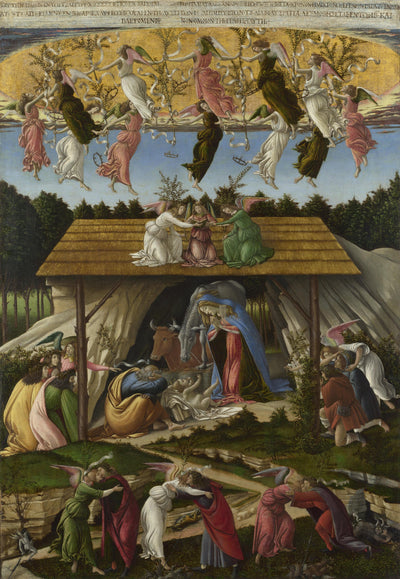
The National Gallery catalogs it as Mystic Nativity, dated 1500: oil on canvas, 108.6 × 74.9 cm (42.8 × 29.5 in). Botticelli’s Mystical Nativity carries a Greek inscription that mentions “the troubles of Italy” and reads them through the Book of Revelation. The gallery links that end-of-the-world tone to the friar Girolamo Savonarola, whom Botticelli is thought to have followed and who was executed in 1498.
Then count the angels: at least 20, all carrying olive branches, a sign of peace. Twelve dance in a ring under the golden dome, their branches hung with scrolls and crowns, while winged demons and horned little devils scuttle into cracks in the rocks. The kings and the shepherds arrive from either side, and the baby reaches up to Mary, paying no attention to his visitors. The gallery bought the picture in 1878.
04The Census at Bethlehem, Pieter Bruegel the Elder (1566)

Zoom
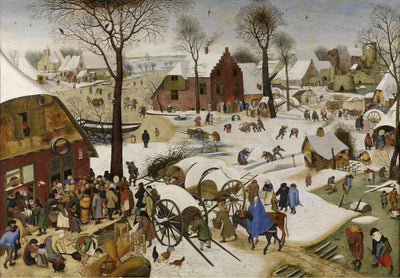
Bruegel sets the census from Luke's Gospel, the one that brought Joseph and Mary to Bethlehem, in a snowy Brabant village, in the words of the Royal Museums of Fine Arts of Belgium, which bought The Census at Bethlehem at an Antwerp sale in 1902. It is oil on an oak panel, 115.5 × 163.5 cm (45.5 × 64.4 in). The holy couple are easy to miss: a man with a saw and a woman wrapped in a big blue coat on a donkey, heading for the crowd at the house on the left, where villagers line up to register and pay.
The museum reads the buildings as a message: the ruin on the right may stand for paganism, the church across the frozen water for Christianity, and a plague house standing alone at the water's edge underlines the picture's theme of faith. Children skate and sled on the ice, and a red sun sits low behind the trees.
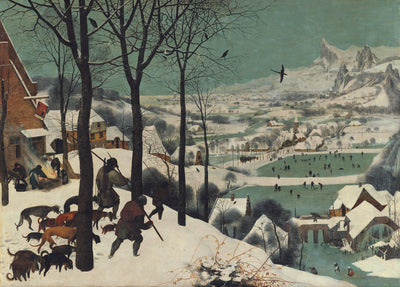
A year earlier, Bruegel painted Hunters in the Snow (1565), which is not a Christmas subject at all: hunters and an exhausted pack of dogs come home with a single fox while skaters cross the ponds below. The Kunsthistorisches Museum in Vienna, which owns the oak panel, 116.5 × 162 cm (45.9 × 63.8 in), calls it the first and most prominent winter landscape of European painting, and it is number 8 in our famous landscape paintings.
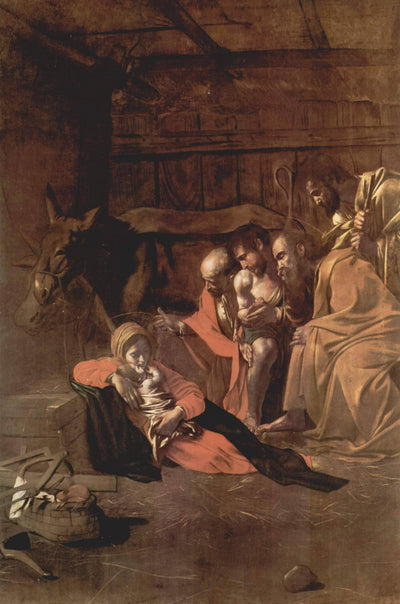
05Adoration of the Shepherds, Caravaggio (1609)

Zoom
Hand-painted oil reproductionSee sizes ›
The Capuchin friars of Santa Maria degli Angeli in Messina commissioned Caravaggio’s Adoration of the Shepherds in 1609, and it now hangs in the city's Regional Museum. It is the largest picture here, oil on canvas, 314 × 211 cm (123.6 × 83.1 in). In 2009 it traveled to Rome to be restored in public view: according to Italy’s Ministry of Culture, conservators worked in the Chamber of Deputies building on Via del Parlamento, and passersby could watch through a window.
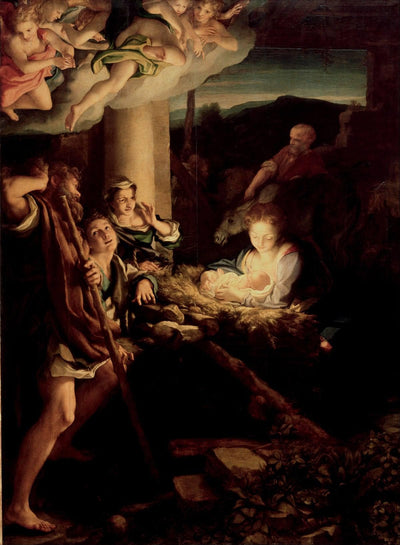
Set it beside Correggio's night scene further down and the change is plain: no glowing baby, no angels in the sky, and Mary in a plain red dress. In the foreground, a basket with bread and a white cloth sits beside a few tools. One hard light picks the figures out of the dark, the method behind Caravaggio’s tenebrism.
More Christmas paintings worth finding

Zoom
Hand-painted oil reproductionSee sizes ›
Correggio’s Holy Night was ordered in 1522 as an altarpiece for the Pratonieri family chapel in San Prospero, Reggio, and painted mostly in the late 1520s. Dresden’s Gemäldegalerie Alte Meister dates it about 1528–1530 and lists it as oil on poplar, 256.5 × 188 cm (101.0 × 74.0 in). The museum calls it the first monumental night piece in Italian painting, lit only by the newborn, a way of showing the Christ child that first spread in Flanders at the end of the 1400s. When Augustus III of Saxony acquired it from the collection of Francesco III d'Este, Duke of Modena, it was already well known: a Dresden gallery inspector noted proudly that all of Europe called it “the famous Night.”
The National Gallery's guide adds three more worth a detour: Guido Reni's Adoration of the Shepherds, about 1640, with angels holding a scroll that announces the birth; Jan Gossaert's Adoration of the Kings, 1510 to 1515, with the three kings in a ruin; and Philippe de Champaigne's Dream of Saint Joseph, 1642 to 1643, with Joseph asleep in an armchair beside his tools.
Snow turns up in history painting too. Paul Delaroche’s Napoleon Crossing the Alps (1850), at the Walker Art Gallery in Liverpool, shows the mule and the peasant guide who actually took Bonaparte over the Great St Bernard Pass, with snow underfoot, and it is one of the pictures in the famous Napoleon paintings.
Bringing one home for December
Of the works above, our studio artists paint The Mystical Nativity, The Census at Bethlehem, the Caravaggio Adoration, The Holy Night and Hunters in the Snow by hand in oil. If the picture has to stay up after January, choose a Bruegel: the snow outlasts the holiday.
Sources
- The Nativity, National Gallery, London
- The Nativity at Night, Geertgen tot Sint Jans, National Gallery, London
- Mystic Nativity, Sandro Botticelli, National Gallery, London
- The Adoration of the Magi, European Space Agency
- Mark Kidger, What was the comet depicted in Giotto's Adoration of the Magi?, Journal of the British Astronomical Association (2026)
- Giotto's Scrovegni Chapel, Italia.it
- The Census at Bethlehem, Royal Museums of Fine Arts of Belgium, on Google Arts & Culture
- Hunters in the Snow (Winter), Kunsthistorisches Museum Vienna
- Die Heilige Nacht, Correggio, Staatliche Kunstsammlungen Dresden
- Caravaggio, restauro aperto, Italian Ministry of Culture
- Researcher offers up new provenance for Caravaggio masterpiece, The Art Newspaper (2025)
- Napoleon Crossing the Alps, Paul Delaroche, Walker Art Gallery, on Google Arts & Culture
- Thomas Kinkade obituary, Associated Press, on MPR News (2012)
- The Meaning of Christmas Depicted in Works of Art, Erin Sweeney Design