4.7/5


The Kandinsky paintings people look up most are his big abstract series: the Compositions, the Improvisations and the Bauhaus-era geometry. Here are six of his best-known works in the order he painted them, so you can watch one artist walk from a blue horseman on a hillside to pure color and line. They all come from the career of Wassily Kandinsky, who gave up a law career at 30 to become a painter and ended up helping to invent abstract art. The chart puts all six in the order he painted them and shows how big each original is, so you can see the pictures grow as his ideas did.
A quick map before the list. Kandinsky sorted his own pictures into three kinds. Impressions came from nature, Improvisations came from spontaneous feeling, and Compositions were the large, planned works he considered his highest achievements. He painted only ten Compositions between 1909 and 1939, according to a University of Hamburg essay on Composition IV. That is why one number in a title can matter so much.
Six Kandinsky paintings from oldest to newest, with their real sizes
| Order | Kandinsky work | Painted | Size of the original (cm) | Kind of picture |
|---|---|---|---|---|
| 1 | The Blue Rider | 1903 | no data | An early scene you can still read |
| 2 |  Composition IV |
1911 | 159.5 by 250.5 | The oldest Composition that survives |
| 3 |  Improvisation 26 (Rowing) |
1912 | 97.2 by 107.5 | An Improvisation, the quick and spontaneous kind |
| 4 |  Composition VII |
1913 | 200.6 by 302.2 | A Composition, planned with more than thirty sketches |
| 5 |  Composition 8 |
1923 | 140 by 201 | A Composition from his Bauhaus years |
| 6 | Yellow-Red-Blue | 1925 | 128 by 201.5 | Bauhaus geometry built from angles and circles |
Sizes are height by width, as listed in the museum and Wikipedia records this article cites, and none was found for The Blue Rider.
Composition VII is by far the biggest canvas here. It stands about twice as tall as Improvisation 26 (Rowing) and is almost three times as wide.
The road to abstraction, 1903 to 1913
01The Blue Rider (1903)

Zoom
This is the picture that gave a movement its name, or at least may have. The Blue Rider shows a rider in a blue cloak galloping a white horse across a green meadow, with a wooded hill behind. The rider is so loosely painted that it nearly dissolves into the landscape. According to Wikipedia's entry on the painting, it may have inspired the name of the Blue Rider group that Kandinsky and Franz Marc founded, and one account of the naming says Marc loved horses, Kandinsky loved riders, and both loved blue.
It is still a recognizable scene. Look at the short, separate strokes of color and you can see him starting to care more about the paint than the subject. Wikipedia lists it in a collection in Zurich, not in a museum you can easily visit, so a reproduction is the practical way to live with it.
02Composition IV (1911)

Zoom
Composition IV is the earliest surviving picture in the Compositions series, because the first three were destroyed. It is oil on canvas, 159.5 by 250.5 centimeters, according to the MoMA catalogue, and it hangs in the Kunstsammlung Nordrhein-Westfalen in Düsseldorf. Kandinsky gave it a second title, "Battle."
Even so, you cannot point at a battle. A mountain-like form dominates the lower center, black strokes bristle on the left, and patches of color suggest figures. That is the point of this stage of his work: motifs from the visible world are still in there, but you read them as you would read music.
03Improvisation 26 (Rowing) (1912)

Zoom
Hand-painted oil reproductionSee sizes ›
The Improvisations were the spontaneous side of his output, and Improvisation 26 (Rowing) is one of the most approachable. It measures 97.2 centimeters high by 107.5 wide and belongs to the Städtische Galerie im Lenbachhaus in Munich, according to its Google Arts & Culture record.
The title gives you a way in. Hunt for the curve of a boat and the sweep of an oar, then let go of the search and follow the color. My advice: if abstract painting feels intimidating, start here. A title that hints at something real is a good handhold.
04Composition VII (1913)

Zoom
Hand-painted oil reproductionSee sizes ›
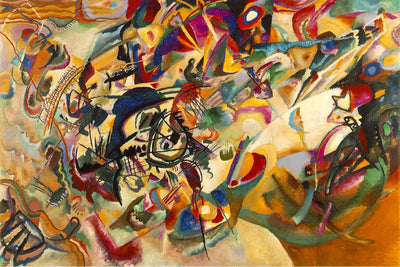
If one Kandinsky is the summit of his pre-war years, it is Composition VII. It is oil on canvas, 200.6 by 302.2 centimeters, in the Tretyakov Gallery in Moscow. According to Wikipedia, art historians read it as a blend of Resurrection, Judgment Day, the Flood and the Garden of Eden, and its preparatory study is a 1913 watercolor in Paris that is described as his first abstract watercolor.
Daily Art Magazine reports that he made more than thirty preliminary sketches for it. That is a lot of planning for a picture that looks like an explosion, and it explains why the chaos feels organized once you stay with it.
The Bauhaus years, 1922 to 1933
Kandinsky joined the Bauhaus faculty in 1922 and taught there until the Nazi government closed the school in 1933. The paintings of this period are cooler and more geometric: circles, triangles, straight lines, set against flat grounds.
05Composition 8 (1923)

Zoom
Hand-painted oil reproductionSee sizes ›
Painted in July 1923, Composition 8 is oil on canvas, 140 by 201 centimeters, and it is in the Guggenheim in New York. The Guggenheim Bilbao teachers' guide says Kandinsky regarded it as the peak of his work after the war, and that the prominent circles anticipate the role circles would play in later paintings.
The Guggenheim connection is a good story. In spring 1929, Solomon and Irene Guggenheim visited Kandinsky in his Dessau studio and bought this painting. It was the first of more than 150 of his works to enter the collection.
06Yellow-Red-Blue (1925)

Zoom
Hand-painted oil reproductionSee sizes ›
The title is a color lesson, and Yellow-Red-Blue follows through. The ground is yellow, the left side is built from sharp angles, the right side from darker circles, and a splash of purple sits near the bottom. The Centre Pompidou holds it, measured at 128 by 201.5 centimeters, a gift of Nina Kandinsky in 1976, according to the Centre Pompidou record. It comes from the same years as Point and Line to Plane (1926), his book on how simple marks behave on a surface.
Where Composition VII feels like weather, this one feels like a diagram you want to hang on a wall. Both are the same artist asking the same question: what can color and form do without a subject?
Late Kandinsky, briefly
After the Bauhaus closed, Kandinsky moved to France in 1933 and became a French citizen in 1939. His Paris paintings, such as Composition IX (1936), use softer, curved, creature-like shapes. They were painted in 1930 or later, so we do not show or sell reproductions of them. The early and middle works above are the ones in the public domain.
A few of them on your wall
Abstract pictures suit big blank walls better than almost anything. Each of these is hand-painted in oil on canvas by our studio artists, in seven sizes with custom sizes on request, and we send you a photo of the finished canvas to approve before shipping. Browse the whole Kandinsky collection, or start with Composition VII from $350. For the wider story, read our guides to famous abstract paintings and what abstract art is.
Sources
- Wassily Kandinsky, Wikipedia
- Composition VII, Wikipedia
- The Blue Rider (painting), Wikipedia
- Concerning the Spiritual in Art, Wikipedia
- Komposition IV, University of Hamburg
- Improvisation 26 (Rowing), Google Arts & Culture
- Composition 8, Guggenheim Bilbao
- Wassily Kandinsky in 5 Abstract Paintings, Daily Art Magazine
- Gelb-Rot-Blau, Centre Pompidou
- Kandinsky Compositions, MoMA catalogue
- Kandinsky: Two events that changed art forever, Christian Science Monitor