4.7/5


Abstract art is painting or sculpture that stops copying what the eye sees and lets color, shape, line and the marks of the brush carry the meaning on their own. Some of it begins with something real, a tree or a concert hall, and pares it down until the subject almost disappears; some begins with nothing but a square. Painters in Stockholm, Munich, Paris, Petrograd and the Netherlands took that step between 1906 and 1917, and their early canvases, many of them in our abstract art paintings collection, are still the best place to learn how to look at it. Just below, three rows sum up the broad families of abstract painting, with the names and canvases that show each one.
This guide covers what the word means, where the idea came from, why painters wanted it, the main kinds you will meet, and a simple way to read a canvas that seems to show nothing at all.
The three families of abstract art, side by side
| Family | What you see | Where and when it took hold | Names to know | A canvas to start with |
|---|---|---|---|---|
| Geometric | Squares, grids and flat color, with nothing borrowed from nature | Petrograd in 1915 and the Netherlands from 1917 | Kazimir Malevich, Piet Mondrian |  Black Square |
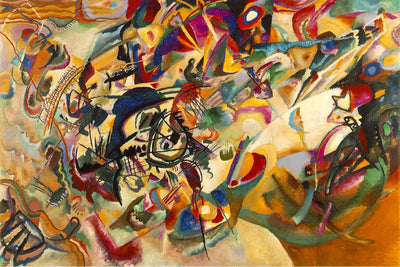
| Lyrical and organic | Curving, flowing forms that feel close to music or growing things | Stockholm from 1906 and Munich by 1911 | Hilma af Klint, Wassily Kandinsky |  Composition VII |
| Gestural and color field | Sweeping or poured marks, or wide, calm areas of color | New York in the 1940s and 1950s | Jackson Pollock, Willem de Kooning, Mark Rothko, Barnett Newman, Clyfford Still | Not pictured here |
No official list of types exists, so these rows follow the grouping explained further down, with dates taken from the guide.
Many paintings sit between families. In the Guggenheim's words, af Klint's temple paintings combine biomorphic and geometric forms.
What abstract art is, and what it is not
Tate defines abstract art as art that "does not attempt to represent an accurate depiction of a visual reality but instead uses shapes, colours, forms and gestural marks to achieve its effect." Strictly speaking, its glossary entry adds, the word abstract means to separate or withdraw something from something else.
That withdrawal can work in two directions. A painter can start from an object, a figure or a landscape and simplify it until it reads as pattern. Or a painter can use geometric shapes or loose gestural marks with no source in the outside world at all, which some artists preferred to call concrete or non-objective art. Tate admits the boundary between the two is not always obvious, so a painting can be abstract and still have a subject hiding in it.
One tree, three steps: how Mondrian got there
The first route is easiest to see in one painter and one motif. Piet Mondrian began as a landscape painter, and in Avond (Evening): The Red Tree, started in 1908 and reworked until 1910, an old apple tree flares up in fiery red against cobalt blue. The Kunstmuseum Den Haag, which owns it, thinks he first drew the tree in a villa garden at Domburg, the Dutch seaside town where he spent a week in September 1908, and sees in this burst of color his final break with naturalistic painting.

Zoom
By 1911 the color had gone. The Gray Tree, painted in the months before Mondrian moved to Paris in January 1912, keeps only black, white and grays, and the museum calls the influence of Cubism on it enormous. The tree is still there, but its branches have turned into a rhythm of arcs.

Zoom
Ten years on, nothing of the tree is left. In Tableau I (1921), now in the Museum Ludwig in Cologne according to the catalogue raisonné of his work, black lines meet at right angles and fence off planes of red, yellow, blue, white and gray. Mondrian set out this system, which he named Neo-Plasticism, in the first year of De Stijl, the Dutch magazine he founded with Theo van Doesburg in 1917.
Where abstract art came from
Painters had been loosening their grip on the subject for decades before anyone went all the way. In 1875 James McNeill Whistler painted Nocturne in Black and Gold: The Falling Rocket, fireworks over Cremorne Gardens in London reduced to dark haze and drifting specks of gold. The Detroit Institute of Arts, which owns the panel, calls it probably his most infamous painting, and it also has a place among our famous landscape paintings.

Zoom
Hand-painted oil reproductionSee sizes ›
Shown at London's Grosvenor Gallery in 1877, it provoked the leading critic of Victorian Britain, John Ruskin:
“I have seen, and heard, much of cockney impudence before now; but never expected to hear a coxcomb ask two hundred guineas for flinging a pot of paint in the public’s face.”
Whistler sued for libel. At the 1878 trial he described his paintings as "an arrangement of line, form, and color first," and the jury found for him but awarded damages of one farthing, a quarter of a penny, as the University of Delaware's Whistler exhibition recounts. Almost thirty years before the first abstract canvases, the quarrel over them had already been argued in court.
Impressionism pushed in the same direction. In 1896 a young Wassily Kandinsky saw one of Monet's Haystacks at an exhibition of French Impressionists in Moscow; Norway's Nasjonalmuseet counts it among the experiences that sent him, at thirty, to Munich to become a painter. Then came the Fauves and the Cubists, who in Tate's words "depended on the visual world for their subject matter but opened the door for more extreme approaches to abstraction."
The first abstract painters, 1906 to 1917
Within about a decade, painters in five countries crossed into pure abstraction, several of them unaware of the others.
Hilma af Klint, Stockholm. Between November 1906 and March 1907 she painted Primordial Chaos, a series of small abstract canvases that the art historian Julia Voss, writing for Tate, places five years before Kandinsky's first abstract picture. They opened The Paintings for the Temple, 193 works made between 1906 and 1915 according to Moderna Museet. She rarely exhibited them and asked that they stay unseen for twenty years after her death in 1944; the Guggenheim notes they remained all but unknown until 1986. She has her own entry among these famous female artists.

Zoom
Hand-painted oil reproductionSee sizes ›
In The Swan, No. 1 (1915), part of a suite painted in 1914 and 1915, the birds are still easy to recognize. Moderna Museet reads the series as af Klint exploring polarities "through a black and a white swan striving for unity," at varying degrees of abstraction.
Wassily Kandinsky, Munich. His book Concerning the Spiritual in Art, which MoMA's copy dates to 1911, gave the new painting its theory, and by 1913, when he painted Composition VII, he had all but given up recognizable objects. Our guide to Kandinsky's paintings follows that path canvas by canvas.
František Kupka and Robert Delaunay, Paris. At the 1912 Salon d'Automne, Kupka showed Amorpha, Fugue in Two Colors, red and blue forms that began as a study of his stepdaughter playing with a ball; the National Gallery Prague, which owns it, counts it among the first abstract paintings ever shown to the public. Delaunay, whose color Disks date from the same year, spearheaded Orphism, a branch of Cubism that put light and color first, and the poet Guillaume Apollinaire coined that name in 1912, according to Britannica.
Kazimir Malevich, Petrograd. In December 1915, at the exhibition 0,10, Malevich hung Black Square in the corner of the room where a Russian home keeps its icons. His name for the new style was Suprematism, which Tate dates back to 1913. The full story of the canvas, including the three later versions, is in our guide to the famous all-black painting.

Zoom
Hand-painted oil reproductionSee sizes ›
Piet Mondrian, the Netherlands. Mondrian reached the grid by the slow route traced above, one tree at a time.
The pioneers at a glance
| Artist | Where | Breakthrough | Year |
|---|---|---|---|
| Hilma af Klint | Stockholm | Primordial Chaos, the start of The Paintings for the Temple | 1906–1907 |
| Wassily Kandinsky | Munich | Concerning the Spiritual in Art; Composition VII | 1911–1913 |
| František Kupka | Paris | Amorpha, Fugue in Two Colors, shown at the Salon d'Automne | 1912 |
| Robert Delaunay | Paris | Color Disks, the core of Orphism | 1912 |
| Kazimir Malevich | Petrograd | Black Square and Suprematism, shown at 0,10 |
1915 |
| Piet Mondrian | The Netherlands | Neo-Plasticism, set out in De Stijl | 1917 |
For the canvases themselves, described one by one, see our list of famous abstract paintings.
Why painters let go of the subject
Tate groups the reasons into a few big ideas. One was "art for art's sake," the view that a painting should be purely about beautiful effects, close to what Whistler argued in court. Another compared painting to music, which moves us through patterns of sound without describing anything. A third, borrowed from Plato, held that the highest beauty lies in geometry rather than in the things of the real world. And because abstract art does not show the material world, it could stand for the spiritual.
That last idea mattered more than it sounds. Af Klint was deeply involved in spiritualism and Theosophy, the Guggenheim notes, and Voss points out that she and Kandinsky each met the esoteric writer Rudolf Steiner, independently, in 1908. Kandinsky put the musical idea into words:
“Colour is the keyboard, the eyes are the hammers, the soul is the piano with many strings. The artist is the hand which plays, touching one key or another, to cause vibrations in the soul.”
He tested it on canvas. On January 2, 1911, Kandinsky went with Franz Marc to a concert of Arnold Schoenberg's music, and Impression III (Concert) followed soon after. The Lenbachhaus in Munich, which owns it, notes that the black grand piano and the backs of the audience can still be made out in a field dominated by yellow and black.

Zoom
Hand-painted oil reproductionSee sizes ›
The main kinds of abstract art
There is no official list, but most abstract painting falls into three broad families.
Geometric. Squares, circles, grids and flat color, with nothing borrowed from nature. Malevich's Suprematism used basic geometric forms in a limited range of colors, and De Stijl, as Tate puts it, promoted "a strict geometry of horizontals and verticals."
Lyrical and organic. Curving, flowing forms that feel closer to music or growing things than to rulers and grids. Kandinsky's Compositions belong here, and af Klint's temple paintings, in the Guggenheim's description, combine biomorphic and geometric forms.
Gestural and color field. Abstract Expressionism, the postwar American wave, developed in New York in the 1940s and 1950s, and Tate splits it into two groups. The action painters, led by Jackson Pollock and Willem de Kooning, attacked the canvas with sweeping marks; Pollock laid his on the ground and poured paint from the can as he moved around it. The color field painters, among them Mark Rothko, Barnett Newman and Clyfford Still, spread large areas of color meant to draw the viewer into contemplation.
How to read an abstract painting
A canvas with no story can feel like a test with no questions. Five habits help.
1. Start with the title. Painters often tell you how to look. Kandinsky sorted his own work, in his book, into "Impressions" taken directly from outward nature, "Improvisations" that came largely unconsciously, and "Compositions" formed slowly over a long time. Whistler's Nocturnes and Arrangements took their names from music, a hint to look at them the way you would listen.
2. Look for what was taken out. Many early abstractions still hold traces of a subject. The Tretyakov Gallery explains that Composition VII grew out of earlier figurative paintings on the Apocalypse, and that faint echoes of trumpeting angels, a rider and the prophet Elijah's fiery chariot survive in the swirl.

Zoom
Hand-painted oil reproductionSee sizes ›
3. Follow the paint. How the color went on is part of the content: brushed, poured, scraped or laid down flat. The edges are worth reading first, because a ruled edge, a feathered one and a dripped one each tell you how fast the hand was moving.
4. Stand where the size puts you. Composition VII is 200 × 300 cm (78.7 × 118.1 in), and the Tretyakov describes that scale as an invitation to a kind of "immersion" inside the picture rather than a view from outside. Step close, then back, and notice which forms hold together at each distance.
5. Ask how much was planned. Here is one answer to the old complaint that a child could do it. For Composition VII, Kandinsky made more than thirty sketches and studies, from pencil notes and watercolors to painted studies more than a meter across, most of them in the autumn of 1913. The final canvas then took only a few days, from November 25 to 28, 1913, according to the Tretyakov.
From one tree to a wall of your own
Abstraction makes most sense as a sequence, which is why Mondrian's trees are a good way in: The Gray Tree hung near Tableau I tells the whole story in two canvases. For more canvases from these first decades, browse the abstract art collection, and our famous paintings guide covers the older masterpieces they broke away from.
Sources
- Tate, Abstract art (art term)
- Tate, Abstract expressionism (art term)
- Tate, De Stijl (art term)
- Tate, Suprematism (art term)
- Julia Voss, "The first abstract artist? (And it's not Kandinsky)", Tate Etc.
- Moderna Museet, Hilma af Klint: topics and central works
- Solomon R. Guggenheim Museum, Hilma af Klint: Paintings for the Future
- Guggenheim press release, April 22, 2019 (reprinted by Art & Object)
- Kunstmuseum Den Haag, Avond (Evening): The Red Tree
- Kunstmuseum Den Haag, The Grey Tree
- RKD, Piet Mondrian catalogue raisonné, works of 1920–1921
- Tretyakov Gallery, Composition VII
- Tretyakov Gallery, Black Suprematic Square
- Lenbachhaus, Impression III (Konzert)
- Detroit Institute of Arts, Nocturne in Black and Gold, the Falling Rocket
- University of Delaware Library, Museums and Press, The Butterfly Goes to Court
- Nasjonalmuseet, Kandinsky: Into the Unknown
- MoMA, Kandinsky, Über das Geistige in der Kunst (1911)
- Wassily Kandinsky, Concerning the Spiritual in Art, translated by Michael T. H. Sadler (Project Gutenberg)
- National Gallery Prague, František Kupka, Amorpha, Fugue in Two Colours
- Britannica, Orphism