4.9/5
4.9/5


Picture a Van Gogh. Don't think, just picture one. For most people the image that shows up is a blue night coiling over a sleeping village, with a black cypress flaring up the left edge like a flame. That reflex settles the question of what is Van Gogh's most famous piece of art faster than any poll could. Sunflowers comes close, closer than people assume, and the reasons it loses tell you a lot about how a painting becomes the one everybody knows.
What is Van Gogh's most famous piece of art?
The Starry Night is Van Gogh's most famous piece of art. He painted it in mid-June 1889 from his room at the Saint-Paul asylum in Saint-Rémy, in the south of France, and it has belonged to the Museum of Modern Art in New York since 1941. It's a mid-sized oil on canvas, 73.7 × 92.1 cm, smaller than most people expect when they finally stand in front of it.
He made more than 2,000 oil paintings, watercolors, drawings and sketches in a career that lasted about a decade. Of all of them, this is the one people recognize from across a room, before they can read the label.
Famous here means recognized, which is a different contest from most expensive or most admired by curators. If you want the whole field, his ten best-known canvases, ranked, are already laid out in a separate list. This piece makes one argument instead: why a single night sky outran every other picture he made, including the flowers he hoped would define him. Put it next to the rest of Van Gogh's paintings and the gap in recognition is obvious. Explaining it takes a little longer.

A night sky painted in daylight
Start with how the thing was made, because it's stranger than the postcard suggests.
He spent about twelve months at the asylum, in 1889–1890, after the crisis in Arles, and kept painting the whole time. Early one morning he watched the sky before dawn. "This morning I saw the countryside from my window a long time before sunrise with nothing but the morning star, which looked very big," he told Theo in a letter written around the start of June.
That morning star is Venus, the big white orb just left of center. The crescent moon sits at the far right. Everything else is edited. The village couldn't be seen from his window at all; he built it from other views, and its steeple looks like the churches of his native Holland, not like anything in Provence. He pulled the cypress much closer than it stood. And he didn't paint any of it at night. The Starry Night, painted in June 1889, came together over several daytime sessions, in light that had nothing to do with the scene on the canvas.
The swirls in the middle of the sky aren't pure invention either. They line up with published astronomical observations of nebulae, the clouds of dust and gas that telescopes were starting to show. So you get a picture that is half observation and half memory, held together by thick paint laid down in short, restless strokes. That mix is the whole reason it works. A strictly accurate view from a hospital window would be a pleasant landscape. This is weather inside a person.
He mentioned it to Theo almost in passing, around 18 June: at last he had a landscape with olive trees, and a new study of a starry sky. No fanfare. A year earlier, in Arles, he had written about stars in a much more loaded way, comparing them to the black dots for towns on a map of France. You take the train to reach Tarascon or Rouen, he reasoned, and you take death to reach a star. It's hard to look at the cypress, a tree of graveyards and mourning, without that line in your head.
He called it a setback
Here's the part that makes the painting's fame a little funny. Van Gogh wasn't proud of it.
By the autumn of 1889 he had pulled back from painting things out of his head; while he fought his illness, he found danger in those abstractions. In a letter to Bernard around 26 November 1889 he admitted: "once again I'm allowing myself to do stars too big, &c., new setback, and I've enough of that." He went back to olive groves and wheat fields, things he could stand in front of.
So the picture the world picked is one its painter filed under mistakes. That isn't rare in art history, but it's rarely this stark. If you want to hear him argue with himself in his own voice, the letters worth starting with are gathered in another article, and the ones from Saint-Rémy are among the most candid he wrote.
Why The Starry Night beat Sunflowers
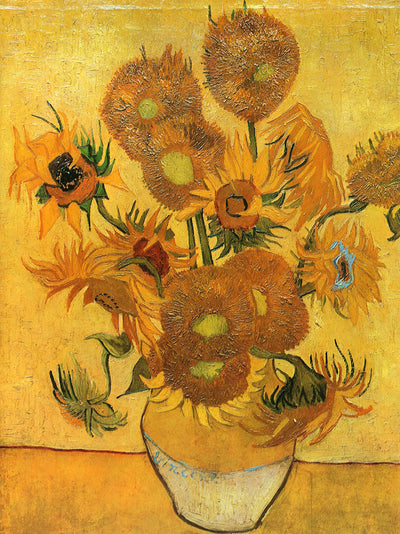
If Van Gogh had voted, Sunflowers would have won. He wanted to be known as the painter of sunflowers, and in a sense he was: friends brought sunflowers to his funeral. Plenty of people still name it first. The case for The Starry Night rests on four things that have nothing to do with which picture is better.
Sunflowers is a series, not a single picture
There is no one Sunflowers. He painted seven canvases of the flowers in a vase between 1888 and 1889: four in August 1888 and three repetitions in January 1889. Five hang in public museums, in Amsterdam, Munich, Philadelphia, Tokyo and London. One is in private hands, and one was destroyed during the Second World War.
The plan behind them was bigger still. He meant to paint a dozen panels for the Yellow House in Arles and finished five of the large vase pictures. The version most English speakers know is the London canvas with fifteen blooms, 92.1 × 73 cm, which the National Gallery bought through the Courtauld Fund in 1924. Fifteen flowers at every stage, from buds to heads gone to seed.
Fame split five ways is fame diluted. Ask someone where Sunflowers is and the honest answer is "which one?" Ask where The Starry Night is and there's one address.
There's a second problem, and it's about what the pictures were for. The big vases are color experiments, built almost entirely from three shades of yellow, and he proved you could make a picture sing that way. But he didn't think of them as stand-alone icons. He wanted two of them to flank his portrait of Madame Roulin rocking a cradle, La Berceuse, as yellow side panels in a triptych, and he thought of the three together as an image of gratitude. Sunflowers was designed to be part of a wall, part of a house, part of a set. The Starry Night was a single study of a single sky, and it was always going to stand alone.

The sunflowers also carry a story that points away from the pictures and toward a friendship. He hung the first two in the room he'd prepared for Paul Gauguin, who arrived in Arles on 23 October 1888. Gauguin was impressed, and later called them "completely Vincent," and the story of how he decorated that guest room is still the best way into the series. Two months later, on 23 December, the arrangement ended with the ear. It's a great story, and it makes Sunflowers a picture about two men. The Starry Night is about one man and the sky, which is easier to carry around.
One canvas, one address in Manhattan
MoMA acquired it in 1941 through the Lillie P. Bliss Bequest, by exchange, which means works from her gift were traded to pay for it. That put the painting in New York, inside a museum of modern art, where it has stayed ever since.
Location matters more than people like to admit. A painting in Manhattan is seen by an enormous, international, constantly renewed crowd, and it's framed by its surroundings as the start of modern painting rather than the end of the nineteenth century. Hung there, the 1889 canvas announces modern painting's turn toward mood, expression, symbol and sentiment. Sunflowers in London reads as a great nineteenth-century still life. The Starry Night in New York reads as the first chapter of the twentieth century.
A song turned the title into a lyric
In the fall of 1970 Don McLean read a biography of Van Gogh, sat down with a print of The Starry Night and wrote the lyrics on a paper bag. "Vincent" came out on the 1971 album American Pie and as a single in 1972. It went to No. 1 in the UK and No. 12 on the Billboard Hot 100.
The first line is the painting's title, doubled: "Starry, starry night." Millions of people who never set foot in a museum can sing it. No song does that for Sunflowers.
It survives being shrunk
This last point is my own, and it's the one I'd bet on. The Starry Night reads at any size. Squash it onto a coffee mug, a phone case or a thumbnail and you still know it from the swirl and the cypress alone. Sunflowers needs its color and texture to land; reduced to a small print, it becomes a vase of yellow flowers, and there are a lot of those in the world.
Try it with his other greats. The bedroom in Arles becomes a small room with a bed. The portraits become a man with a beard. The night sky alone keeps its identity at the size of a postage stamp, because what you recognize is movement, and movement survives when detail doesn't.
A picture that stays recognizable when it's tiny gets reproduced endlessly, and every reproduction is another place someone sees it. MoMA's own shop sells it as a 1,000-piece jigsaw puzzle. That feedback loop has been running for decades, and at this point it's hard to imagine anything catching up.
The paintings that come next
If The Starry Night is first and Sunflowers is a strong second, the third spot is a real argument. Two candidates stand out.
The café terrace in Arles at night is the obvious one. It shares the starry sky and the yellow-against-blue contrast, painted about 16 September 1888, nine months before the Saint-Rémy picture. He painted what he saw: the positions of the stars match the sky over Arles on 16 or 17 September 1888. In a way it's the rehearsal for the more famous night.
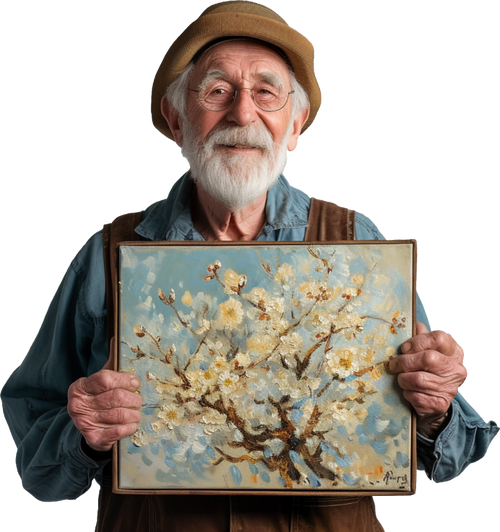
The other is the almond branches he painted for his nephew in February 1890. Theo and his wife Jo had just had a son, named Vincent Willem after his uncle, and the painting was a gift for the baby. That boy grew up to found the Van Gogh Museum, and the picture stayed closest to the family's hearts.

Where are Van Gogh's most famous paintings kept?
They're spread across two continents and then some, which is part of why no single museum owns his reputation. The short version:
| Painting | Year | Where it hangs |
|---|---|---|
| The Starry Night | 1889 | Museum of Modern Art, New York |
| Sunflowers (fifteen blooms) | 1888 | National Gallery, London |
| Sunflowers (repetition) | 1889 | Van Gogh Museum, Amsterdam |
| Other Sunflowers versions | 1888–1889 | Munich, Philadelphia, Tokyo |
| Terrace of a Café at Night | 1888 | Kröller-Müller Museum, Otterlo |
| Almond Blossom | 1890 | Van Gogh Museum, Amsterdam |
For depth, the Netherlands wins. The Van Gogh Museum in Amsterdam holds the largest collection of his work anywhere, and the Kröller-Müller in Otterlo has the second largest, with 91 paintings and 180 drawings, including the café terrace. Helene Kröller-Müller bought it for her own collection. For the single most famous canvas, though, you have to fly to New York.
If you're planning trips around pictures rather than one artist, a longer list of paintings worth seeing in person covers the other museums that belong on the same itinerary.
A night sky for your own wall
Seeing the swirl in person is worth the trip, but it lives in New York. Art & See paints copies of it by hand in oil, at the size you choose, along with the sunflowers, orchards and cafés from every period of his work. It's the closest thing to hanging the real brushwork at home.