4.7/5


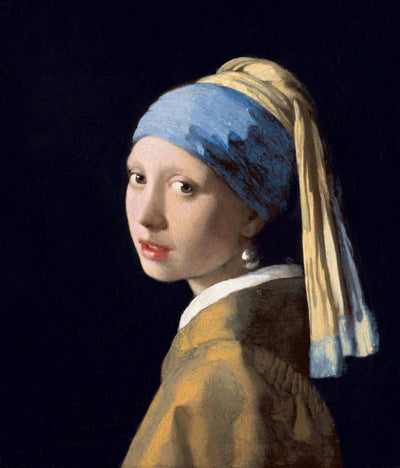
To analyze a painting like Vermeer’s Girl with a Pearl Earring, look at it slowly and write down what you see before you decide what it means. Start with the lines and shapes. Then move on to color, light, space and the way everything is arranged. Only after that, ask what the artist was saying and whether it works. This guide tests each step on real masterpieces, and every one of them is hand-painted in oil by our studio artists.
This kind of close looking has a name. Tate defines formalism as the study of art based on its form, meaning the way it is made and what it looks like. It is a good place to begin, because it gives you something solid to point at before you start guessing about meaning.
The eight steps, in the order that works
Keep a pencil and a sheet of paper next to you. The first six steps only ask what is in front of your eyes. The last two are where your own thinking comes in.
- Describe the painting as if you were telling a friend who cannot see it.
- Follow the lines and the shapes that make up the picture.
- Name the colors and say how they work together.
- Find the light and the dark, and where each one sits.
- Work out the space, from what is near to what is far.
- See how the whole picture is arranged on the canvas.
- Say what you think it means, and point to the proof.
- Decide whether it works, and give a reason.
| Step | Ask yourself | Words that help |
|---|---|---|
| 1. Describe | What is here, and how big is it? | subject, size, material |
| 2. Lines and shapes | Are the edges soft or sharp? | outline, contour, brushstroke |
| 3. Color | Which colors rule, and which are rare? | warm, cool, contrast |
| 4. Light | Where does the light come from? | tone, shadow, chiaroscuro |
| 5. Space | How deep does it feel? | foreground, vanishing point, overlap |
| 6. Arrangement | Where does my eye land, then go? | balance, center, diagonal |
| 7. Meaning | What does the picture seem to say? | mood, symbol, story |
| 8. Judgment | Does it work, and why? | effect, reason, proof |
Step 1: Look first, and describe
Spend a full minute in silence. Then write what you see in plain words, with no opinions yet. Note the subject, the size, the material and anything that surprises you.
Vermeer’s Girl with a Pearl Earring is oil on canvas and fairly small. It is about 44.5 centimeters tall and 39 wide, according to Wikipedia. It shows one young person against a dark background. She looks back at us over her shoulder, wearing a blue and yellow turban and a large pearl.

Van Gogh’s Café Terrace at Night is also oil on canvas, but bigger at 80.7 by 65.3 centimeters. It shows a lit café terrace at night, a few tiny figures, a street that leads away and a sky full of stars.

Step 2: Follow the lines and shapes
Lines can be real, like an outline, or implied, like the edge where two colors meet. Ask whether they are smooth or rough and straight or curved. Ask whether your eye wants to follow them somewhere.
In the Vermeer, the lines are soft and the edges are blurred, especially around the face. The shapes are simple: a round head, a long fall of cloth and one bright oval for the pearl. In the Van Gogh, the lines are rougher and the brushstrokes show. The tables and the cobblestones are built from short strokes, and the edge of the café wall pushes your eye down the street.
For a clearer lesson in line, look at his The Starry Night. Van Gogh painted it in June 1889, and the sky is made of long curling strokes. Wikipedia notes that he exaggerated the cypress trees in the foreground. Notice how the curves of the sky and the tall dark shape of the trees pull your eye in two directions.

Hand-painted oil reproductionSee sizes of The Starry Night ›
Step 3: Name the colors
Say which colors dominate and which ones are rare. Notice which ones sit side by side. Warm colors such as yellow and orange tend to come forward, while cool colors such as blue tend to sit back.
The Vermeer is built on a few colors. The blue of the turban is natural ultramarine, one of the pigments found when researchers studied the painting in 2018. Van Gogh took the opposite approach. He wrote to his sister that this was a night painting without black, with only blue, violet and green. The lit area, he said, turned pale sulfur yellow and lemon green. The Wikipedia entry for Café Terrace at Night quotes the letter in full.
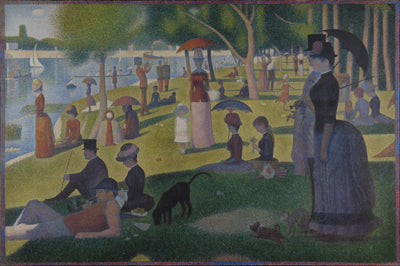
Color can also work by dots. Georges Seurat painted A Sunday Afternoon on the Island of La Grande Jatte with tiny dots and small strokes of pure color placed side by side. Wikipedia explains that the dots blend in the viewer’s eye. The mix happens in your head. Step close, then step back, and watch the colors change.

Hand-painted oil reproductionSee sizes of A Sunday Afternoon on the Island of La Grande Jatte ›
Step 4: Find the light
Ask where the light comes from and where the darkest part is. Painters call the balance of light and shade chiaroscuro. They use the word tone for how light or dark a color is, apart from which color it is.
In the Vermeer, the light comes from the upper left and rests on the face, the lips and the pearl. The background stays dark. In the Van Gogh, the light comes from a lantern inside the scene. The glow spreads across the terrace and fades into dark blue at the edges. One painting uses soft contrast, and the other uses a single warm source in the middle of a cool night.
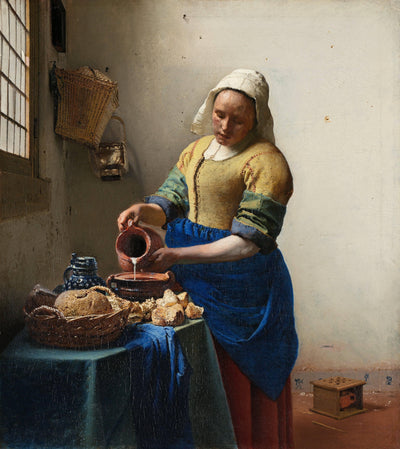
Vermeer’s The Milkmaid shows how gentle light can still feel solid. The Rijksmuseum dates it to about 1658. Window light falls across the wall and the table, and it picks out the rough crust of the bread without flattening the shapes. Cover the lit wall with your hand and see how the woman seems to lose her weight.

Hand-painted oil reproductionSee sizes of The Milkmaid ›
Step 5: Work out the space
A painting is flat, but artists make it feel deep. Perspective is the system for drawing three-dimensional space on a flat surface. Its key idea is that parallel lines seem to meet in the distance. Look for overlapping shapes, changes in size and a vanishing point.
The Vermeer has almost no space. The figure fills the frame, and the dark ground sits right behind her. Yet the 2018 study found signs of a green curtain behind her head, so the dark background is not as empty as it looks. The Van Gogh does the reverse. The street narrows as it moves away from the viewer, and one art historian has described its perspective as funnel-shaped.
For a masterclass in space, study Las Meninas. Velázquez painted it in 1656, and it hangs in the Prado in Madrid. One critic quoted on Wikipedia calls the room a simple box with a single vanishing point. A mirror on the back wall shows the king and queen. Count the layers from the girl in front to the man in the doorway, and you will feel the room open up behind her.

Hand-painted oil reproductionSee sizes of Las Meninas ›
Step 6: See how it is arranged
Composition means how the parts are arranged in the picture. Ask where the eye lands first and where it goes next. Ask what balances what. Look for a center, a diagonal, a repeated shape or a gap.
In the Vermeer, the head sits near the middle and her eyes find yours at once. Then your gaze drops to the pearl and the bright lips. In the Van Gogh, the lit terrace holds the left side, and the street leads the eye back into the blue distance. The stars give the top of the canvas a rhythm of its own.
Delacroix’s Liberty Leading the People adds a strong example. Wikipedia says the mound of dead and wounded works like a pedestal, and Liberty strides from it toward the viewer. Your eye climbs from the bodies to her raised flag. Try covering half of any painting with a sheet of paper to see how the balance changes.

Hand-painted oil reproductionSee sizes of Liberty Leading the People ›
Step 7: Say what it means
Now you can guess at meaning, and your guess should rest on what you wrote in the first six steps. If you say a painting feels calm or lonely, point to the line, color or light that makes you say so.
Here you can also bring in facts. The Vermeer is a tronie, a Dutch word for a head or face study that was not meant to be a portrait of a named person. That is why the picture names no sitter. The Van Gogh dates to early September 1888 in Arles, and it is the first painting where he used a starry sky.
Some meanings come from a single choice. In Wanderer above the Sea of Fog, Caspar David Friedrich shows a man from behind, so we look at the view together with him. Wikipedia calls this a rear-facing figure and says the painting has been read as a picture of self-reflection. That reading rests on what you can see: his back, his stance and the endless fog.

Hand-painted oil reproductionSee sizes of Wanderer above the Sea of Fog ›
Step 8: Decide what you think
The last step is your own judgment. Ask whether the artist did what they set out to do. Ask whether the parts work together, and whether the picture still holds your attention after ten minutes. A good judgment always names a reason.
You might say the Vermeer works because the soft light and the plain background keep you looking at one face. You might say the Van Gogh works because the warm lantern against the cool night makes you feel the evening air. You can also disagree with a famous painting and still do this well. The test is whether you can point to something in the picture that backs you up.
Which painting teaches which step
If you want to practice, pick the painting that matches the step you find hardest. This table lists the eight paintings used above and the lesson each one teaches best.
| Painting | Artist | Year | Best for |
|---|---|---|---|
 Girl with a Pearl Earring |
Johannes Vermeer | c. 1665 | Describing one figure |
 Café Terrace at Night |
Vincent van Gogh | 1888 | Color and a single light source |
 The Starry Night |
Vincent van Gogh | 1889 | Line and rhythm |
 A Sunday Afternoon on the Island of La Grande Jatte |
Georges Seurat | 1886 | Color made of dots |
 The Milkmaid |
Johannes Vermeer | c. 1658 | Soft light |
 Las Meninas |
Diego Velázquez | 1656 | Space and layers |
 Liberty Leading the People |
Eugène Delacroix | 1830 | Arrangement |
 Wanderer above the Sea of Fog |
Caspar David Friedrich | 1818 | Meaning from one choice |
Try it on a painting you can live with
The best way to learn this is to practice on a painting you see every day. A hand-painted oil copy of a famous work lets you study the brushwork, the color and the light in your own room, in every kind of daylight. Our studio artists paint each one on canvas by hand. You can browse every Vermeer painting we offer or the full Van Gogh collection.
If you want to keep looking, our guide to what makes Van Gogh paintings special lists seven things to watch for in his work. Our list of every Vermeer painting shows where to see each one. Our roundup of the most famous paintings of women gives you more portraits to practice on.
Sources
- Formalism, Tate
- Chiaroscuro, Tate
- Perspective, Tate
- The Milkmaid, Rijksmuseum
- Girl with a Pearl Earring, Wikipedia
- Café Terrace at Night, Wikipedia
- The Starry Night, Wikipedia
- A Sunday Afternoon on the Island of La Grande Jatte, Wikipedia
- Las Meninas, Wikipedia
- Liberty Leading the People, Wikipedia
- Wanderer above the Sea of Fog, Wikipedia