4.9/5
4.9/5


Walk into a gallery of 17th-century paintings and you can often spot a Caravaggio before you read the label. The Caravaggio art style starts with tenebrism: bodies caught in one hard beam of light while most of the canvas sinks into near-black shadow. Five more habits confirm it. He painted ordinary Romans, froze the split second of action, pushed figures against the front edge, dressed saints in street clothes and never cleaned up a piece of fruit.
Michelangelo Merisi, called Caravaggio, was born in Milan in 1571 and died in 1610, aged 38. Here's how to test each signature on a real canvas.
1. Tenebrism: one hard light, the rest in darkness

Stand in front of his Calling of Saint Matthew (1599–1600) in Rome's San Luigi dei Francesi and the first thing you'll notice is a diagonal beam. It crosses from the upper right, above Christ's pointing hand, and lands on the faces of the men at the table. Caravaggio even planned it around the only window that lets daylight into the chapel.
That's tenebrism, from the Italian tenebroso, "dark, gloomy, mysterious." It's chiaroscuro pushed to the extreme, where darkness takes over most of the picture, and Caravaggio is generally credited with inventing it.
So find the light source first. His Saint John the Baptist in the Wilderness (1604), in Kansas City, is lit from above and to his right, with deep shadow filling his eye sockets. That single raking light is also the first thing to check when you compare copies of Caravaggio's paintings.
2. Ordinary Romans as models, painted straight onto the canvas
In the Madonna di Loreto (c. 1604–1606, Sant'Agostino, Rome), the Virgin and her two wrinkled pilgrims are all barefoot, set against a wall of flaking brick, and the kneeling pilgrim's soles point straight at you. His rival Giovanni Baglione wrote that the common people made "a great cackle" over it.
Caravaggio worked fast from live models, skipped preparatory drawings and scored guidelines into the canvas with the end of his brush handle. Those marks still show: look for lines incised into the gesso ground along Saint John's left leg in the Kansas City picture. His sitters were people he knew. Fillide Melandroni, a well-known Roman courtesan, probably posed for Judith.
3. The split second of action

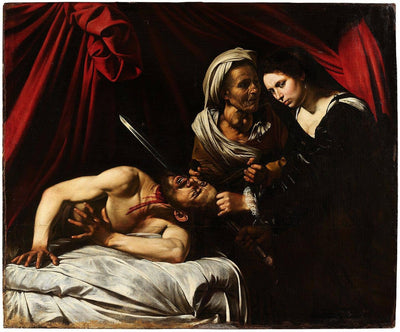
Most painters showed Judith before or after the deed. In his Judith cutting Holofernes's throat (about 1599, Palazzo Barberini, Rome) you get the instant of decapitation itself, blade in the neck, the maid Abra at her side.
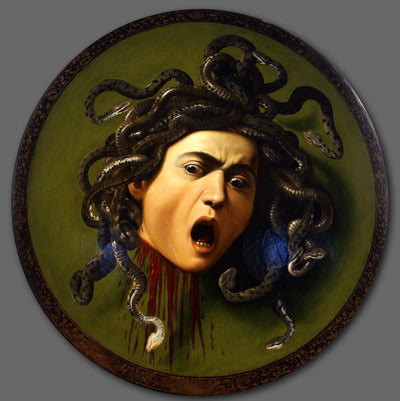
The Medusa he painted on a shield (about 1597, Uffizi, Florence) freezes the other end of a killing: the Gorgon's severed head, still conscious and screaming. The support is a convex poplar shield that Cardinal Francesco Maria del Monte commissioned as a gift for Ferdinando I de' Medici, and the face is thought to be Caravaggio's own. The Uffizi gives it a room of its own.
Quick test: ask what happens one second later. If the answer is obvious, and usually violent, you're looking at Caravaggio or someone who studied him.
4. Figures pressed against the front edge
In the Supper at Emmaus (1601, National Gallery, London), a disciple's arms seem to stretch out of the frame and a basket of food teeters over the table's edge toward you. The Basket of Fruit in Milan plays the same trick alone. Check the bottom edge: in his half-length pictures, a table or a ledge is often all that separates you from the figures.
5. Saints in the clothes of his own day
Back to the Calling. The Gospel places Matthew in the custom house, and Caravaggio seats him among men who could be his Roman neighbors, dressed in the fashions of 1600, while Christ and Peter step in from the right. Saints lose their props too. The Kansas City Saint John has no halo and no lamb, and almost none of the attributes painters normally gave him.
6. Fruit painted with its flaws

The Basket of Fruit (about 1599, Biblioteca Ambrosiana, Milan) looks fresh from across the room. Up close you'll find an apple with two insect holes, figs splitting along the sides, mummified grapes and a shriveled leaf.
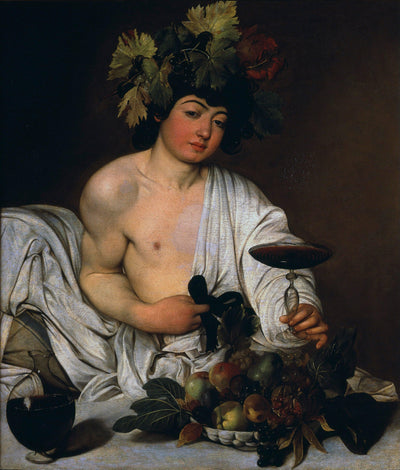
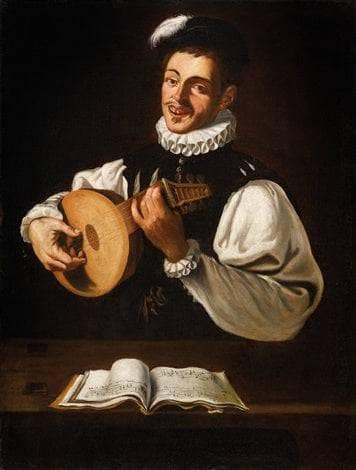
The fruit beside his young men gets the same treatment. In the young Bacchus with his bowl of fruit (about 1598), the bowl holds a bursting pomegranate and a rotting apple, a reminder that youth and pleasure don't last. The boy with the lute (about 1596) adds sheet music precise enough to read, madrigals by Jacques Arcadelt in the Hermitage version. Caravaggio thought it was, in Baglione's words, "the best piece that he ever painted."
Caravaggio's art style or a follower's?
Not every dark, dramatic canvas is his. His followers, the Caravaggisti, were also called tenebrosi, "shadowists," and the best known include Artemisia Gentileschi, Jusepe de Ribera, Gerrit van Honthorst and Georges de La Tour. The Cardsharps alone survives in more than 50 copies and variants by other painters, while counts of his own paintings run from 40 to 80. A label reading "follower of" or "circle of" means another hand held the brush.
The imitators were a sign of success. His Saint Matthew canvases caused a sensation in 1600, fashion later turned against him, and the 20th century brought him back: the Bacchus was found in the Uffizi storerooms in 1913, Judith only in 1950. The critic André Berne-Joffroy summed it up: "What begins in the work of Caravaggio is, quite simply, modern painting."
To see the real thing, Rome is still the place, with six of them hanging in one Borghese room and three churches that keep the canvases painted for them. In the US, originals hang in New York, Fort Worth, Hartford, Detroit, Kansas City and Cleveland, which has the only altarpiece he left in America, The Crucifixion of Saint Andrew (1606–1607).
A Caravaggio for your wall
If one of these pictures stays with you, Art & See paints every Caravaggio in the collection by hand in oils, the way the originals were made. Start with the one whose light or drama hooked you, and when you want to look beyond Caravaggio, browse the masterpieces people ask for most.