4.9/5


Romantic landscape paintings are the storms, summits, ruins and wild rivers that painters in Germany, Norway, Britain and the United States turned into the main subject of serious art between about 1800 and the 1860s, using scale, weather and light to carry feelings that older art gave to saints and heroes. They belong to the wider movement our Romanticism collection gathers. Eight canvases tell the story here, from an altarpiece Friedrich painted in Dresden to a Rocky Mountain panorama of 1863. The table up top counts the photos people have shared of each canvas, and it is honest about the five where no clean count exists.
Which Romantic landscapes get photographed the most
| Rank | Painting | Painter | Museum | Shared photos |
|---|---|---|---|---|
| 1 |  The Oxbow |
Thomas Cole | The Met, New York | 16 |
| 2 | Niagara | Frederic Edwin Church | National Gallery of Art, Washington | 9 |
| 3 |  The Rocky Mountains, Lander's Peak |
Albert Bierstadt | The Met, New York | 5 |
| — | Hadleigh Castle | John Constable | Yale Center for British Art, New Haven | no data |
| — |  Cross in the Mountains (Tetschen Altar) |
Caspar David Friedrich | Galerie Neue Meister, Dresden | no data |
| — |  The Sea of Ice |
Caspar David Friedrich | Hamburger Kunsthalle | no data |
| — | View from Stalheim | Johan Christian Dahl | Nasjonalmuseet, Oslo | no data |
| — | Kindred Spirits | Asher B. Durand | Crystal Bridges Museum of American Art, Bentonville | no data |
Each number is the count of photos in that painting's own category on Wikimedia Commons, checked in October 2026. For the five marked no data, no category for that one painting turned up, so they follow in the order the story tells them.
All three ranked pictures are American, and two of them, The Oxbow and Lander's Peak, belong to the Met.
Why landscape had to earn its place
For two centuries the academies told painters what mattered. Tate explains that the French Royal Academy ranked the subjects in the 1600s: history painting first, then portraits, scenes of daily life, landscape and, last, still life. People were the measure of all things, so a view without a human story counted for little.
Romantic painters kept the ambition of history painting and took it outdoors. A cliff, a storm or a ruin could now carry grief, faith or national pride. Romantic landscape is one of the three classic kinds, beside the ideal and the realistic, as our guide to the three types of landscape painting explains.
Dresden, 1808: a landscape on the altar
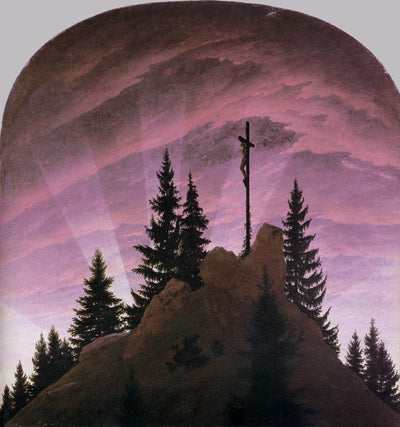
The first public fight over the idea broke out around one picture. In March 1807 Caspar David Friedrich (1774–1840) showed a large sepia drawing of a cross in the mountains at the Dresden Academy exhibition. According to the Kupferstichkabinett in Berlin, which owns the drawing, it led Count and Countess von Thun-Hohenstein to order an oil version for the chapel of their castle at Tetschen.

Zoom
Friedrich finished it by Christmas 1808, and it was his first large oil painting. Nothing in it looks like a conventional altarpiece: the crucifix is small, and the rock, the trees and the sky do the talking. The critic Friedrich Wilhelm Basilius von Ramdohr attacked it in print for giving far too much room to landscape, which, as Planet Wissen sums up his complaint, was now creeping onto altars where only the cross belonged. The Berlin record calls the picture famous and, in its day, hotly disputed. It belongs to the Galerie Neue Meister of the Staatliche Kunstsammlungen Dresden, which have owned it since 1921. Cross in the Mountains is also painted by hand in oil.
Friedrich after the Wanderer
Two of Friedrich's best-known canvases have their own pages on this site. Wanderer above the Sea of Fog (about 1817), in the Hamburger Kunsthalle, is one of the most famous paintings in the world, and The Monk by the Sea (1808–1810), in Berlin's Alte Nationalgalerie, appears in our guides to famous German paintings and famous ocean paintings.
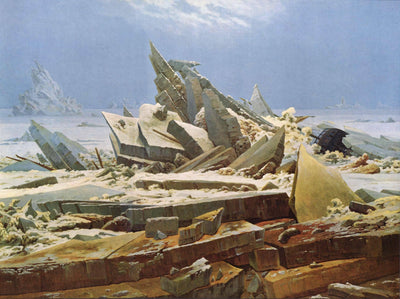
The picture that states his view of nature most bluntly is The Sea of Ice (1823–1824). A peak of broken ice plates rises in the middle of a polar scene and buries a sailing ship beneath it. The Friedrich portal run by the museums of Hamburg, Berlin and Dresden notes that many expeditions of the period were stopped by pack ice, but that Friedrich does not seem to point to any particular voyage. It reads the picture as a verdict on the hunt for a Northwest Passage, a case of human hubris, and calls the composition "as fantastic as it is unsettling."

Zoom
The canvas, 96.7 × 126.9 cm (38.1 × 50.0 in), entered the Hamburger Kunsthalle in 1905. You can also own The Sea of Ice as a hand-painted canvas.
Norway: Dahl's valley
Romantic landscape also gave a young country a picture of itself. Johan Christian Dahl (1788–1857), a Norwegian who taught as a professor at the Dresden Academy from 1824, toured Norway in 1826 and drew as he went. Sixteen years later, as the Nasjonalmuseet in Oslo tells it, his drawings of the view toward the Nærø Valley in Sogn became the basis of View from Stalheim (1842), one of his most complex paintings.

Zoom
Hand-painted oil reproductionSee sizes ›
Mountains rise under a dark, rain-heavy sky, and sunlight breaking through the clouds lights a rainbow over the valley. Dahl hides the drop behind a small plateau in the foreground and lets the mist of a waterfall hint at it, so the view feels both monumental and close. The museum reads the rainbow as a possible sign of the divine and a tribute to the young Norwegian nation, and the damaged birch as a reminder of nature's violence. The canvas measures 189.7 × 245.8 cm (74.7 × 96.8 in) and was a gift to the museum in 1914. View from Stalheim is also painted by hand in oil.
England: Constable's skies
In England the change came through weather. John Constable (1776–1837), born at East Bergholt in Suffolk, painted mostly the countryside where he grew up, according to the National Gallery in London. The best-known result, The Hay Wain (1821), is covered in our guide to Romanticism in art, with its surprising success in Paris. The same year he told his friend John Fisher what the work meant to him.
“Painting is with me but another word for feeling.”
Grief later pushed that feeling into darker weather. His wife, Maria, died of tuberculosis in November 1828, and in 1829 he showed Hadleigh Castle, The Mouth of the Thames: Morning after a Stormy Night at the Royal Academy. It was the first picture he exhibited after his election as a full Academician in February 1829, and he had lines from James Thomson's poem The Seasons printed beside it in the catalogue.

Zoom
Hand-painted oil reproductionSee sizes ›
A broken tower stands over the estuary, a shepherd and his dog cross the foreground, and the storm is only just clearing. The Yale Center for British Art, which owns the canvas, 121.9 × 164.5 cm (48.0 × 64.8 in), ties its mood to his loss; in December 1828 he had written, "Hourly do I feel the loss of my departed Angel." A full-size study hangs at Tate Britain. The hand-painted Hadleigh Castle follows the finished Yale version.
Constable's near contemporary J.M.W. Turner (1775–1851) went the other way, toward light. His growing use of brilliant color in landscapes and seascapes earned him the name "the painter of light," the National Gallery notes. His storms, steamships and sunsets, The Fighting Temeraire (1839) among them, have their own story in our guide to Turner landscapes.
America: the Hudson River School
Thomas Cole (1801–1848) was born at Bolton-le-Moors in Lancashire and reached Philadelphia with his family at 17. In the summer of 1825 he took his first sketching trip up the Hudson River. The Smithsonian American Art Museum calls him the first of the Hudson River School of painters and "the first American artist to picture the wilderness with the passion of a poet." He also knew the English work: Cole saw Constable's Hadleigh Castle at the Royal Academy in 1829 and greatly admired it, the Met notes in an essay on his clouds. For the wider American story, see our 25 famous American paintings.
Seven years later Cole painted the picture that sums up the American version. The Met catalogs it as View from Mount Holyoke, Northampton, Massachusetts, after a Thunderstorm, The Oxbow (1836). From the top of the 935-foot mountain Cole looks west: on the left, storm and untouched forest; on the right, sunlit farmland inside the loop of the river that gives the picture its name. A gift of Mrs. Russell Sage to the Met in 1908, it measures 130.8 × 193 cm (51.5 × 76.0 in).

Zoom
Hand-painted oil reproductionSee sizes ›
Cole published his "Essay on American Scenery" in the January 1836 issue of American Monthly magazine, arguing that Americans had yet to see the beauty of their own country. That same year Ralph Waldo Emerson published Nature, and the Met points out that Emerson set "land," valued for timber or crops, against "landscape," valued for the pleasure it gives. The Oxbow as a hand-painted canvas needs a long wall for its two halves.
Who painted the "transcendental" landscape, then? In America, the Hudson River School. Emerson's essay called for the self-discovery of spiritual truths, and the Transcendentalists believed that great spiritual and moral truths could be found in nature; many Hudson River School artists, the Albany Institute of History & Art adds, captured the contemplative mood Emerson described. Cole, Asher B. Durand and Frederic Edwin Church are the painters to look at.
Durand painted the friendship behind it. After Cole died in 1848, the merchant Jonathan Sturges commissioned Kindred Spirits (1849) as a memorial: Cole, holding a sketchbook, stands on a ledge in the Catskills talking with the poet William Cullen Bryant. The Met's essay on Durand says the picture paid tribute to Bryant's eulogy for Cole, and that Durand inherited the leadership of American landscape painting. The canvas, 111.8 × 91.4 cm (44.0 × 36.0 in), belongs to Crystal Bridges Museum of American Art in Bentonville, Arkansas.

Zoom
Hand-painted oil reproductionSee sizes ›
The rock, moss and bark are painted almost leaf by leaf, yet the picture is an elegy. Its tall format suits a narrow wall, and Kindred Spirits is available hand-painted in oil.
The next generation made the feeling bigger. Frederic Edwin Church made oil and pencil sketches on several visits to Niagara Falls in 1856, and in 1857 he unveiled Niagara, a seven-foot-wide view from the Canadian shore, as a one-picture exhibition. The National Gallery of Art in Washington calls the show a sensation that made him the most important American artist of his day. The Corcoran Gallery of Art bought it in 1876, and it joined the National Gallery in 2014. It measures 101.6 × 229.9 cm (40.0 × 90.5 in).

Zoom
Hand-painted oil reproductionSee sizes ›
Church leaves out the safe ground a viewer would stand on: the water starts at the bottom edge of the canvas. Niagara as a hand-painted canvas suits a wide wall.
Albert Bierstadt took the idea west. In 1859 he joined a government survey expedition led by Frederick W. Lander, and his studies from the Wind River Range became The Rocky Mountains, Lander's Peak (1863). He named the central peak after Lander, who died in the Civil War. At 186.7 × 306.7 cm (73.5 × 120.8 in), it is the largest canvas in this story. James McHenry, an American living in London, bought it in 1865, and the Met acquired it in 1907.

Zoom
Hand-painted oil reproductionSee sizes ›
The museum is frank about what the picture leaves out: it reads the painting as promotion of Manifest Destiny that ignored the Indigenous people of the region, among them the Shoshone shown camped in the foreground. You can also own Lander's Peak as a hand-painted canvas.
How to recognize a Romantic landscape
- Small people, large world. Look for figures you could cover with a fingertip: the friends on Durand's ledge, the goats and travelers in Dahl's valley, the camp under Lander's Peak.
- Weather as plot. Storms arriving or clearing, rainbows, mist and low sun do the work that faces and gestures do in a history painting.
- Faith out of doors. A crucifix on a summit, a rainbow over a valley or dawn after a storm lets a landscape carry religious feeling without a church.
- Real places, rearranged. Most of these pictures were composed in the studio from studies made on the spot, so each view is true in its parts and invented as a whole.
The most famous Romantic paintings, and the best landscape painter
If you came for the most famous paintings of Romanticism in general, the core list reaches beyond landscape: Henry Fuseli's The Nightmare (1781), Francisco Goya's The Third of May 1808 (1814), Théodore Géricault's The Raft of the Medusa (1818–1819) and Eugène Delacroix's Liberty Leading the People (1830). The Romanticism guide linked above gives each one a section, and our list of the 20 most famous landscape paintings in the world sets the Romantics in the longer history of the genre.
As for the best landscape painter, no museum awards the title. The National Gallery calls Turner perhaps the best-loved English Romantic artist. John Ruskin, who met him in 1840 and became the great champion of his work, wrote in the preface to the first volume of Modern Painters (1843) that the book "originated in indignation at the shallow and false criticism of the periodicals of the day" on the living artist it mainly discusses. Constable stands out here, because his skies were studied from life and still read as weather rather than scenery.
Living with a Romantic landscape
These pictures were made to be stood in front of, so they want a wall you can step back from and light that does not compete with their skies. All eight are linked above as hand-painted canvases, and for scenery from other periods there are our landscape oil paintings.
Sources
- Tate, Genres (art term)
- Staatliche Museen zu Berlin, Kupferstichkabinett, Caspar David Friedrich, Das Kreuz im Gebirge (sepia drawing, collection record)
- J. Paul Getty Museum, Friedrich to Richter exhibition, Cross in the Mountains (Tetschen Altar)
- Planet Wissen (WDR), Caspar David Friedrich und die Religion (in German)
- Caspar David Friedrich portal (Hamburger Kunsthalle, Staatliche Museen zu Berlin, Staatliche Kunstsammlungen Dresden), The Sea of Ice
- Hamburger Kunsthalle, Caspar David Friedrich
- Nasjonalmuseet, Oslo, Johan Christian Dahl, View from Stalheim (NG.M.01060)
- Victoria and Albert Museum, Johan Christian Dahl, Landscape with Canal and Chateau (catalogue entry)
- National Gallery, London, John Constable (biography)
- Victoria and Albert Museum, John Constable, Study of Clouds and Trees (1821–1822)
- Regency History, John Constable quotations from C.R. Leslie, Memoirs of the Life of John Constable (1845)
- Yale Center for British Art, John Constable, Hadleigh Castle, The Mouth of the Thames: Morning after a Stormy Night
- National Gallery, London, Joseph Mallord William Turner (biography)
- John Ruskin, Modern Painters, volume 1 (Project Gutenberg text)
- Smithsonian American Art Museum, Thomas Cole (biography)
- The Metropolitan Museum of Art, Thomas Cole, View from Mount Holyoke, Northampton, Massachusetts, after a Thunderstorm, The Oxbow (08.228)
- The Metropolitan Museum of Art, "The soul of all scenery": Thomas Cole's clouds
- The Metropolitan Museum of Art, Perspectives essay on Thomas Cole, Emerson's Nature and the national parks
- Albany Institute of History & Art, The Making of the Hudson River School: Landscape and Transcendence
- The Metropolitan Museum of Art, Heilbrunn Timeline of Art History, Asher Brown Durand (1796–1886)
- Crystal Bridges Museum of American Art on Google Arts & Culture, Asher B. Durand, Kindred Spirits
- National Gallery of Art, Washington, Frederic Edwin Church, Niagara (2014.79.10)
- National Gallery of Art, Washington, 19th-century blockbuster: Frederic Edwin Church's Niagara
- The Metropolitan Museum of Art, Albert Bierstadt, The Rocky Mountains, Lander's Peak (07.123)