4.9/5


Realism art is the mid-19th-century movement, born in France around the revolution of 1848, that gave farmhands, road workers and small-town mourners the canvas size and seriousness the Academy kept for gods, kings and battles. Gustave Courbet led it and wrote its manifesto in 1855, and by the 1870s it had followers in Berlin, Saint Petersburg and Philadelphia. Our collection of Realism paintings follows the same route. To see the break at a glance, the first table puts the old rules next to the new ones and names one canvas from the article as proof of each.
This guide is about the movement itself: what the word means, why 1848 set it off, what Courbet's manifesto said, how to spot a Realist picture and how the idea traveled. The ten best-known canvases, from A Burial at Ornans to The Gross Clinic, each get their full story in our companion list of famous Realism paintings.
Realism against what came before it, point by point
| Question | Before Realism | Realism | Canvas that shows it |
|---|---|---|---|
| Who fills the picture? | Gods, heroes, saints and Bible figures | Peasants, clergy and townspeople of the painter's own day, in the clothes they really wore |  Religious Procession in Kursk Province |
| How big can daily life be? | Small, because big canvases were kept for history painting | As big as a history painting, 195 × 257 cm for a simple dinner |  After Dinner at Ornans |
| When does the scene take place? | Long ago, in myth or scripture | In what Courbet called "my time," even inside a steelworks | The Iron Rolling Mill |
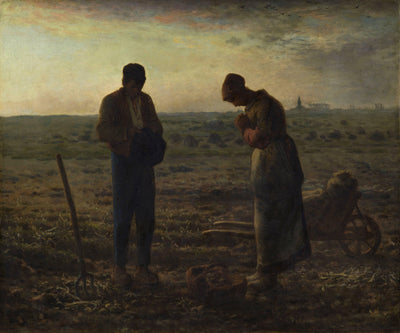
| What is the mood? | The emotion and drama of Romanticism | Quiet, with people who wait, work or pray and no big climax |  The Angelus |
| How do faces look? | Made finer than life | Left plain, so the mourners look like the villagers they were | A Burial at Ornans |
| Who makes the rules? | The Academy and its ladder of subjects | The painter, by his "own estimation" | The Painter's Studio |
Both sides come from the museums and writers quoted below, and the size given is that of the original canvas in Lille.
What Realism means in art
Tate gives the word two meanings. Strictly, it names a mid-19th-century movement that painted everyday subjects in a naturalistic way. Loosely, it describes any picture painted in sharp, almost photographic focus, whatever the subject, which is why Tate can file an early Pre-Raphaelite picture like Millais's Ophelia under realism too. This guide is about the movement.
According to Tate, the novelist Champfleury coined the term in the 1840s, and his friend Courbet became its face. What they pushed against was the Academy's ladder of subjects. History painting, the "grand manner" of heroes, saints and myths, sat at the top and got the big canvases; scenes of daily life, called genre painting, were expected to stay small. After 1848, as Smarthistory's Realism unit puts it, French artists also turned increasingly away from the emotion and drama of Romanticism.
Why Realism began in 1848
The February revolution of 1848 ended the French monarchy and brought in the Second Republic, as Smarthistory explains in its essay on A Burial at Ornans. The new government held the Salon of 1848 without a jury, and on 14 March it launched a competition for a painted image of the Republic itself, according to the Musée d'Orsay's exhibition on 1848.
Honoré Daumier entered that competition with a sketch now in the Musée d'Orsay: a strong, bare-breasted Republic nursing her children, also titled The Republic Feeds and Educates Her Children. The museum's record says it was picked for a full-size version that was never painted.
The young Republic also commissioned work. Rosa Bonheur's Plowing in the Nivernais was ordered by the state in 1848, finished in 1849 and shown at that year's Salon: teams of oxen turning heavy ground across 133 × 260 cm (52.4 × 102.4 in). The Musée d'Orsay, which owns it, records that the state first meant it for the museum in Lyon and then kept it in Paris. For more women painters, from Artemisia Gentileschi onward, see our list of famous female artists.
Courbet's turn came at the Salon of 1849. His After Dinner at Ornans won a medal that, the Musée d'Orsay notes, exempted him from the Salon jury in the years that followed, and the state bought the picture; it now hangs in the Palais des Beaux-Arts in Lille. It shows nothing more than men lingering at the table after dinner in his home town, yet it measures 195 × 257 cm (76.8 × 101.2 in), a format that, the Lille museum points out, was then reserved for history painting.

Zoom
The jury exemption let Courbet send three large canvases straight to the Salon of 1850–1851. One was A Burial at Ornans, a village funeral 315 × 668 cm (124.0 × 263.0 in). Smarthistory points out that he presented it as a history painting, breaking the Academy's rule that genre scenes stay small, and that its mourners are not idealized and barely interact. The Musée d'Orsay records how badly it was received, with critics attacking its supposed vulgarity; the canvas entered the national collections only in 1881, as a gift from the painter's sister Juliette.
Courbet's manifesto of 1855
The real test came with the Exposition Universelle of 1855 in Paris. When the exhibition turned down The Painter's Studio, a canvas of 361 × 598 cm (142.1 × 235.4 in) that the Musée d'Orsay dates to 1854–1855, Courbet paid for his own building outside the official exhibition, the Pavilion of Realism, and hung it there beside A Burial at Ornans. Its full title calls the picture a "real allegory" of a seven-year phase of his artistic life, and he described its crowd as "the whole world coming to me to be painted."
For the pavilion's catalogue he wrote a short preface that became known as the Realist Manifesto. Here is the goal it sets out, in Linda Nochlin's translation as quoted by the art historian Lauren S. Weingarden:
“To translate the customs, the ideas, the appearance of my time, according to my own estimation … to create living art.”
Two phrases carry the program. "My time" rules out Greek gods, Roman heroes and Bible scenes as subject matter. "My own estimation" puts the painter's eye above the Academy's rules about what deserves a big canvas and how it should look.
How to recognize a Realist painting
Realism is easier to see than to define. These six signs, taken from the pictures in this guide, help pick out a Realist canvas in a museum:
- People of the painter's own day. Villagers, farm workers, soldiers and pilgrims in the clothes they actually wore, never in togas or armor.
- Faces and bodies left as they are. Weathered skin, heavy hands and tired postures stay in, and Tate also notes a new frankness about the body and sexuality.
- Ordinary scenes at heroic size. A dinner, a funeral or a plowing team on a canvas built for a coronation.
- No staged climax. Figures stand, wait, pray or work; nobody strikes a pose for the viewer.
- The light of the hour. Lamplight, dusk or the glare of a dusty road, as the scene requires, rather than a spotlight on the hero.
- A moment without a moral. The painter shows what happened and leaves the judging to the viewer.
The hands are a good place to start: in The Angelus the man presses his hat to his chest and the woman joins her hands under her chin, and both pairs of hands are thick and unposed.
Size was never the rule, though. Jean-François Millet's The Angelus (1857–1859) measures just 55.5 × 66 cm (21.9 × 26.0 in): a man and a woman stop work in a flat field at dusk to pray, with a village church on the horizon. The Musée d'Orsay records that an American, Thomas Gold Appleton, ordered it around 1857 and never took delivery. In 1865 Millet explained where the idea came from: his grandmother, hearing the bell, would make the field workers stop to say the Angelus for the dead.

Zoom
How Realism spread
Courbet's example traveled with exhibitions and students, and in each country it found its own subjects: a revolution and a steelworks in Germany, the road and the church in Russia, the Civil War and the Bible in the United States.
Germany
In Berlin, Adolph Menzel answered the March revolution of 1848 with Laying Out of the March Dead, an oil sketch of the public lying-in-state of its victims: 183 people killed in the army's intervention, laid out in front of the Neue Kirche on the Gendarmenmarkt. The Hamburger Kunsthalle, which owns it, notes that Menzel had not witnessed the barricade fighting and reads the unfinished canvas as a sign of his disappointment with the revolution. Twenty-four years later he traveled to the Königshütte works in Upper Silesia to study factory conditions, and painted The Iron Rolling Mill (1872–1875), 158 × 254 cm (62.2 × 100.0 in), now in Berlin's Alte Nationalgalerie. Its workers, the museum writes, must submit to "the unbending workings of the machinery."
Wilhelm Leibl became Courbet's friend in 1869, according to the Musée d'Orsay, and Britannica describes his objective style, like Courbet's, as a direct, careful recording of nature, objects, figures and situations.
Russia
In Saint Petersburg the Society for Traveling Art Exhibitions, known as the Wanderers, opened its first show in November 1871, according to the Tretyakov Gallery. Ilya Repin's Barge Haulers on the Volga (1870–1873, State Russian Museum) gets its full story in our guide to famous Russian paintings. His Religious Procession in Kursk Province (1880–1883, Tretyakov Gallery) spreads a whole provincial society across 175 × 280 cm (68.9 × 110.2 in): peasants, clergy, townspeople and a mounted constable on a dusty road, banners overhead and a gilded icon case carried shoulder-high.

Zoom
Hand-painted oil reproductionSee sizes ›
United States
Americans took Realism partly from Paris. Winslow Homer's Prisoners from the Front (1866, Metropolitan Museum of Art) sets a Union officer, whom the Met identifies as Francis Channing Barlow, opposite three Confederate prisoners taken at Spotsylvania in 1864. The painting went to the Exposition Universelle in Paris in 1867, and so did Homer: late in 1866, the Met's essay on Homer says, he began a stay of about ten months in Paris and the French countryside.

Zoom
Hand-painted oil reproductionSee sizes ›
Thomas Eakins studied at the École des Beaux-Arts in Paris from 1866 to 1870 under the academic painter Jean-Léon Gérôme and was back in Philadelphia in July 1870, according to the Philadelphia Museum of Art, which titled its retrospective "Thomas Eakins: American Realist." His operating-room picture The Gross Clinic (1875) is one of the ten in our list. For more of the country's history in paint, see these famous American paintings.
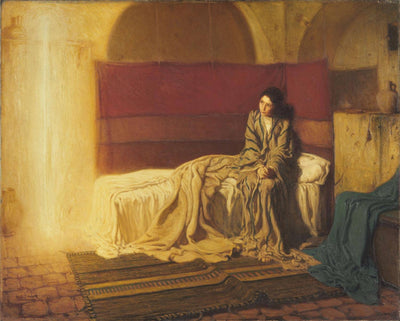
Eakins and Thomas Hovenden, "the realist painters" in the museum's words, were among the teachers of Henry Ossawa Tanner at the Pennsylvania Academy of the Fine Arts. Tanner settled in Paris and, soon after a trip to Egypt and Palestine in 1897, painted The Annunciation (1898): Mary is an adolescent in rumpled peasant clothes with no halo, and the angel Gabriel is only a shaft of light. Shown at the Paris Salon of 1898, it was bought for Philadelphia in 1899, the first work by Tanner to enter an American museum, according to the Philadelphia Museum of Art. Realism had reached one of the oldest themes in European art; for how other painters, from Giotto to Dalí, pictured the Gospels, see the most famous paintings of Jesus.
The original and our hand-painted copy

The original

Our reproduction, painted by hand in oil
Key Realist paintings at a glance
The works discussed in this guide, in the order they were painted:
| Year | Painting | Artist | Where to see it |
|---|---|---|---|
| 1848 | Laying Out of the March Dead (unfinished) | Adolph Menzel | Hamburger Kunsthalle |
| 1849 | After Dinner at Ornans |
Gustave Courbet | Palais des Beaux-Arts, Lille |
| 1849 | Plowing in the Nivernais | Rosa Bonheur | Musée d'Orsay, Paris |
| 1849–1850 | A Burial at Ornans | Gustave Courbet | Musée d'Orsay, Paris |
| 1854–1855 | The Painter's Studio | Gustave Courbet | Musée d'Orsay, Paris |
| 1857–1859 | The Angelus |
Jean-François Millet | Musée d'Orsay, Paris |
| 1866 |  Prisoners from the Front |
Winslow Homer | Metropolitan Museum of Art, New York |
| 1870–1873 | Barge Haulers on the Volga | Ilya Repin | State Russian Museum, Saint Petersburg |
| 1872–1875 | The Iron Rolling Mill | Adolph Menzel | Alte Nationalgalerie, Berlin |
| 1880–1883 | Religious Procession in Kursk Province |
Ilya Repin | Tretyakov Gallery, Moscow |
| 1898 |  The Annunciation |
Henry Ossawa Tanner | Philadelphia Museum of Art |
Living with a Realist picture
Realist canvases were made for slow looking: the meaning sits in a worn boot, a bent back or a bowed head rather than in a symbol. Start with The Angelus or After Dinner at Ornans, browse the full Realism collection, or see where these works stand among the most famous paintings in the world.
Sources
- Tate, Realism (art term)
- Smarthistory, Gustave Courbet, A Burial at Ornans
- Smarthistory, 19th-century European art syllabus (Realism unit)
- Musée d'Orsay, Gustave Courbet, Un enterrement à Ornans (collection record)
- Musée d'Orsay, A Burial at Ornans: completion of a remarkable restoration (September 2026)
- Musée d'Orsay, Gustave Courbet, L'Atelier du peintre (collection record)
- Musée d'Orsay, exhibition 1848: the Republic and Living Art
- Musée d'Orsay, Honoré Daumier, La République (collection record)
- Musée d'Orsay, Rosa Bonheur, Labourage nivernais (collection record)
- Musée d'Orsay, Jean-François Millet, L'Angélus (collection record)
- Palais des Beaux-Arts de Lille, Gustave Courbet, After Dinner in Ornans
- Palais des Beaux-Arts de Lille, L'Après-dînée à Ornans : un chef-d'œuvre révélé
- Lauren S. Weingarden, "Imaging and Imagining the French Peasant: Gustave Courbet and Rural Physiologies," Nineteenth-Century Art Worldwide 12, no. 1 (2013)
- Hamburger Kunsthalle, Adolph Menzel, Die Aufbahrung der Gefallenen der Märzrevolution in Berlin (collection record)
- Alte Nationalgalerie, Staatliche Museen zu Berlin, Adolph Menzel, The Iron Rolling Mill (Google Arts & Culture)
- Musée d'Orsay, Wilhelm Leibl (artist record)
- Britannica, Wilhelm Leibl
- State Tretyakov Gallery, Aleksey Savrasov, The Rooks Have Arrived (first Wanderers exhibition, November 1871)
- State Russian Museum, Ilya Repin, Barge Haulers on the Volga
- State Tretyakov Gallery, Ilya Repin, Religious Procession in Kursk Province (Google Arts & Culture)
- The Metropolitan Museum of Art, Winslow Homer, Prisoners from the Front
- The Metropolitan Museum of Art, Heilbrunn Timeline of Art History, Winslow Homer (1836–1910)
- Philadelphia Museum of Art, Thomas Eakins: American Realist (exhibition, 2001–2002)
- Philadelphia Museum of Art, Henry Ossawa Tanner, The Annunciation
- Philadelphia Museum of Art, The Annunciation (education resource, PDF)