4.7/5
4.7/5


Put a Raphael next to a painting by his teacher and the difference is hard to name at first. Both are calm. Both are pretty. But the Raphael holds together, as if nothing in it could be moved an inch without the whole thing going wrong. That feeling is the core of Raphael art style, and it comes from a handful of habits you can learn to spot: measured geometry, figures stacked into pyramids, faces taken from an ideal rather than a model, clear light, big architecture that organizes a crowd, and a stack of drawings behind every figure.
Raphael (Raffaello Santi) was born in Urbino in 1483, the son of the court painter Giovanni Santi, and died in Rome in 1520, at 37. He packed several careers into that time: a young Umbrian painter trained in Perugino's manner, a Florentine portraitist and painter of Madonnas in about 1500–1508, then the painter of popes, and finally the architect in charge of St Peter's. The traits below hold across all of them, and they're the reason the Raphael paintings people copy today still look fresh on a wall five centuries later.
1. Geometry you can check with a ruler

Start with the Marriage of the Virgin he signed in 1504. He was about 21. Perugino had painted the same subject, and Raphael borrowed its layout almost whole: the priest in the middle, Mary and Joseph joining hands, a domed temple on the rise behind. Then he rebuilt it.
The figures stand in a shallow curve that answers the curve of the temple's wall. The pavement lines all run to the open door, so your eye passes through the wedding and out into the sky beyond. The building is drawn so exactly that scholars have wondered whether he worked from a wooden model. Perugino had lined up the parts correctly; Raphael made the parts depend on each other. The panel came to Milan from the church of San Francesco in Città di Castello, and it's now the star of the Brera in Milan, signed with his name and the year in Roman numerals.
The same tidiness shows up at tiny scale. His little Saint Michael in the Louvre, painted around 1503–1505 on a poplar panel about 31 by 26.5 centimeters, fills a hellish landscape with monsters, yet the archangel's body makes one clean diagonal through the chaos.
2. The group built as a pyramid

When Raphael moved to Florence he met Leonardo's work, and it changed how he arranged people. Look at the Madonna of the Meadow in Vienna, painted in 1505 or 1506 for the Florentine patron Taddeo Taddei. Mary's head is the peak. Her spread cloak and the two children at her feet, Jesus and the young John the Baptist, make the base. The whole group sits inside a triangle, and the meadow behind it fades toward a far horizon.
He used that shape again and again, in the Madonna of the Goldfinch for a Florentine wedding in 1506 and in dozens of variations after. The pyramid gives a picture weight at the bottom and a quiet point at the top, which is why his Madonnas feel settled even when the babies are wriggling.
How did Leonardo change Raphael's style?
Raphael took the pyramid group from Leonardo, and the Mona Lisa pose for portraits. What he refused was the smoke. Leonardo melts his edges into shadow; Raphael keeps his contours readable. You can see both halves of that bargain in trait 4.
3. Faces from an idea, not a sitter
Raphael's women look related. Same oval face, same lowered eyes, same small mouth. That's deliberate. In a letter printed under his name in 1554 and addressed to his friend Baldassare Castiglione, he explains it: "to paint a beautiful woman I need to see many beautiful women," and since good judges and beautiful women are both scarce, "I avail myself of a certain Idea that comes to my mind."
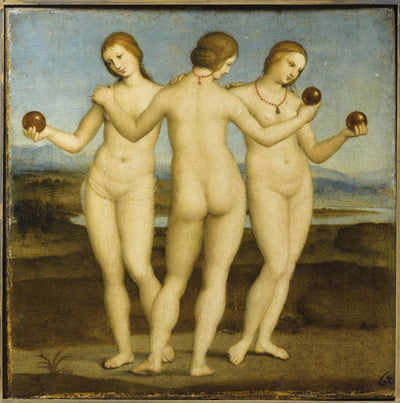
That "certain Idea" is the key to his figures. He didn't paint the girl in front of him; he painted what she should have looked like. Early on he took the idea from ancient sculpture. The Three Graces at Chantilly, a panel from his early years, is based on an antique marble group of three nude women, each holding a golden ball.
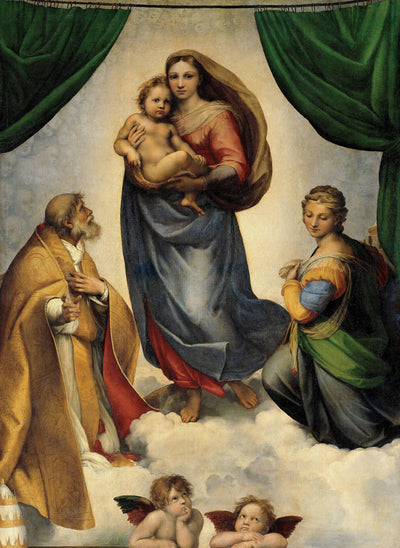
The same ideal face looks down from the Sistine Madonna in Dresden, commissioned by Pope Julius II for the monastery of San Sisto in Piacenza and painted in 1512–1513. Most people know it only from its bottom edge, where two bored little angels lean on a ledge. Around 1800 those two were copied out of the painting and began a career of their own on porcelain and jewelry.
4. Clear light instead of smoke
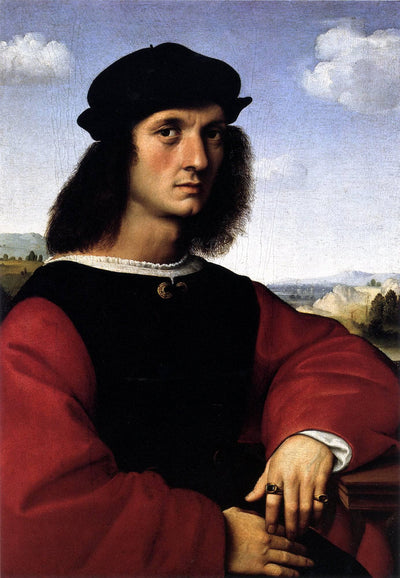
Stand in front of his portrait of the merchant Agnolo Doni and you'll recognize the pose: half length, turned three-quarters, one hand resting on the other, a landscape behind. It's the Mona Lisa's pose, so close that it suggests Raphael saw Leonardo's portrait in Florence. Doni was a rich cloth merchant who married Maddalena Strozzi on 31 January 1504, and Raphael painted the couple as a pair.
But look at the light. Where Leonardo blurs, Raphael describes: crisp sleeves, rings on the fingers, a sky with clear blue depth. The two portraits hang side by side in Florence, and the pair at the Uffizi is the easiest place to see that swap of mist for daylight. His colors stay clean because he isn't hiding the forms in shadow. Reds read as red, blues as blue.
5. Architecture that organizes a crowd
In 1508, at 25, Raphael was called to Rome to work for Julius II in the papal apartments. The first room he painted, the Stanza della Segnatura, holds the fresco that answers one of the questions people ask most about him.
What is the most famous Raphael painting in the Vatican?
For most visitors it's the School of Athens, on the wall of that first room. The setting is a vast vaulted hall inspired by Bramante's plans for the new St Peter's. Plato, pointing upward, and Aristotle stand at the vanishing point, and dozens of philosophers spread out on the steps around them. Heraclitus, leaning on a block of marble, is a portrait of Michelangelo, who was painting the Sistine Chapel nearby at the same time. Raphael put himself at the far right in a black beret.
That's trait five in action. A crowd that size would be a mess in lesser hands; here the arches and the perspective do the sorting. Every group has its own patch of floor. If you count paintings on panel rather than frescoes, the other answer is the Transfiguration, below.
6. A drawing behind every figure

Raphael planned on paper before he touched a panel. He'd sketch a composition several ways, study heads and hands separately, and then draw a full-size cartoon, which he transferred by pricking the outlines and dusting charcoal through the holes. Infrared photographs of his Saint Catherine in London show the pounced dots under the paint, along with the changes he still made while painting. The National Gallery's study of his cartoons walks through that process step by step.
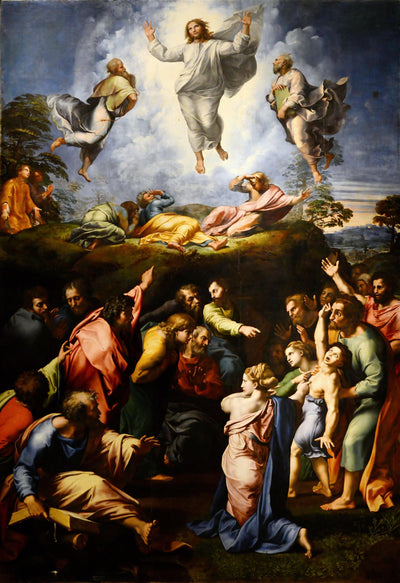
This habit explains his most dramatic picture. The Transfiguration, his last painting, was ordered by Cardinal Giulio de' Medici, the future Pope Clement VII, for the cathedral of Narbonne, and Raphael worked on it from 1516 until his death in 1520. It stacks two Gospel scenes: Christ glowing between Moses and Elijah on top, and below, the apostles meeting a possessed boy they can't heal. The lower half is full of pointing hands and shocked faces, each worked out in chalk studies first. The cardinal kept the painting in Rome instead of sending it to France, and it now hangs in the Vatican picture gallery. Giorgio Vasari, who wrote the first lives of the Renaissance painters, called it "the most famous, the most beautiful and most divine" of his works.
So the late Raphael is louder than the young one: stronger contrasts, more movement, faces that argue. The geometry is still there underneath. If you want to set him beside the other big names of the Renaissance, the hundred-odd paintings everyone knows makes a good map.
A Raphael in the living room
Because his pictures rest on drawing and clear color, they're among the kindest to copy by hand: a skilled painter can follow the contours and match the reds and blues without guessing at fog. If one of these six traits caught your eye, you'll find every Raphael the studio paints in oil gathered in one place, from the early Saint Michael to the Transfiguration, each made to order on canvas.
Sources
- Pinacoteca di Brera, The Marriage of the Virgin
- Kunsthistorisches Museum Vienna, The Madonna of the Meadow
- Gallerie degli Uffizi, The portraits of Agnolo and Maddalena Doni
- Vatican Museums, School of Athens; Vatican Museums, The Transfiguration
- Musée du Louvre, Saint Michel (INV 608)
- The National Gallery, London, Studying Raphael: drawings and cartoons
- Staatliche Kunstsammlungen Dresden, The Sistine Madonna
- The Open University, letter to Baldassare Castiglione printed by Ludovico Dolce, 1554