4.7/5


Medieval animal paintings almost never show an animal just for its looks: a lion meant Christ rising on the third day, a pelican meant his sacrifice, a dragon meant the devil, and a white deer could be a king's personal badge. Most of these creatures were never painted on canvas. They live on the parchment of illuminated books, on wooden altarpieces and in woven wool hangings, and the panels in our medieval paintings collection borrow the same symbols. The chart below starts with the animal, then gives its meaning and the work where you can find it.
This guide starts with the books that taught those meanings, follows the animals into the margins and onto coats of arms, then into the altarpieces, and ends with the unicorns of the great late hangings. Uccello's dragon, Bosch's owls and the unicorn hangings were made between about 1470 and 1505, as the Middle Ages gave way to the Renaissance.
What each medieval animal stood for
| Animal | What it stood for | Where it appears | Who keeps it |
|---|---|---|---|
| 🦁 Lion | Christ rising from the tomb on the third day | Aberdeen Bestiary | University of Aberdeen |
| 🐦 Pelican | Christ, who saved people with his own blood | Aberdeen Bestiary | University of Aberdeen |
| 🐑 Lamb | Christ, with the dove of the Holy Spirit above | The Ghent Altarpiece | Saint Bavo's Cathedral, Ghent |
| 🐉 Dragon | The devil, whose strength is in its tail | Aberdeen Bestiary | University of Aberdeen |
| 🐉 Dragon | Evil, beaten by a Christian knight |  Saint George and the Dragon |
National Gallery, London |
| 🦉 Owl | Evil, staring out at the viewer |  The Garden of Earthly Delights |
Museo del Prado, Madrid |
| 🦌 White hart | Richard II's own badge, maybe a pun on "Richart" | The Wilton Diptych | National Gallery, London |
| 🐕 Greyhound | Devotion, and maybe a knight's loyalty to his king | Hours of Simon de Varie | J. Paul Getty Museum |
| 🦁 Lion | A grateful friend, since Jerome pulled a thorn from its paw |  Saint Jerome in His Study |
Detroit Institute of Arts |
| 🦌 Stag with a crucifix | A call to become a Christian | The Vision of Saint Eustace | National Gallery, London |
| 🦄 Unicorn | The beloved, tamed | The Unicorn Rests in a Garden | The Met Cloisters, New York |
| 🦄 Unicorn and lion | The pair hold up the Le Viste family arms | The Lady and the Unicorn | Musée de Cluny, Paris |
| 🐌 Snail | Still argued over: the Resurrection, a hated group, a joke or a garden pest | Gorleston Psalter | British Library |
The rows run from Christ to evil, then to people, stories and love, and they end with the one animal nobody can explain.
A book of beasts with a lesson in each
The meanings came from the bestiary, which the British Library calls a kind of medieval encyclopedia relating to natural history: every creature in it, real or invented, was explained by its place in the Christian view of the world. Bestiaries grew popular in England from the 12th century on. Their core text goes back to the Physiologus, a Greek book that the University of Aberdeen places in Alexandria, probably in about the fourth century.

Zoom
One English copy, the Aberdeen Bestiary, was written and illuminated in England around 1200 and is now digitized page by page, with a translation, by the University of Aberdeen. Its entry on the lion lists three habits and reads each one as Christ. The lion seems to sleep with its eyes open, as Christ's divine nature stayed awake while his body lay in the tomb. Its cubs are born dead, and the lioness watches over them until the father comes on the third day and breathes into their faces: the Resurrection, told as natural history.
The pelican is stranger still. In the Aberdeen text the chicks strike their parents in the face, the parents strike back and kill them, and on the third day the mother opens her own side and lets her blood pour over the dead young, which brings them back to life. The book spells out the lesson: the pelican signifies Christ, who redeemed humanity with his own blood. Smaller birds carried meanings too; one of them has its own story in our article on what the goldfinch means in art.
Knights against snails: animals in the margins
Not every medieval animal was a sermon. In the borders of manuscripts from around 1300, mostly English, armored knights square off against snails, and the British Library has gathered eight of these duels from its own shelves, among them a late 13th-century genealogical roll, the Gorleston Psalter of 1310–1324, the Queen Mary Psalter and the Smithfield Decretals. Nobody agrees on why they are there. In 1850 the Comte de Bastard read a snail placed near the Raising of Lazarus as a sign of the Resurrection; the art historian Lilian Randall linked the snail to the Lombards, a group vilified for treachery and usury; others see class satire or a plain garden pest.
These little scenes are drawn and colored on parchment, in the margins of books meant to be held in the hands: book art rather than paintings for a wall. Our famous cat paintings list follows another animal into framed pictures, starting with Goya in the 1780s.
Badges and loyal dogs
Animals also stood for people. The Getty's Medieval Beasts exhibition points out that coats of arms often carried animals chosen for their owners' virtues. In 1455 Jean Fouquet, a French court painter, filled a page of the Hours of Simon de Varie with a woman and a greyhound holding up a coat of arms. The greyhound meant devotion, and Simon, a knight and treasury official, may have picked it to show his loyalty to the French king. Fouquet painted the dog with a realism the Getty singles out.
The best-known animal badge of the period belongs to Richard II of England. The Wilton Diptych, a small folding altarpiece of about 1395–9 in egg tempera on oak, shows the king kneeling before the Virgin and Child. His emblem, a white hart, appears twice: chained and crowned on the outside, and pinned as a badge on the angels around Mary. The National Gallery thinks Richard probably inherited the hart from his mother's badge and that it may pun on "Richart", the French form of his name. Beside him, John the Baptist carries a small white lamb.
The Lamb at the center of Ghent

Zoom
In Ghent a whole altarpiece is built around one animal. Across the lower register of the opened Ghent Altarpiece, finished in 1432 for the church that is now Saint Bavo's Cathedral, warriors, judges, apostles, prophets, martyrs, hermits and pilgrims gather in a paradise landscape to worship the Lamb of God, with the dove of the Holy Spirit above. Our studio painters copy the Adoration of the Lamb panel on its own.
The Lamb itself looks different since the latest restoration. Restorers working at the MSK Ghent found that close to 70% of the altarpiece's surface had been overpainted, most likely during a restoration around 1550, and removing that layer brought back the original Lamb, whose large, staring eyes face the viewer from an almost human face. Britannica notes that the altarpiece has been called "the first major oil painting"; our article on whether Jan van Eyck invented oil painting explains what he did and did not invent, and our list of famous Gothic paintings sets the altarpiece among the medieval panels around it.
Saint Jerome's lion

Zoom
A lion in a saint's study tells a story rather than a riddle. In Saint Jerome in His Study, a tiny panel of 20.6 × 13.3 cm (8.1 × 5.2 in) that the Detroit Institute of Arts gives to Jan van Eyck and dates to about 1435, the lion sits at Jerome's feet because he once pulled a thorn from its paw, and the animal stayed with him out of gratitude. The museum reads other things in the room as symbols as well: the hourglass for the passing of time and death, and a pomegranate on top of a jar labeled "TYRIRICA" for Christ's resurrection.
The panel is painted in oil on linen paper laid on oak, and Detroit bought it in 1925. A date, possibly 1442, is inscribed on the wall above the saint, which would fall after Jan's death in 1441, and some catalogues list the panel as the work of Jan van Eyck and his workshop.
A stag with a crucifix: Pisanello's hunt

Zoom
Pisanello's The Vision of Saint Eustace in the National Gallery is the nearest thing in this story to a painting about animals. A huntsman in a blue hat, identified as Saint Eustace, a Roman soldier, stops his horse as a stag appears with a crucifix between its antlers, the vision that converts him. Around it the forest is full of dogs, birds, a hare and a bear, painted by an artist the gallery describes as known for his animal studies; even the horse's shoes turn up at the ends for grip.
Its small size, 54.8 × 65.5 cm (21.6 × 25.8 in), suggests a private collector. It is painted in egg tempera on wood, and the blank scroll at the front has never been explained. For horses painted as the subject of the picture, centuries later, see our list of the most famous horse paintings.
Dragons: the devil with a tail
Zoom
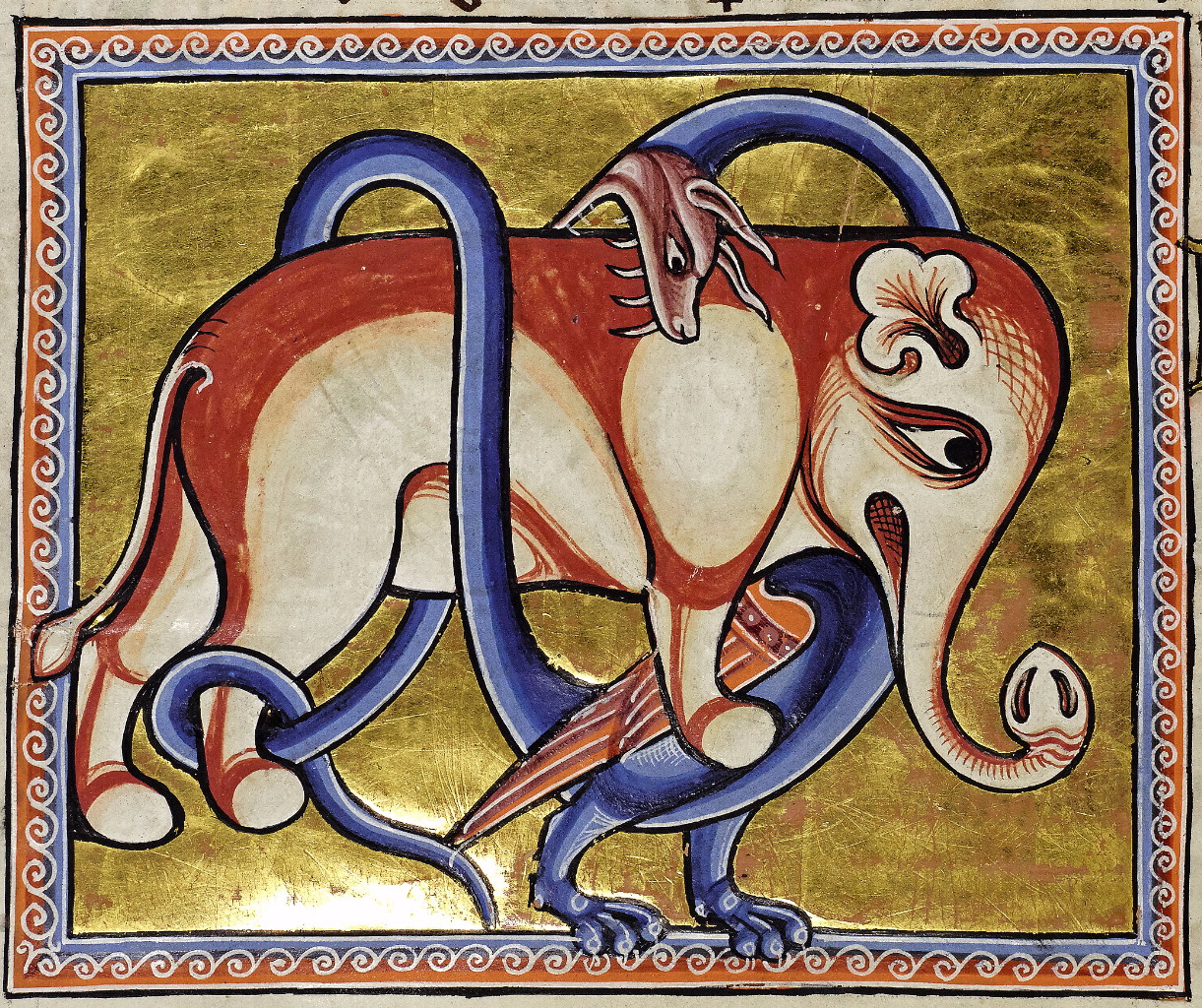
In the bestiary the dragon is the largest of all serpents, and the Aberdeen text is exact about its weapon: its strength lies in its tail, not its teeth. It waits on the paths elephants use, knots its tail around their legs and suffocates them, which is what the illuminator painted. Then comes the lesson: "The Devil is like the dragon; he is the most monstrous serpent of all." The Getty adds the other half of the medieval view, that the dragon was also seen as the most powerful of God's creatures.

Zoom
Hand-painted oil reproductionSee sizes ›
By the time Paolo Uccello painted Saint George and the Dragon, about 1470, the dragon had a famous story of its own. In the Golden Legend, George is a Christian knight from Cappadocia; the dragon has eaten all the sheep and is being fed children chosen by lot; after George strikes it, he tells the princess to tie her belt around its neck and lead it to the city. Uccello puts both moments into one scene.
The National Gallery points out how the dragon's oddly triangular body echoes the mouth of its cave, and how a spiraling cloud at the top right balances the curve of the cave. The picture is oil on canvas, 55.6 × 74.2 cm (21.9 × 29.2 in).
Unicorns woven in wool

Zoom
The most famous medieval unicorns are not painted at all: they are woven. The Met Cloisters in New York keeps the seven hangings known as the Unicorn Tapestries, made in fine wool and silk with silver and gilded threads in 1495–1505, designed in France and woven in the Southern Netherlands. In The Unicorn Rests in a Garden, the Met reads the unicorn as the beloved tamed. It is chained to a tree inside a fence low enough to jump, so its captivity looks willing, and the ripe pomegranates above it were a medieval symbol of fertility and marriage. Even the small frog among the violets was cited by medieval writers for its noisy mating.
In Paris, the Musée de Cluny keeps the other great set, The Lady and the Unicorn: six hangings woven around 1500 that show the five senses, plus a sixth scene inscribed "À mon seul désir" ("To my only desire") whose meaning is still debated. In every scene a unicorn and a lion carry the arms of the Le Viste family, while a peaceable crowd of a monkey, dogs, rabbits and a heron fills the flowered red ground. The museum acquired the set in 1882.
Bosch's owls at the end of the Middle Ages

Zoom
Hand-painted oil reproductionSee sizes ›
Hieronymus Bosch's The Garden of Earthly Delights, painted in 1490–1500 and in the Prado since 1933, gathers the old animal symbols on a grand scale. In the central panel, the Prado notes, real and imaginary animals are far larger than their natural scale, and Bosch singles out two kinds of owl, which evoke evil and stare straight out at the viewer from the edges of the panel.
An owl already sits inside the fountain in the Paradise panel on the left. In Hell, on the right, a bird-headed creature that the Prado identifies as a kind of owl sits on a child's stool and devours the greedy. The triptych's wider story is told in our guide to famous religious paintings, and it is one of the most famous paintings in the world.
A medieval beast for your own wall
Medieval animals were made to be read, so a single beast on a wall works best when you know its story. Our animal paintings collection gathers creatures from every century, and two of the pictures above carry their meaning on their own: van Eyck's Saint Jerome with his lion and Uccello's George and the dragon.
Sources
- Medieval Beasts, exhibition page, J. Paul Getty Museum
- Jean Fouquet, Hours of Simon de Varie (Ms. 7), J. Paul Getty Museum
- What is a bestiary?, British Library Medieval Manuscripts blog
- Knight v snail, British Library Medieval Manuscripts blog
- The Aberdeen Bestiary: about the manuscript, University of Aberdeen
- What is a bestiary?, University of Aberdeen
- Aberdeen Bestiary, folio 5r: Adam names the animals
- Aberdeen Bestiary, folio 7v: the lion
- Aberdeen Bestiary, folios 34v and 35r: the pelican
- Aberdeen Bestiary, folios 65v and 66r: the dragon
- The Wilton Diptych, National Gallery, London
- Ghent Altarpiece, Encyclopaedia Britannica
- Restoration of the Ghent Altarpiece, MSK Ghent
- Saint Jerome in His Study, Detroit Institute of Arts
- Pisanello, The Vision of Saint Eustace, National Gallery, London
- Paolo Uccello, Saint George and the Dragon, National Gallery, London
- The Unicorn Rests in a Garden (from the Unicorn Tapestries), The Met
- The Lady and the Unicorn, Musée de Cluny
- The Garden of Earthly Delights Triptych, Museo del Prado