4.9/5
4.9/5


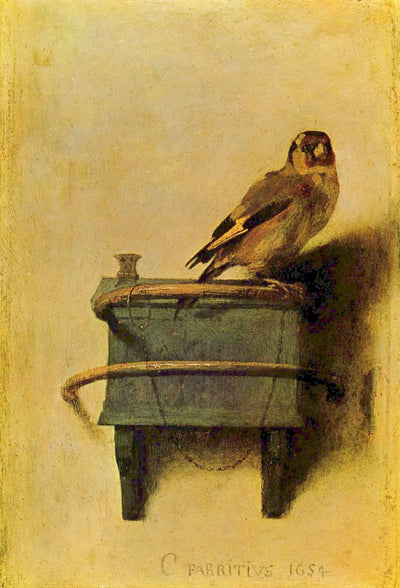
Look closely at enough Madonnas and you start seeing the same small bird: red face, black cap, a yellow bar across the wing, usually clutched in a child's fist. Goldfinch symbolism in art is mostly about death and rescue. For Renaissance painters the bird pointed to the Passion, to the soul and, in plague years, to protection. Then, in 1654, a Dutch painter chained one to a feeding box on a plain wall and let it be a pet, which is why so many people now know the bird from Fabritius's tiny panel of a chained finch before they ever meet it in a Raphael.
That shift, from sign to living bird, is the whole story. It also explains why the Fabritius still feels modern next to the altarpieces, and why it's the picture people ask for when they look through the handful of Fabritius paintings that survive.
Why a goldfinch ends up in Christ's hand
Start with a Sienese altarpiece from the 1360s. In Luca di Tommè's Madonna and Child with four angels, the Christ Child stands on his mother's lap, staring straight out at us, while a goldfinch in his left hand seems to be struggling to get away. Around his neck hang a small crucifix and a branch of red coral. Every one of those details was meant to be read.
The bird could carry several meanings at once, and painters liked it for exactly that reason.
The soul. Since ancient Egypt a small bird had stood for the human soul. A finch held in God's hand is a soul in safe keeping.
The Resurrection. A legend that never made it into the Bible told how the boy Jesus was given clay birds by his friends and brought them to life. Medieval theologians read that as a preview of his own return from the dead.
A pet. In the fourteenth century young children often kept tame birds. A holy infant gripping a finch looked like any child a parent knew, which made God human in a way a gold background couldn't.
The thorn and the red face
The meaning that stuck hardest comes from another legend. As Christ carried the cross to Calvary, a small bird flew down and pulled a thorn from his crown. His blood splashed onto it, and that's why the goldfinch has a red face. (Some versions give the job to a robin, which also has red on it.) Put that bird in a baby's hand and you've painted the Crucifixion without showing a cross. The mother knows; the child doesn't yet.
Why is the goldfinch linked to the plague?
Here the finch borrows from an older, stranger creature. Since classical times people believed in the charadrius, a bird that could draw the illness out of a sick man simply by looking him in the eye. A thirteenth-century English bestiary shows one perched on a sickbed, staring down the patient. Artists sometimes drew the charadrius as a goldfinch, so the finch picked up the healing job too.
For Luca di Tommè that wasn't abstract. The Black Death reached Italy in 1348 and cut Siena's population from 42,000 to 15,000; it came back in 1363 and 1374, and he lost his first wife in one of the outbreaks. A Christ Child holding a plague charm and wearing coral against the evil eye was a picture of protection for people who badly wanted some.
Raphael's fragile bird

By the time Raphael painted the Madonna del Cardellino, the symbol was familiar enough to be handled gently. He made it as a wedding picture: Lorenzo Nasi, a Florentine wool merchant, married Sandra di Matteo Canigiani on 23 February 1506, and the panel was ready by then. Mary holds a small book, the young John the Baptist offers the goldfinch, and the Christ Child reaches to stroke it.
The Uffizi describes the bird as "innocently fragile", and that's the right word. Raphael keeps the old meaning (the book in Mary's hand and the finch both foreshadow the sacrifice) but lets it sit inside a warm, ordinary moment between two boys. The pyramid of figures owes a lot to Leonardo. The feeling is Raphael's own.
The painting nearly didn't survive. In 1547 a landslide brought down the Nasi house, and the panel broke into seventeen pieces. It was patched together in the sixteenth century, reached the Uffizi in 1704, and went through a ten-year restoration in Florence that ended in 2008.
Barocci, a cat and a warning

About seventy years later Federico Barocci pushed the idea further, and he made it funny before he made it sad. In his Madonna of the Cat, probably from about 1575, the holy family sits in a palace bedroom. The infant Christ turns from nursing to watch his cousin John tease the household cat with a goldfinch held just out of reach. Joseph leans in, smiling. Mary points at the cat, which is on its haunches, ready to pounce.
It reads as a domestic joke until you remember what the bird stands for. The cat is about to go for the Passion. A caption on Cornelis Cort's 1577 engraving of the picture spells it out: this is the moment the Christ Child grasps humanity's expulsion from paradise and, with it, his own future as redeemer. Barocci worked hard to make the moment look casual; around 35 preparatory drawings for this one canvas survive.
Is The Goldfinch a real painting?

Yes. If you know it from Donna Tartt's novel, the painting behind the title is real: a small oil on panel, 33.5 by 22.8 cm, signed and dated "C FABRITIVS 1654" at the bottom. It has been in the royal picture gallery in The Hague since it was bought in 1896. Tartt fell for it on a trip to the Netherlands: "It's just its own little marvel."
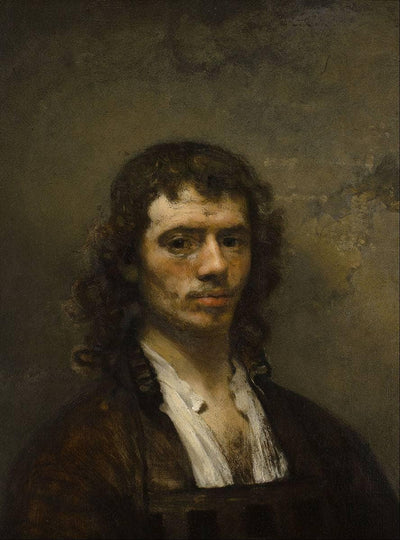
Carel Fabritius (1622–1654) trained with Rembrandt in Amsterdam from about 1641–1643, and painted his later, lighter pictures in Delft. He died there at 32, the same year he painted the bird, when a gunpowder store exploded, and only about twelve of his paintings survive, among them a self-portrait of the painter.
So what does Fabritius's goldfinch mean?
My honest answer: much less than Raphael's, and that's the point. Nothing in the panel asks you to think of thorns or plague. What you see is a real household pet of the Dutch Republic. Goldfinches were kept because they could learn tricks, and the Dutch nickname for the bird is puttertje, the "water-drawer," because a trained one would haul up a thimble-sized bucket of water on a chain. The feeding box, the perch and the chain on its leg are the gear such a bird lived with.
Some viewers read the chain as captivity or a soul held on earth. That's a modern reading, and you're free to take it. But Fabritius cared about something else: fooling the eye. The panel was cut from a larger board, and it may once have been part of a real cage, a small door over a wall niche, or a cover protecting another picture. The bird is painted as if seen from below, so it was meant to be looked up at. His fellow Rembrandt pupil Samuel van Hoogstraten recommended "depicting something flat on a flat surface" for the best illusion, and a bird against a whitewashed wall is about as flat as a subject gets.
Look at the wing. Fabritius laid two strokes of yellow over the black and scratched into the wet paint with the handle of his brush to show the dark underneath, a trick he picked up from Rembrandt. When the painting was CT-scanned in 2003, the first painting ever examined that way, the scans also showed the bottom perch was added later, over the white background, to push the illusion further.
How to read the bird when you meet it
A quick test that works in most museums. If a goldfinch sits in the hands of the Christ Child or the young Baptist, read it as the Passion first, and in fourteenth-century Italian pictures consider the plague too. If it's alone, alive and doing what pet birds do, as in Delft in 1654, start with the bird itself and let any symbolism be your own. Once you've spotted it, you'll find it in dozens of Madonnas, and it's a good excuse to go back through the paintings everyone recognizes on sight with fresh eyes.
A finch for your own wall
Fabritius's bird was made to sit on a plain wall and catch someone off guard, and it still does that at home. Art & See paints a hand-painted copy of The Goldfinch in oil, and you can browse everything the studio paints after Carel Fabritius if you want the self-portrait beside it.
Sources
- Fitzwilliam Museum, The Goldfinch (signs and symbols)
- Fitzwilliam Museum, Luca di Tommè altarpiece
- Uffizi Galleries, Madonna of the Goldfinch
- Opificio delle Pietre Dure, restoration record
- National Gallery, The Madonna of the Cat
- Mauritshuis, The Goldfinch catalogue entry
- Mauritshuis, The Goldfinch art story