4.7/5


Famous war paintings run from Paolo Uccello's Florentine cavalry charge of the late 1430s to Picasso's Guernica of 1937, and the nine below follow that span in order. Together they show how the picture of battle changed, from pageant and courtly surrender to firing squads, skulls and a line of blinded soldiers. Several are available hand-painted in oil from our war paintings collection. In the table, the nine are ranked by the count of languages with a Wikipedia article on each. It also shows how long after the fighting each was painted, and whether the painter saw it.
One question helps with every picture here: who paid for it? A Florentine patron, a duke, a king, a court painter and three governments commissioned seven of the nine, and the table names each patron the museums record. The later the picture, the more often the painter showed what the patron had not asked for.
Top 9 war paintings, and how close each painter got to the fight
| # | War painting | Years after the event | Was the painter there? | Read in how many languages |
|---|---|---|---|---|
| 1 | Guernica | Less than a year, since the raid and the painting both date from 1937 | No. Picasso knew the raid from photos in the press. | 67 |
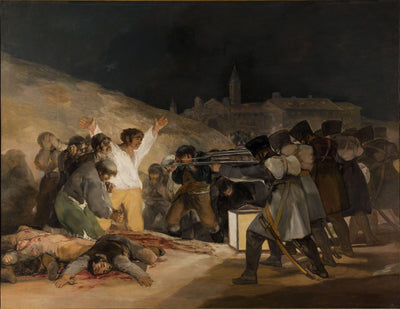
| 2 |  The Third of May 1808 |
6 years (1808 to 1814) | Our sources don't say. | 44 |
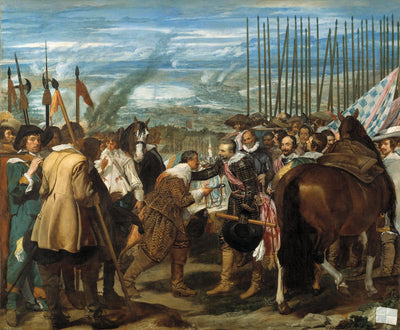
| 3 |  The Surrender of Breda |
About 10 years (1625 to about 1635) | Our sources don't say. | 37 |
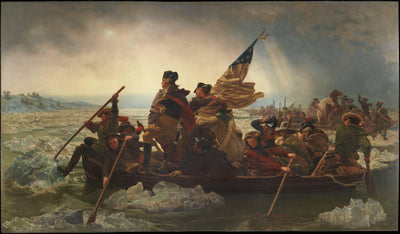
| 4 |  Washington Crossing the Delaware |
75 years (1776 to 1851) | Our sources don't say. | 23 |
| 5 |  The Battle of Alexander at Issus |
About 1,860 years (333 BC to 1529) | No. The battle took place in ancient times. | 21 |
| 6 | The Battle of San Romano | About 6 to 8 years (1432 to about 1438–1440) | Our sources don't say. | 18 |
| 7 | Gassed | About 1 year (seen in August 1918, finished in 1919) | Yes. Sargent saw gassed men at a dressing station in France. | 14 |
| 8 |  The Consequences of War |
No single battle; Rubens wrote that Europe had suffered for many years | There is no battle in it to see. | 10 |
| 9 | The Apotheosis of War | No date given | Yes. Vereshchagin traveled with the Russian army on its campaign. | No data |
Language counts come from Wikipedia, October 2026. We could not find a Wikipedia article just for The Apotheosis of War.
Sargent and Vereshchagin are the two painters here known to have traveled with an army, and neither of their pictures shows a victory.
Painted for courts: 1438 to 1638
01The Battle of San Romano, Paolo Uccello (about 1438–1440)

Zoom
On June 1, 1432, Florentine troops won at San Romano, one battle in Florence's war against Lucca, Milan and Siena over access to the port of Pisa. Uccello painted three panels of the fight, and the National Gallery in London, which owns one, dates its panel to about 1438–1440 and ties the set to Leonardo Bartolini Salimbeni, who had them made around his second marriage in 1438. They stayed in the Salimbeni town house in Florence until Lorenzo de' Medici had them forcibly removed in 1484.
The London panel measures 182 × 320 cm (71.7 × 126.0 in) and is painted in egg tempera with some oil on poplar, the medium of the Italian altarpieces in our guide to famous Gothic paintings. What was new was the geometry. Broken lances lie on the ground in a grid that runs into depth, yet a hedge stops the lines before they can meet, and the gallery points out that the fallen knight is foreshortened back to front. The battle reads like a tournament staged to show off perspective, not a slaughter.
The other two panels are in Florence and Paris. The Uffizi's shows a knight, possibly the Sienese leader Bernardino della Carda, being unhorsed; the Louvre's shows Michelotto Attendolo giving the order to attack. The National Gallery says nobody knows in which order the three were meant to be seen.
02The Battle of Alexander at Issus, Albrecht Altdorfer (1529)

Zoom
Duke William IV of Bavaria commissioned Altdorfer's battle for a cycle of history paintings in his Munich Residence. It shows Alexander the Great defeating the Persian king Darius III at Issus in 333 BC, a victory that, in the Alte Pinakothek's words, helped strengthen Alexander's position as ruler over the eastern Mediterranean.
The panel is small for the crowd it holds, 158.4 × 120.3 cm (62.4 × 47.4 in) on limewood, and the land curves away below the sky like a map; the museum notes that Altdorfer drew on the cartographic material of his time. A red cord hanging from the inscription panel leads the eye to the two leaders, and the Latin text, later altered, gives details of the battle and its casualties. The Alte Pinakothek lists the picture in Room I on its upper floor.
03The Surrender of Breda, Diego Velázquez (about 1635)

Zoom
When Philip IV filled the Hall of Realms in his Buen Retiro palace with the military triumphs of his reign, the capture of Breda in 1625 went to Velázquez, then the most prestigious painter at court. The Prado dates The Surrender of Breda to about 1635 and notes that he was competing with the court's best artists on the same walls. The canvas measures 307.3 × 371.5 cm (121.0 × 146.3 in).
The war is still there, in the background. The Prado reads the smoke behind the armies as a sign of "destruction, war and death," while in front the Genoese general Ambrosio Spínola receives the Dutch governor Justinus van Nassau with a gesture that "seems more like the announcement of impending peace than that of war's end." The handover itself, Velázquez's signature and the play that told the same scene are covered in our list of famous Spanish paintings.
04The Consequences of War, Peter Paul Rubens (1637–1638)

Zoom
Hand-painted oil reproductionSee sizes ›
There is no battle in this one. The Medici court painter Justus Suttermans asked his friend Rubens for the picture in 1637, and Rubens sent The Consequences of War to Florence with a letter dated March 12, 1638, that explains each figure. Mars has left the temple of Janus open, its doors kept shut in peacetime by Roman custom. Venus and her cupids try to hold him back, the Fury Alekto drags him forward with a torch, and a book and a drawing lie under his boots to show the arts and letters trampled.
“That grief-stricken woman clothed in black, with torn veil, robbed of all her jewels and other ornaments, is the unfortunate Europe who, for so many years now, has suffered plunder, outrage, and misery”
The Uffizi reads the painting as an image of a Europe torn apart by the Thirty Years' War that also speaks of war in any period, without showing a single destroyed city or fighting army. It was sold to Grand Prince Ferdinando de' Medici in 1691 and belongs to the Palatine Gallery of the Pitti Palace.
The nineteenth century: 1814 to 1871
05The Third of May 1808, Francisco de Goya (1814)

Zoom
Hand-painted oil reproductionSee sizes ›
The Regency Council, which governed Spain in the absence of Ferdinand VII, commissioned the work in February 1814, and Goya painted two scenes of the Madrid rising of 1808: The Third of May 1808 and its companion, The 2nd of May 1808, both now in the Prado. Napoleon's own painters had made war look like glory, in pictures such as Jacques-Louis David's Napoleon Crossing the Alps (1800–1801) and Gros's Bonaparte Visiting the Plague Victims of Jaffa (1804), both in our list of famous Napoleon paintings.
Goya shows the reprisal, not the fight. The Prado describes the firing squad as battle grenadiers and guard sailors in campaign uniform and gray capes, their faces turned away from us, while the prisoners come up from the city in a line that seems to have no end and the dead pile up in front. Goya also recorded the war in etchings, the subject of our guide to Goya's Disasters of War, and the painting's place in his career is traced in the ten most famous Goya paintings.
06Washington Crossing the Delaware, Emanuel Leutze (1851)

Zoom
Hand-painted oil reproductionSee sizes ›
On Christmas night 1776, Smithsonian Magazine recounts, Washington led 2,400 soldiers across the half-frozen Delaware to surprise the Hessian forces at Trenton. Leutze turned the crossing into a monument: the Met's Washington Crossing the Delaware measures 378.5 × 647.7 cm (149.0 × 255.0 in), although the troops actually crossed a stretch of river less than 300 yards wide.
The Met's canvas is not the first. Leutze finished an earlier, smaller version in 1849, and it hung in the Kunsthalle Bremen until an air raid destroyed it in the Second World War. After the Met's picture he also painted a replica about 3 feet tall and 6 feet wide, leaving out the watch fob Washington carries in the large one. The Met canvas's owners, and the liberties Leutze took with the flag and the boats, are in our guide to famous paintings at the Met.
07The Apotheosis of War, Vasily Vereshchagin (1871)

Zoom
Vereshchagin painted this after his attachment to the Imperial Russian Army as it conquered lands in what is now southeastern Uzbekistan, as ArtReview puts it. There is no battle, no flag and no army: only bleached skulls under a hard sky, birds, and the shell of a city. The canvas, 127 × 197 cm (50.0 × 77.6 in), belongs to the Tretyakov Gallery in Moscow.
The title does half the work and the frame does the rest, with an inscription ArtReview says should be read ironically: "Dedicated to all the great conquerors: past, present and future." Britannica notes that the pacifist and humanitarian movement of the painter's own time made use of this pyramid of skulls.
The twentieth century: 1919 and 1937
08Gassed, John Singer Sargent (1919)

Zoom
The British government commissioned Sargent to paint the central picture for a planned Hall of Remembrance, and in July 1918 he traveled to France with the painter Henry Tonks. He was given the theme of Anglo-American cooperation, found nothing in it to paint, and chose instead what he saw in August 1918 at a dressing station on the Doullens road after a mustard gas attack. In a letter of 1920, Tonks remembered the gassed men being brought in "in parties of about six just as Sargent has depicted them, by an orderly." Sargent's own doubt about the brief survives too: "how can one do an epic without masses of men?"
The canvas is 231 × 611.1 cm (90.9 × 240.6 in), signed "John S. Sargent Aug 1918" and finished in 1919, and it belongs to the Imperial War Museums in London. More gassed men sit and lie on the grass around the line, and behind them, in the evening sun, soldiers play football; the museum reads the game as a sign of how routine such attacks had become. The paint sits thinly for a canvas this size, and the museum's own label calls it "lightly painted with great skill."
09Guernica, Pablo Picasso (1937)
If one picture has to answer the question of the most famous war painting, it is this one. Britannica notes that Guernica drew mixed reviews in the Spanish Republic's pavilion at the 1937 world's fair in Paris and then "became an icon as it traveled the world" in the years that followed. The bombing behind it came on April 26, 1937, when German aircraft attacked the Basque town for Franco's Nationalists; Britannica says the three-hour raid nearly wiped out the town and killed or wounded a third of its people.
Picasso knew the raid from photographs in the press, among them the French newspaper L'Humanité, yet the Museo Reina Sofía points out that neither the studies nor the finished canvas alludes to a specific event: it is a general plea against the barbarity and terror of war. The museum links its grisaille, a palette of grays, to film and press photography, and names Rubens, Delacroix, David and Goya among the painters it borrows from, which ties its bull, wounded horse and mother with a dead child to numbers 4 and 5 above. The canvas measures 349.3 × 776.6 cm (137.5 × 305.7 in), hangs in the Reina Sofía in Madrid and stands among the most famous paintings in the world.
Who are some famous war painters?
Some painters made war their life's subject. Britannica describes Vereshchagin as a Russian painter "noted for his war scenes"; he was wounded in the Russo-Turkish War and died in 1904 aboard the flagship of Admiral Stepan Makarov during the Russo-Japanese War. Goya and Sargent belong on the same list, and so do these four:
- Paul Nash, commissioned by Britain's Ministry of Information in April 1918. His painting The Menin Road (1919, Imperial War Museums) shows rain-filled shell holes and shattered trees near Gheluvelt in Belgium, which he called "perhaps the most dreaded and disastrous locality of any area in any of the theatres of War."
- Otto Dix, who drew on his own experience of the First World War in The War (Der Krieg), painted between 1929 and 1932 in four panels arranged like an altarpiece, from troops leaving at daybreak to dead soldiers in a dugout. It belongs to the Galerie Neue Meister in Dresden.
- Édouard Manet, whose The Battle of the USS Kearsarge and the CSS Alabama (1864, Philadelphia Museum of Art) imagines an American Civil War sea fight off Cherbourg on June 19, 1864; the museum notes it was already in the window of Alfred Cadart's print shop in Paris that July.
- Salvador Dalí, who painted Soft Construction with Boiled Beans (Premonition of Civil War) in Paris in early 1936, on the eve of the Spanish Civil War, according to the Philadelphia Museum of Art, which owns it.
Living with a battle picture
At home, a war painting works best when it carries a story you can tell a guest: the keys of Breda, the white shirt in Goya's lantern light, Altdorfer's sky over two armies. Our studio artists paint The Surrender of Breda, The Third of May 1808 and the other works linked above by hand in oil, and you can browse them together in our war paintings collection.
Sources
- National Gallery, London: Paolo Uccello, The Battle of San Romano
- Alte Pinakothek, Munich: Albrecht Altdorfer, The Battle of Alexander at Issus (collection record)
- Museo del Prado: Diego Velázquez, The Surrender of Breda
- Uffizi Galleries: The Consequences of War by Pieter Paul Rubens
- Smarthistory: Peter Paul Rubens, The Consequences of War (with Rubens's letter to Sustermans)
- Museo del Prado: Francisco de Goya, The 3rd of May 1808 in Madrid, or "The Executions"
- The Met: Emanuel Leutze, Washington Crossing the Delaware (collection record)
- Smithsonian Magazine: 'Washington Crossing the Delaware' Sails Toward the Auction Block (April 28, 2022)
- State Tretyakov Gallery on Google Arts & Culture: Vasily Vereshchagin, The Apotheosis of War
- ArtReview: The Haunting Return of Vasily Vereshchagin's The Apotheosis of War (Oliver Basciano, 2022)
- Britannica: Vasily Vasilyevich Vereshchagin
- Imperial War Museums: John Singer Sargent, Gassed (Art.IWM ART 1460)
- Imperial War Museums: Paul Nash, The Menin Road (Art.IWM ART 2242)
- Museo Reina Sofía: Pablo Picasso, Guernica (collection record)
- Britannica: Guernica, painting by Picasso
- Staatliche Kunstsammlungen Dresden on Google Arts & Culture: Otto Dix, The War
- Philadelphia Museum of Art: Édouard Manet, The Battle of the USS "Kearsarge" and the CSS "Alabama"
- Philadelphia Museum of Art: Salvador Dalí, Soft Construction with Boiled Beans (Premonition of Civil War)