4.9/5
4.9/5


Goya's Disasters of War (Los desastres de la guerra) is a series of 82 etchings Francisco Goya made in 1810–1820 about the Peninsular War and its aftermath. He never published them. The Royal Academy of San Fernando in Madrid issued the first edition in 1863, 35 years after his death, with 80 of the plates.
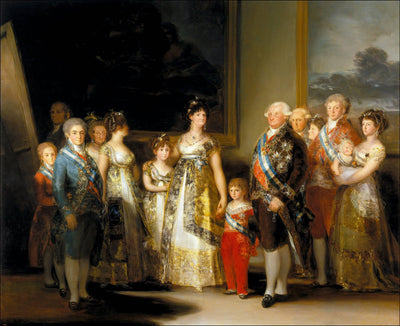
If you know the Goya paintings from his court years, like his portrait of the whole royal family, the prints can look like another man's work. They're small and colorless, and many are hard to look at. Goya made them in private while he kept his post as first court painter, and his own title for them was blunter than the one they carry now: Fatales consequencias de la sangrienta guerra en España con Buonaparte, Y otros caprichos enfáticos (Fatal consequences of Spain's bloody war with Bonaparte, and other emphatic caprices).
Why Goya's Disasters of War stayed hidden for 35 years
The prints spare nobody. French soldiers rape and loot, yet in plate 3 a Spanish civilian raises an axe over a French soldier, and the last plates turn on the restored monarchy and the clergy. That double criticism, of France and of the restored Bourbons, is what kept the series unpublished; the 2014 show at the Frist in Nashville was built around that story.
Ferdinand VII came back in 1814 and threw out the liberal Constitution of 1812. Goya's 80 Caprichos had gone on sale in 1799 and been pulled almost at once after threats from the Inquisition. Most art historians think he was waiting until the plates could appear uncensored.
He died in Bordeaux on 16 April 1828 with the plates unpublished. In November 1862 the Academy paid close to 28,000 reales for 80 of them, along with 18 plates of his Disparates. The first edition of 500 impressions came out in 1863.
So the 35 years run from Goya's death to that edition. Counted from 1810, the images waited 53 years. Plates 81 and 82 took longer: Paul Lefort donated them to the Academy in April 1870, and they weren't published until 1957.
The 82 plates fall into three groups
Few plates are dated. Scholars order them by the events shown and the batches of copper used, and the groups broadly follow the order Goya made them in.
| Group | Plates | When | What you see |
|---|---|---|---|
| War | 1–47 | Mostly during the war | Executions, rape, mutilation, civilians fighting back |
| Famine in Madrid | 48–64 | Probably done by early 1814 | The starving and the dead |
| Caprichos enfáticos | 65–82 | 1813–1820 | Allegories against the restored monarchy and the clergy |
War, plates 1–47

The series opens on a man kneeling in the dark with his arms flung wide, Tristes presentimientos de lo que ha de acontecer (Sad forebodings of what must come to pass). Goya made it after the war, so the foreboding comes with hindsight. Plates to look for:
- Que valor! (What courage!), plate 7. Agustina de Aragón fires a cannon at the first siege of Zaragoza, the series' only named hero. Goya didn't see it, but in October 1808 General Palafox summoned artists, Goya among them, to examine the ruined city.
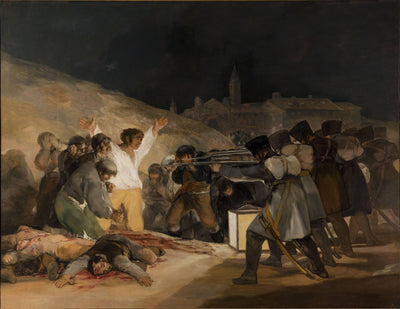
- Y no hay remedio (And it cannot be helped), plate 15. A blindfolded prisoner tied to a stake faces a firing squad. It anticipates the execution scene he painted in 1814.
- No se puede mirar (One can't look), plate 26. The soldiers stay out of frame; all you see is the bayonets poking in from the right edge.
- Yo lo vi (I saw it), plate 44. A woman reaches for a fallen child as the crowd flees. The caption is Goya's claim to have been there.
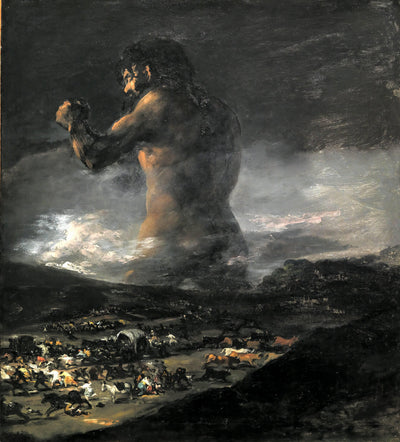
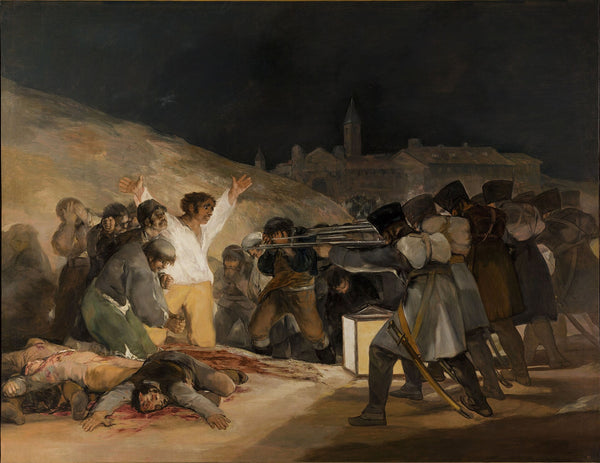
That 1814 canvas, The Third of May 1808, is the better known of his two paintings of the Madrid uprising. He asked the provisional government in February 1814 for the chance to record the revolt against the French, and the result, 268 × 347 cm, hangs in the Prado. The prints came first and they're freer; in the painting he kept closer to convention. The same war sits behind the giant striding over a fleeing crowd, a canvas the Prado gave to his friend Asensio Juliá in 2008 and handed back to Goya in 2021.
Famine, plates 48–64

Madrid went hungry from August 1811 until Wellington's armies liberated it in August 1812, and starvation killed 20,000 people in the city that year. Goya assigns no blame, and no building here can be placed on a map. Men carry the bodies of women; children cry beside dead parents.
Plate 50, Madre infeliz! (Unhappy mother!), is the one that stays with you. Men carry off a dead woman while her small daughter stands apart, crying into her hands. The critic Robert Hughes saw in the space between them "a darkness that seems to be the very essence of loss and orphanhood."
Caprichos enfáticos, plates 65–82
Goya's title calls the last group emphatic caprices. Made in 1813–1820, across Ferdinand VII's fall and return, these allegories go after the Inquisition and the judicial torture of the day. The war is over; these are the disasters of peace.
- Esto es lo peor! (This is the worst!), plate 74. A wolf, helped by a friar, writes "Miserable humanity, the fault is thine" and signs with the name of the fable writer Giovanni Battista Casti.
- Que se rompe la cuerda! (The rope is breaking), plate 77. The cleric on the tightrope was a pope in the preparatory drawing, quietly demoted to a cardinal or bishop for the 1863 printing.
- Murió la Verdad (Truth has died) and Si resucitará? (Will she live again?), plates 79 and 80. A wreathed woman, read as Truth or as the Constitution of 1812, lies dead, then glows before a mob of monks and monsters.
- Esto es lo verdadero (This is the true way), plate 82. She returns beside a peasant, apparently as peace and plenty, in a plate the 1863 buyers never saw.
Scarce copper, recycled plates
Goya worked from drawings, mostly in red chalk, and many survive. On the copper, etching gave him the lines and aquatint the tones, with drypoint and burin on top. The plates run from 142 × 168 mm up to 163 × 260 mm, none bigger than a sheet of letter paper, and there's no color anywhere.
Copper ran short during the war, so Goya cut two older etched plates in half to get four for the series. The scars are still there in Madrid: the back of the copper for plate 15 carries half an etching of a crag with buildings and trees (the other half is on plate 13), and plate 30 shows part of a crag with a waterfall on its reverse.
The 1863 edition changed the look. The engravers Carlos de Haes and Domingo Martínez retouched some plates before printing, and the printers left a film of ink, called surface tone, to suit mid-century taste. The Goya scholar Juliet Wilson-Bareau put it bluntly: the later editions "provide a dulled and distorted reflection of the artist's intentions." Check the sky and the woman's dress in plate 44: toned in the published edition, clean in the proofs printed under Goya's supervision.
Why are Goya's paintings so dark?
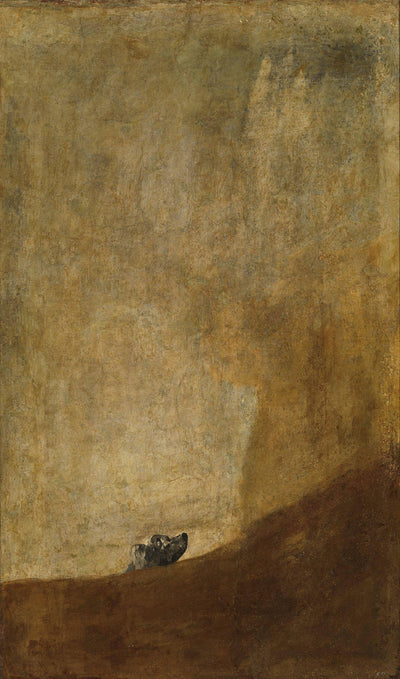
Illness came first. Between late 1792 and early 1793 an undiagnosed illness left Goya deaf, and his work grew progressively darker after it. Then came six years of war and a starving capital. After 1814 the restored king crushed the liberal hopes Goya shared. Hughes found the end of that road in the half-sunk dog he painted on his own wall, a dog "whose master is as absent from him as God is from Goya."
What are Goya's Black Paintings?
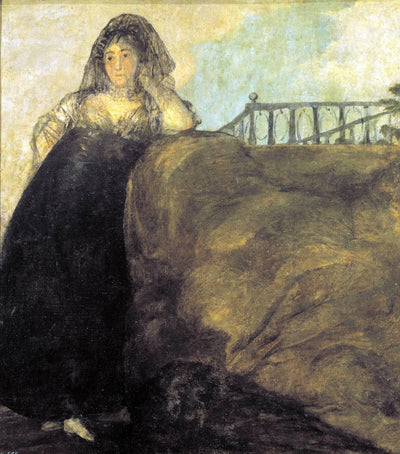
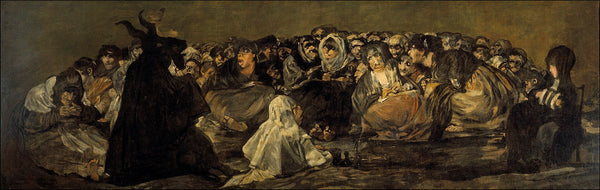
They're 14 murals Goya painted in oil on the walls of his house outside Madrid, bought in February 1819, probably in 1820–1823. He never titled them or meant them for public view. They include the god eating his own child, the portrait of his companion Leocadia and Fight with Cudgels, and he was finishing the last Disasters plates in the same years.
Where are the 14 Black Paintings?
All 14 are in the Museo del Prado in Madrid. From 1874 they were moved from the walls to canvas for Baron Émile d'Erlanger, who hoped to sell them at the 1878 Paris World's Fair. He gave them to the Spanish state in 1881.
Where the prints and plates are now
More than 1,000 impressions of each plate have been printed, so most print rooms hold part of a set. The ones worth knowing:
- The British Museum in London has the only complete album of proofs, which Goya gave his friend Juan Agustín Ceán Bermúdez, with his handwritten title and captions.
- The Royal Academy of San Fernando in Madrid keeps the original copper plates in its Calcografía Nacional.
- The Museo del Prado in Madrid owns impressions of the 1863 edition.
- The Museum of Fine Arts, Boston, holds the most important group of loose proofs.
- The Met in New York bought its 1863 impression of plate 26 in 1922.
Buying a set? Check the edition. After 1863 (500 impressions) came 1892 (100), 1903 (100), 1906 (275) and 1937, and later impressions show wear in the aquatint.
Dalí and the Chapman brothers answered the series

Outside a small circle in Spain, nobody saw the series before 1863. Dalí's Soft Construction with Boiled Beans (1936) echoes plate 39, Grande hazaña! Con muertos! (A heroic feat! With dead men!). In 1993 Jake and Dinos Chapman made 82 toy-like sculptures after the series, and the Tate bought them that year. If Goya sends you looking for other canvases that changed how painters saw the world, start with the pictures people ask about most.
Goya in oil, not ink
The Disasters of War exist only as small etchings in black and white, so the way to live with this chapter of Goya is through the canvases from the same war years. Every Goya the Art & See studio paints by hand is done in oil on canvas, from the Madrid firing squad of 1814 to the giant painted during the Peninsular War.
Sources
- Real Academia de Bellas Artes de San Fernando, Desastres de la guerra
- Real Academia de San Fernando collections, Goya prints and plates
- Calcografía Nacional, copper plate M-3521
- Calcografía Nacional, copper plate M-3536
- Frist Art Museum, Goya: The Disasters of War
- The Metropolitan Museum of Art, plate 26 record