4.7/5


The three types usually taught are the ideal (or classical) landscape, which arranges nature into a calm, perfect world; the realistic (or naturalistic) landscape, which records a real place in real weather; and the Romantic landscape, which uses nature to make you feel awe, fear or solitude. Most of the examples below are also available as hand-painted canvases, and our landscape oil paintings collection gathers many more. Below, a chart sets out two paintings for each type, with the clue that gives each one away.
The trio is a teaching shorthand rather than an official system, and no single author stands behind it. It works because it follows the order in which the three approaches appeared in European painting, the same order Encyclopaedia Britannica uses in its history of the genre: ideal first, Dutch next, Romantic last. Earlier critics drew the lines in other places, and their versions explain where the modern three come from.
Six paintings that show the three types of landscape
| Type | Example | Painter and year | Where it hangs | How to tell |
|---|---|---|---|---|
| 🏛️ Ideal | Seaport with the Embarkation of the Queen of Sheba | Claude Lorrain, 1648 | National Gallery, London | The queen leaves by sea from palace steps, though the Bible sends her by camel. |
| 🏛️ Ideal | Landscape with the Ashes of Phocion | Nicolas Poussin, 1648 | Walker Art Gallery, Liverpool | A widow grieves, yet everything around her stays calm and neat. |
| 🌾 Realistic |  Wheat Fields |
Jacob van Ruisdael, about 1670 | The Met, New York | A sandy road runs between ripe fields, under clouds that fill most of the picture. |
| 🌾 Realistic |  Flatford Mill |
John Constable, 1816–17 | Tate Britain, London | Real work at his father's mill: a barge is being unhitched from its tow horse. |
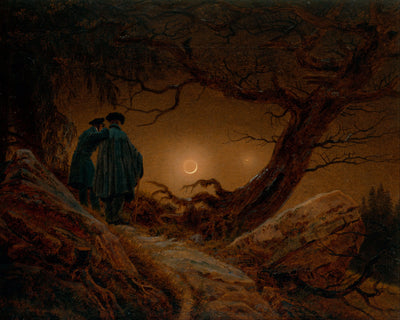
| 🌙 Romantic |  Two Men Contemplating the Moon |
Caspar David Friedrich, 1819–20 | Galerie Neue Meister, Dresden | Two small men watch a crescent moon, and the trees and path carry hidden meanings. |
| 🌙 Romantic |  The Great Day of His Wrath |
John Martin, 1851–53 | Tate | Mountains roll like waves, and a whole city is thrown into the abyss. |
The two ideal examples come from the same year, 1648, and from the two French-born painters who started the type in Rome.
Who decided there are three?
Nobody, exactly. The most influential early scheme had two. In 1708 the French critic Roger de Piles split landscape into a heroic style and a pastoral, or rural, one, in his Cours de peinture par principes:
“Among the many different styles of landskip, I shall confine my self to two; the heroick, and the pastoral or rural; for all other styles are but mixtures of these.”
His heroic landscape shows nature “as we think she ought to be,” and he held up Poussin as the painter who expressed it most happily. His rural landscape shows “nature simple, without ornament, and without artifice.” Those are, in all but name, the ideal and the realistic types.
Later in the 18th century British writers built a different set of three. Tate describes a scale with the beautiful (peaceful, even pretty views) at one end, the sublime (awesome sights such as great mountains) at the other, and the picturesque in between: artistic views with some wildness, a theory developed by William Gilpin and Uvedale Price. Tate adds that the idea of art producing upsetting or disturbing effects became an important element in Romantic art. Read that way, the modern trio is de Piles’s two styles plus the sublime.
01The ideal landscape: nature as it ought to be
Britannica dates the classical, or ideal, landscape to the 17th century and to two French-born painters who made their careers in Italy, Nicolas Poussin and Claude Lorrain. They set their scenes in an idyllic, mythical Arcadia and added biblical and mythological stories, partly to raise the standing of landscape itself. The Getty’s curriculum for teachers sums up the method: “every tree, rock, or animal was carefully placed to present a harmonious, balanced, and timeless mood.”

Zoom
Claude’s Seaport with the Embarkation of the Queen of Sheba (1648) shows how far the arranging could go. In the Bible the queen crosses the desert by camel to visit Solomon; Claude sends her by sea instead, the National Gallery in London points out, from steps lined with classical palaces that echo his years in Rome, in the soft light of sunrise. The canvas measures 149.1 × 196.7 cm (58.7 × 77.4 in) and hangs in Room 36. It was among the first pictures the Gallery bought, in 1824, and J.M.W. Turner later bequeathed two of his own paintings on condition that they hang beside it and its pair, a story our guide to Turner’s landscapes picks up.

Zoom
Poussin’s version of the ideal is sterner. In Landscape with the Ashes of Phocion (1648), the Athenian general Phocion has been unjustly executed for treason and refused burial in Athens, and his widow secretly gathers his ashes, the Walker Art Gallery in Liverpool explains. A wealthy French silk merchant ordered it together with a companion showing the body being carried out of the city, and the museum reads its message as Stoic. Everything around the grieving woman stays orderly and calm, which is the point. Our hand-painted Ashes of Phocion follows the Liverpool composition.
How to recognize the type: trees or buildings framing the sides, a glowing distance, small figures from scripture, myth or ancient history, and a stillness no real afternoon ever had.
02The realistic landscape: nature as it is
In the same century, painters in the Dutch Republic looked at their own flat country instead. The Getty notes that the rising Protestant middle class wanted secular pictures for their homes, and landscape filled that demand. Britannica names Jacob van Ruisdael, Aelbert Cuyp and Meindert Hobbema, and points to the sky, often cloudy and filling half the canvas or more, as the element that sets the mood.

Zoom
Ruisdael’s Wheat Fields (about 1670) is a textbook case. A sandy road leads between ripe fields, and the clouds take up most of the picture. The canvas, 100 × 130.2 cm (39.4 × 51.3 in), came to the Metropolitan Museum of Art with Benjamin Altman’s bequest in 1913. Our guide to Dutch Golden Age paintings covers the period’s other landmarks.
The realistic strand returned in England two centuries later. Britannica says John Constable “worked in a realist mode with a high level of precision” in his views of the English countryside, and one canvas shows what that meant in practice.

Zoom
Hand-painted oil reproductionSee sizes ›
Tate calls Flatford Mill (1816–17) “a snapshot of working life” at Constable’s father’s business premises on the River Stour: a barge is being unhitched from its tow horse so it can be poled under Flatford bridge. It is the largest painting Constable worked on outdoors, though X-rays show he changed it in the studio, painting out a horse on the towpath and putting two boys in the distance. It measures 101.6 × 127 cm (40.0 × 50.0 in) and is at Tate Britain. Tate’s catalogue calls it the forerunner of his six-foot river canvases, among them The Hay Wain (1821), now in the National Gallery and covered in our guide to Romanticism in art.
In France the Barbizon painters, among them Théodore Rousseau, Charles-François Daubigny and Jean-François Millet, worked in and around the forest of Fontainebleau from the 1830s. Britannica says they gave up the balanced compositions of their predecessors for “a truer, if less harmonious” picture of their surroundings, a step toward the movement our guide to Realism in art explains. How to recognize the type: a place you could find on a map, real weather, working people, and nothing improved for effect.
03The Romantic landscape: nature as feeling
The third type grew from an 18th-century idea. In 1757 Edmund Burke defined the sublime as the strongest emotion the mind is capable of feeling and wrote that “whatever is in any sort terrible” is a source of it, Tate explains. Landscape painters took him at his word: storms, peaks, ruins and night became subjects in their own right. Britannica calls Caspar David Friedrich the painter who epitomized the Romantic landscape in Germany, with pictures “charged with emotional and religious symbolism.” His best-known image, Wanderer above the Sea of Fog (about 1817, Hamburger Kunsthalle), shows a man seen from behind above a sea of mist. Our story of Romantic landscape paintings follows the movement from Dresden to Norway, England and America.

Zoom
Hand-painted oil reproductionSee sizes ›
A quieter example is Friedrich’s Two Men Contemplating the Moon (1819–20), in the Galerie Neue Meister in Dresden. The Friedrich portal of the Hamburg, Berlin and Dresden museums spells out its symbols: the path between a leafless tree and an evergreen stands for a life’s journey between death and the promise of eternal life, and the waxing moon for Christ. The two men wear the “old German costume” that, after the Carlsbad Decrees of 1819, was banned as an expression of liberal, revolutionary views, so the picture is quietly political too. Friedrich painted the scene more than once. The Metropolitan Museum, which owns a later version from about 1825–30, notes that one figure has often been identified as Friedrich himself and that the other is his disciple August Heinrich.

Zoom
Hand-painted oil reproductionSee sizes ›
At the loud end of the scale sits John Martin’s The Great Day of His Wrath (1851–53). It is the third picture in his Judgement series, a triptych drawn from the Book of Revelation: mountains roll like waves of rock and a whole city is torn up and thrown into the abyss. Tate, which owns it and uses it to illustrate its definition of the sublime, says Martin’s aim was “highly Romantic: to express the sublime, apocalyptic force of nature and the helplessness of man.” The canvas measures 196.5 × 303.2 cm (77.4 × 119.4 in). The three pictures toured for 20 years, and according to Tate as many as eight million people saw them.
In America the Hudson River School, active from about 1825 to 1870 by Britannica’s count, gave the type a national subject: Thomas Cole, Asher B. Durand and Thomas Doughty first, then younger painters such as Frederic Edwin Church and Albert Bierstadt, whose The Rocky Mountains, Lander’s Peak (1863) is at the Met. Our list of famous American paintings places them in the wider national story. How to recognize the type: a tiny human figure, nature far bigger or wilder than any person, and light used as drama.
Where the types blur
Painters did not stay in one box. Constable, the realist, lost his wife Maria in 1828, and the Yale Center for British Art says his grief moved him to paint Hadleigh Castle (1829), a ruin on the Essex coast where the Thames estuary meets the sea, “on a grand scale”: a real place, painted in a Romantic key. Claude’s harbors are equally mixed, and the National Gallery counts the Queen of Sheba port among its three imaginary seaports. Even city views divide the same way: the Gallery’s glossary splits vedute, the Italian name for topographical views, into imaginary scenes and precisely rendered views of a known site, such as Canaletto’s Venice.
After the three: Impressionist and abstract landscapes
The 19th century kept adding approaches. The Getty moves from the Barbizon painters, who worked outdoors directly from nature, to the Impressionists, Monet, Pissarro, Renoir and Sisley, who devoted most of their careers to landscape. Their loyalty to what the eye sees makes them heirs of the realistic type, with faster brushwork and brighter color.

Zoom
Hand-painted oil reproductionSee sizes ›
Monet’s Poppies (1873), at the Musée d’Orsay, is a small canvas, 50 × 65.3 cm (19.7 × 25.7 in), that he showed at the first Impressionist exhibition in 1874. The museum describes two color zones, one red and one bluish green, built from blobs of paint, and concludes that “a step towards abstraction had been taken.” That step leads to the abstract landscapes of the 20th century. For more, see our Impressionist landscape paintings, Monet’s landscapes beyond the water lilies, the 20 most famous landscape paintings in the world and, for the wider canon, the most famous paintings in the world.
Other counts: four types, six types, five genres
Ask for four types of landscape and you will not find a standard list either. The nearest thing is Britannica’s history, which runs through the ideal, Dutch and Romantic landscapes and then adds two more chapters, the Impressionist landscape and modernist or abstract landscape, and popular guides go further, counting five, six or even seven types. Those longer lists usually mix styles with subjects, setting seascapes or city views beside Impressionism.
The broader question, what are the three types of paintings, has no fixed answer at all. The old academic system recognized five genres, Tate explains: history, portrait, genre scenes of everyday life, landscape and still life, ranked in that order. Landscape and still life shared the bottom because neither involved human subject matter.
What landscape paintings are called
They are simply called landscapes, and the word itself began in the studio. The Online Etymology Dictionary dates “landscape” in English to about 1600, from the Dutch landschap, a painters’ term that separated the scenery from the subject of a picture. Other words name the subject rather than the type: a seascape shows the sea, as in our famous ocean paintings, and “skyscape” was in English print by 1817.
Order, truth or mood
Choosing between the three comes down to what a room needs: the order of an ideal landscape, the plain truth of a real place, or a Romantic mood. The ideal and Romantic types are the most sensitive to light, because so much of their effect rests on a glow or a darkness, so they reward a well-lit wall. Our landscape oil paintings collection is the easiest place to compare the three side by side.
Sources
- Encyclopaedia Britannica, Landscape painting (Naomi Blumberg)
- J. Paul Getty Museum, Education, Brief History of the Landscape Genre (Landscapes, Classical to Modern curriculum)
- Roger de Piles, The Principles of Painting (English translation, 1743), Getty Research Institute copy, Internet Archive
- Tate, Picturesque (art term)
- Tate, Sublime (art term)
- Tate, Genres (art term)
- National Gallery, London, Claude, Seaport with the Embarkation of the Queen of Sheba (NG14)
- Walker Art Gallery, Liverpool, on Google Arts & Culture, Nicolas Poussin, Landscape with the Ashes of Phocion
- The Metropolitan Museum of Art, Jacob van Ruisdael, Wheat Fields
- Tate, John Constable, Flatford Mill (‘Scene on a Navigable River’) (N01273)
- National Gallery, London, John Constable, The Hay Wain (NG1207)
- Caspar David Friedrich portal (Hamburger Kunsthalle, Staatliche Museen zu Berlin, Staatliche Kunstsammlungen Dresden), Two Men Contemplating the Moon
- Caspar David Friedrich portal, Wanderer above the Sea of Fog
- The Metropolitan Museum of Art, Caspar David Friedrich, Two Men Contemplating the Moon (2000.51)
- Tate, John Martin, The Great Day of His Wrath (N05613)
- The Metropolitan Museum of Art, Albert Bierstadt, The Rocky Mountains, Lander's Peak (07.123)
- Yale Center for British Art, John Constable, Hadleigh Castle, The Mouth of the Thames: Morning after a Stormy Night
- National Gallery, London, Glossary: Vedute
- Musée d'Orsay, Claude Monet, Coquelicots (Poppies)
- Online Etymology Dictionary, landscape