4.9/5
4.9/5


Eight paintings carry most of Napoleon's legend, and five of them were made during his rise and reign: Antoine-Jean Gros's young general on the bridge at Arcole, Jacques-Louis David's rearing horse in the Alps, Gros's plague hospital at Jaffa, David's Coronation and Ingres's emperor on his throne. The other three came after his death, from Paul Delaroche, Ernest Meissonier and William Quiller Orchardson, and they show the mule, the mud and the exile that the official pictures left out. Several of them are among the most famous paintings in the world, and each one either builds the myth or tests it.
I have put them in the order of the events they show, from northern Italy in 1796 to the deck of a British warship in 1815, so the list reads as one life, told first by his own painters and then by the generation that followed.
At a glance
| # | Painting | Artist | Year | Where to see it |
|---|---|---|---|---|
| 1 |  Bonaparte at the Pont d'Arcole Bonaparte at the Pont d'Arcole |
Antoine-Jean Gros | 1796 | Palace of Versailles |
| 2 |  Napoleon Crossing the Alps Napoleon Crossing the Alps |
Jacques-Louis David | 1800–1801 | Château de Malmaison, Rueil-Malmaison; other versions in Berlin, Vienna and Versailles |
| 3 |  Bonaparte Visiting the Plague Victims of Jaffa Bonaparte Visiting the Plague Victims of Jaffa |
Antoine-Jean Gros | 1804 | Louvre, Paris |
| 4 |  The Coronation of Napoleon The Coronation of Napoleon |
Jacques-Louis David | 1805–1807 | Louvre, Paris; David's replica at Versailles |
| 5 |  Napoleon I on His Imperial Throne Napoleon I on His Imperial Throne |
Jean-Auguste-Dominique Ingres | 1806 | Musée de l'Armée, Paris |
| 6 |  Napoleon Crossing the Alps Napoleon Crossing the Alps |
Paul Delaroche | 1850 | Walker Art Gallery, Liverpool |
| 7 |  1814, Campaign of France 1814, Campaign of France |
Ernest Meissonier | 1864 | Musée d'Orsay, Paris |
| 8 |  Napoleon on Board the Bellerophon Napoleon on Board the Bellerophon |
William Quiller Orchardson | 1880 | Tate, London (not on display) |
Painted for the general and first consul, 1796–1801
01Bonaparte at the Pont d'Arcole, Antoine-Jean Gros (1796)

Zoom
On November 17, 1796, during the campaign in northern Italy, Bonaparte rallies his troops at the bridge of Arcole. The Fondation Napoléon calls it the first emblematic image of the Napoleonic myth, and points out that in reality the bridge was never crossed. Gros had been at the battle, and with Josephine's help he got the general to sit for him several times in Milan.
The finished canvas belongs to the Palace of Versailles, which describes its Napoleonic collection as the largest in the world. Its catalogue record gives 130 × 94 cm (51.2 × 37.0 in) and says Gros painted it from life in 1796 at the Palazzo Serbelloni in Milan, working from a sketch Bonaparte had approved (that sketch is now in the Louvre); it was shown at the Salon of 1801. Gros's Arcole portrait is Napoleon before the crown: bare-headed, long-haired, twisting back toward the men behind him.
02Napoleon Crossing the Alps, Jacques-Louis David (1800–1801)

Zoom
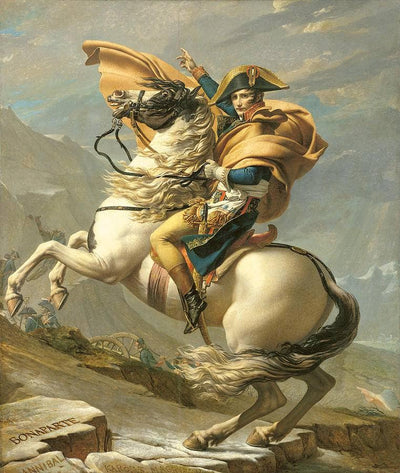
In May 1800 the First Consul took his army over the Great St Bernard Pass against the Austrians, a campaign that ended with victory at Marengo in June. Soon afterward King Charles IV of Spain ordered this rearing-horse portrait for the hall of great commanders in his Madrid palace, and paid 24,000 francs for it. Smarthistory dates the work from October 1800 to January 1801. Napoleon refused to sit, so David worked from an earlier portrait and the uniform worn at Marengo, which one of his sons put on before posing on top of a ladder.
What Napoleon did ask for, according to the Château de Malmaison, was to be shown "calm on a fiery horse." The museum adds that the real animal was a surer-footed mule, and Smarthistory notes that he crossed a couple of days behind his troops, on a narrow path. David carved three names into the foreground rocks, Bonaparte, Hannibal and Karolus Magnus (Charlemagne), two earlier leaders who had taken armies over the Alps.
How many versions of Napoleon Crossing the Alps are there? David painted five. After seeing the Madrid canvas in the painter's studio, Napoleon ordered repetitions, changing the color of the cloak, the horse's coat and the harness. The original painted for Madrid, with a yellow cloak and a piebald horse, is at Malmaison outside Paris. The one made for Bonaparte himself, with a red cloak and a bay-brown horse, is at Charlottenburg Palace in Berlin (Fondation Napoléon). The copy sent to the palace in Milan now hangs in the Upper Belvedere in Vienna, dated 1801, at 275 × 232 cm (108.3 × 91.3 in). Versailles has the other two: the version painted for the library of the Invalides, dated 1802, and the one David kept, which his daughter gave to Louis-Napoléon Bonaparte around 1850. The other famous crossing of the pass, Delaroche's, is number 6 below.
David's road from the Revolution to the imperial court is traced in our guide to Jacques-Louis David's paintings.
The emperor's official image, 1804–1806
03Bonaparte Visiting the Plague Victims of Jaffa, Antoine-Jean Gros (1804)

Zoom
Hand-painted oil reproductionSee sizes ›
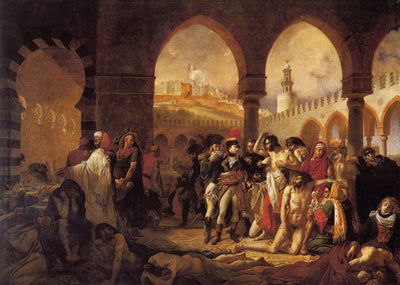
The scene is dated March 11, 1799, during the campaign in Syria, in the courtyard of a mosque at Jaffa that served as a military hospital. In the Louvre's description, Bonaparte touches the swelling on a patient's chest while a doctor tries to stop him, two local men hand out bread at left, and a blinded soldier gropes his way toward the general.
The Fondation Napoléon explains why Napoleon wanted it: rumors accused him of having plague-stricken French soldiers poisoned during the Syrian campaign. Touching the sick without fear placed him in the line of the healing kings who were believed to cure scrofula, and the picture went on show in 1804, the year the Empire was created. The Ministry of the Interior commissioned it at the First Consul's initiative; Gros painted it in his studio in the Jeu de Paume at Versailles and was paid 16,000 francs in 1805.
Gros's Jaffa canvas measures 523 × 715 cm (205.9 × 281.5 in) and hangs in the Salle Mollien (Room 700, Denon wing) with the museum's Romantic paintings. More of the building's highlights are in our tour of famous paintings at the Louvre.
04The Coronation of Napoleon, Jacques-Louis David (1805–1807)

Zoom
Hand-painted oil reproductionSee sizes ›
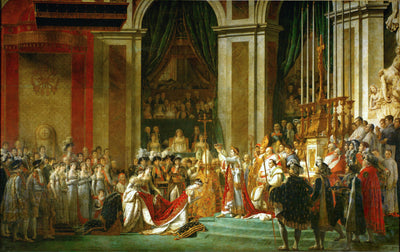
Who painted the picture of Napoleon's coronation? Jacques-Louis David, with the help of Georges Rouget. The Louvre's record adds that it took two years, that David was paid 65,000 francs in all, and that the canvas, signed and dated 1806 and 1807, was first shown to the public at the Louvre in February 1808. At 621 × 979 cm (244.5 × 385.4 in), David's Coronation now hangs in the Salle Daru (Room 702).
Its timing went wrong. The Fondation Napoléon notes that Napoleon's remarriage in 1810 made it impossible to install a picture of Josephine's crowning in a palace, so the Empire's most famous painting was on public view for barely six months. Was Napoleon related to Marie Antoinette? Not by blood. His second wife, Marie-Louise of Austria, whom he married in 1810 after divorcing Josephine, was the queen's great-niece.
There is also a second Coronation. Versailles says David painted a replica in Paris and then in Brussels between 1808 and 1822 for a group of American businessmen, and that the picture toured the United States and Europe through the 19th century; Versailles acquired it in 1947 and hung it in its Coronation Room the following year. Who stands in the crowd, who was added and what David painted out are covered in our list of famous French paintings.
05Napoleon I on His Imperial Throne, Jean-Auguste-Dominique Ingres (1806)

Zoom
Hand-painted oil reproductionSee sizes ›
Ingres was 26 when he showed this 259 × 162 cm (102.0 × 63.8 in) portrait, and the Musée de l'Armée, which owns it, reads the regalia one by one. The laurel wreath was the mark of victorious generals, and then of emperors, in ancient Rome. The scepter of Charles V is topped by a small Charlemagne, enthroned in the same pose as Napoleon. The Grand Master's chain of the Legion of Honor lies on the ermine collar, and the purple mantle is scattered with golden bees, taken from metal insects found in the tomb of the Merovingian king Childeric. Even the carpet is bordered with signs of the zodiac, its Virgo borrowed from Raphael's Madonna of the Chair.
The museum traces the frontal, motionless composition to Byzantine icons and medieval manuscripts, and it did not go down well. The Corps législatif bought the picture on August 26, 1806, for its president's reception room. Before the Salon opened, officials warned the minister that critics would call it "Gothic and barbarous," and the public found it bizarre, the emperor's face waxy and unreal. Ingres left for Italy at the end of that year. After the Empire fell, Ingres's throne portrait went into storage, was deposited at the Invalides in 1832 and has been on show at the Musée de l'Armée since the early 20th century.
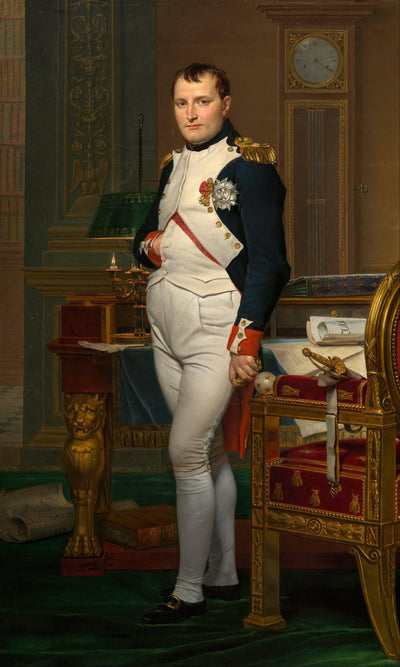
Six years later David painted the opposite image. The Emperor Napoleon in His Study at the Tuileries (1812), commissioned by a Scottish nobleman, the Marquis of Douglas, later 10th Duke of Hamilton, shows Napoleon beside his desk at 4:13 in the morning, the candle nearly out, his hair untidy and a scroll marked CODE on the desk: a ruler who stays up all night writing laws. It measures 203.9 × 125.1 cm (80.3 × 49.3 in) and is on view at the National Gallery of Art in Washington, Gallery M56 of the West Building.
The legend revised, 1814–1880
Outside France the image had turned sooner. Goya's The Third of May 1808 (1814, Prado) shows faceless French soldiers executing Spanish insurgents on the night after the Madrid uprising, as the Fundación Goya en Aragón describes it. It appears among our famous war paintings and in the guide to the most famous Goya paintings. French painters revised the legend later, once Napoleon had been dead for decades and could be shown tired, cold and alone.
06Napoleon Crossing the Alps, Paul Delaroche (1850)

Zoom
Hand-painted oil reproductionSee sizes ›
Delaroche trained under Gros, who called him "the glory of my school," yet he painted the crossing the way the official artists had not. The Royal Collection Trust explains that he followed the account of the historian Adolphe Thiers, published in 1845: a pensive Bonaparte on a blinkered, sure-footed mule, led by a local guide who walks beside him while the military escort follows.
The Walker Art Gallery in Liverpool, which received Delaroche's mule crossing from Henry Yates Thompson in 1893, describes it as a deliberate correction of the showy, propagandist versions by Napoleon's own painters. Another version belongs to the Louvre, and the Walker says both were commissioned by a group of British collectors "obsessed with the Napoleonic legend." Its snowy pass also earns it a place among the winter scenes in our famous Christmas paintings.
071814, Campaign of France, Ernest Meissonier (1864)

Zoom
Hand-painted oil reproductionSee sizes ›
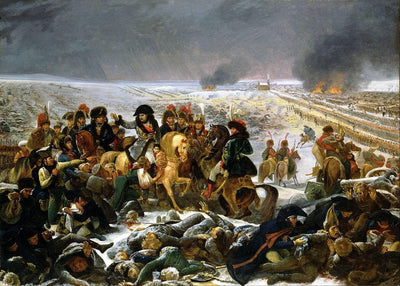
Meissonier was born in 1815, so his Napoleon came from research, not memory: the Musée d'Orsay says he gathered documents, questioned eyewitnesses and tried, without success, to borrow the emperor's gray coat. The episode came after several victories but, in the museum's reading, announces the defeats to come. There is no action, only loneliness and despondency, the officers' doubt set against Napoleon's isolated resolve, and snow dirtied by the marching army.
The panel, 51.5 × 76.5 cm (20.3 × 30.1 in), oil on wood, is small for a military subject; it is signed and dated 1864, was shown at that year's Salon and was bequeathed to the national museums by Alfred Chauchard in 1909. The Walters Art Museum in Baltimore owns an even smaller picture from the same campaign, Meissonier's 1862 painting of Napoleon alone on horseback, 32.4 × 24.2 cm (12.8 × 9.5 in), commissioned by the emperor's nephew Prince Napoleon and set just after the hard-won victory at Arcis-sur-Aube. The museum lists it as not on view.
08Napoleon on Board the Bellerophon, William Quiller Orchardson (1880)

Zoom
The last image is the quietest. Tate's label describes the deposed emperor on the deck of HMS Bellerophon, on his way to exile on St Helena, where he remained until his death in 1821. He stands apart and looks out to sea while the officers on the left watch him with curiosity; Tate's catalogue identifies them as Count Las Cases, Generals Montholon, Savary and Lallemand, and Colonel Planat.
Orchardson trained in Edinburgh and moved to London in 1862. The canvas, 165.1 × 248.9 cm (65.0 × 98.0 in), was exhibited in 1880, and Tate acquired it that year through the Chantrey Bequest; it is currently not on display.
David's horse or Delaroche's mule
The two crossings of the Great St Bernard, painted about fifty years apart, sum up this list: one painted for a king's palace, the other painted to correct it. To see more of the painter who fixed Napoleon's public face, browse the Jacques-Louis David collection.
Sources
- Palace of Versailles, Bonaparte au pont d'Arcole, 17 novembre 1796 (collection record, in French)
- Fondation Napoléon, General Bonaparte on the bridge at Arcole, 17 November 1796
- Palace of Versailles, Napoleon. Images of the legend (exhibition)
- Smarthistory, Jacques-Louis David, Napoleon Crossing the Alps
- Château de Malmaison, Le Premier consul franchissant les Alpes au col du Grand-Saint-Bernard (collection record, in French)
- Fondation Napoléon, Le Premier Consul franchissant les Alpes (in French)
- Belvedere, Vienna, Napoleon at the Great St. Bernard Pass (collection record)
- Palace of Versailles, Bonaparte franchissant le mont Saint-Bernard (collection record, in French)
- Louvre, Bonaparte visitant les pestiférés de Jaffa (collection record)
- Fondation Napoléon, Bonaparte visitant les pestiférés de Jaffa (in French)
- Louvre, Le Couronnement de l'empereur Napoléon Ier (collection record)
- Fondation Napoléon, Le Sacre or the Coronation of Napoleon
- Palace of Versailles, The Coronation Room
- Palace of Versailles, Marie-Louise
- Musée de l'Armée, Napoléon Ier sur le trône impérial, par Ingres (object sheet, PDF, in French)
- National Gallery of Art, The Emperor Napoleon in His Study at the Tuileries
- Fundación Goya en Aragón, The Third of May 1808 (catalogue entry)
- Walker Art Gallery on Google Arts & Culture, Paul Delaroche, Napoleon Crossing the Alps
- Royal Collection Trust, Paul Delaroche, Napoleon Bonaparte crossing the Alps
- Musée d'Orsay, Ernest Meissonier, Campagne de France, 1814
- Walters Art Museum, Jean-Louis-Ernest Meissonier, 1814
- Tate, William Quiller Orchardson, Napoleon on Board the Bellerophon