4.9/5


Impressionism catches how a scene looks in one passing moment of light. Post-Impressionism, which grew out of it in the late 1880s, keeps the bright color and the visible brushwork but uses them to build solid form, show a feeling or carry an idea. Below, four pairs of paintings set one movement against the other, one difference at a time, and you can browse the later camp in our collection of Post-Impressionist paintings. The chart right below holds all eight differences, each with a pair of real canvases you can compare.
A handy shortcut in front of a canvas: if it makes you feel the weather, it is probably Impressionist; if it makes you feel the painter, it is probably Post-Impressionist. The second group never saw itself as a movement. The English critic Roger Fry coined the label for his 1910 exhibition Manet and the Post-Impressionists at the Grafton Galleries in London, as the Met's essay on Post-Impressionism explains, by which time Van Gogh and Seurat had been dead for nearly twenty years. Our guide to Post-Impressionism, its artists and its key paintings tells the longer story.
The left column follows the Met's essay Impressionism: Art and Modernity, the right one Britannica's entry on Post-Impressionism. The four pairs below show each difference on real canvases.
Eight ways to tell the two movements apart
| # | Where they part | Impressionism | Post-Impressionism | Pair to compare |
|---|---|---|---|---|
| 1 | Time | Eight group shows in Paris, from 1874 to 1886 | From the late 1880s, with a name given by Roger Fry in 1910 | Impression, Sunrise (shown 1874) · A Sunday on La Grande Jatte (shown 1886) |
| 2 | A moment or something lasting | One passing hour of light on a harbor | Something "solid and durable," in Cézanne's words | Impression, Sunrise · The Card Players |
| 3 | Mixing color | Bright touches set down by instinct | Tiny dots placed by a strict system | Bal du moulin de la Galette · A Sunday on La Grande Jatte |
| 4 | Seeing or feeling | The view as it stood in front of the painter | The view changed, with a cypress moved closer and a glowing sky | The Water-Lily Pond · The Starry Night |
| 5 | Real or imagined | A scene that could happen on any afternoon in Paris | A vision that exists only in the minds of the women at prayer | L'Absinthe · Vision of the Sermon |
| 6 | Speed | Often quick, like a canvas finished in a few hours | Often slow, like a canvas reworked two years after it began | Impression, Sunrise · A Sunday on La Grande Jatte |
| 7 | Friends or loners | A society of friends that showed together | Independent painters who mostly worked alone | Pissarro, who showed at all eight group shows and took up Seurat's dots by the last one |
| 8 | What grew from it | The Post-Impressionists themselves | Fauvism, Cubism and Expressionism | Van Gogh's Arles work, which the Met calls proto-Expressionist |
The Impressionist side draws on the Met's essay on the movement, the other side on Britannica, and each pair on the museum that owns it.
A moment versus something that lasts: Monet and Cézanne
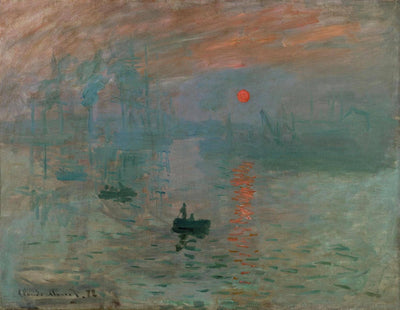
Impression, Sunrise (1872) shows the port of Le Havre at dawn, seen from the window of Monet's hotel. The Musée Marmottan Monet, which owns it, says he finished it in a few hours and added the rowboats and the orange sun near the end. It is a small canvas, 50 × 65 cm (19.7 × 25.6 in). Monet needed a title for the catalogue of the group's first exhibition in 1874, held in the photographer Nadar's former studio, and chose "Impression". On April 25, 1874, the critic Louis Leroy turned the word against the whole show in his review for Le Charivari, and the movement had its name.

Zoom
Cézanne wanted the opposite of a passing moment. Britannica quotes his aim: to make of Impressionism "something solid and durable like the art of the museums." He even took a subject from a museum. The Musée d'Orsay notes that he had certainly seen The Card Players attributed to the Le Nain brothers in the museum of Aix-en-Provence, his hometown, and in the 1890s he took up the theme several times.
In the Orsay's version of The Card Players (1893–1896), 47 × 56.5 cm (18.5 × 22.2 in), two men thought to be farm workers from his father's estate at the Jas de Bouffan face each other across a table. The museum points out how it is built: the bottle is the central axis and splits the picture into two symmetrical halves, and Cézanne trades glances and gestures for heavy silhouettes and silent concentration. Monet's harbor would look different ten minutes later. Cézanne's players look as if they could sit there forever.

Zoom
Color mixed in the eye, by instinct or by system: Renoir and Seurat
Both camps put strokes of color side by side and let the viewer's eye blend them. The difference is method. Renoir's Bal du moulin de la Galette (1876), 131.5 × 176.5 cm (51.8 × 69.5 in), is a crowded dance at a popular spot on the Butte Montmartre. The Musée d'Orsay describes a crowd in motion under light that is both natural and artificial, caught in vibrant, colored touches, and notes that critics of the day disliked the way the forms seemed to dissolve. Renoir showed it at the third Impressionist exhibition, in 1877.

Zoom
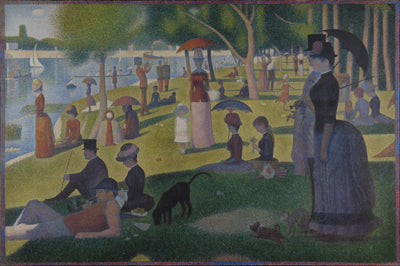
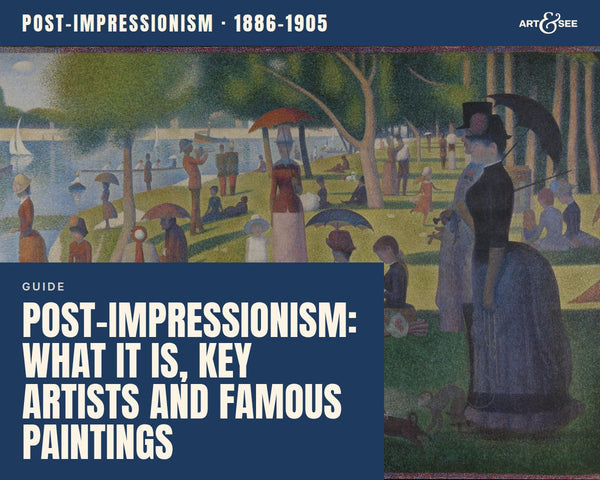
Seurat turned the same idea into a system. Britannica describes it: tiny dots of contrasting colors placed side by side and chosen to blend, seen from a distance, into one dominant color, a technique called pointillism that became the basis of Neo-Impressionism. A Sunday on La Grande Jatte (1884–86) is huge, 207.5 × 308.1 cm (81.7 × 121.3 in), and it was slow. The Art Institute of Chicago says Seurat returned to it two years after he began, enlarging some silhouettes and adding figures such as the monkey on a leash, and he painted its border in 1888–89. His aim, the museum says, was a painting of modern life equal to a classical Greek frieze, which is why his strollers stand as still as statues while Renoir's dancers blur. The Met notes that the finished canvas made its debut at the eighth and final Impressionist exhibition, in 1886.

Zoom
Hand-painted oil reproductionSee sizes ›
What the eye sees versus what the painter feels: Monet and Van Gogh
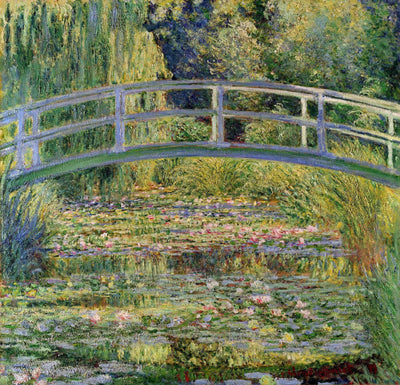
Monet kept painting what was in front of him long after 1886. In 1893 he bought land next to his house at Giverny and enlarged a pond into a water garden, planted with hybrid water lilies and crossed by a Japanese-style bridge that he built in 1895, according to the National Gallery in London. He painted the bridge that year and came back to it in 1899. In the Gallery's The Water-Lily Pond (1899), the bridge runs the full width of the canvas and is cut off at both edges, and the thick, separate brushstrokes are closer to his early Impressionist work than to his hazier late canvases. Our guide to Monet's Japanese Bridge paintings follows the whole series.
The original and our hand-painted copy
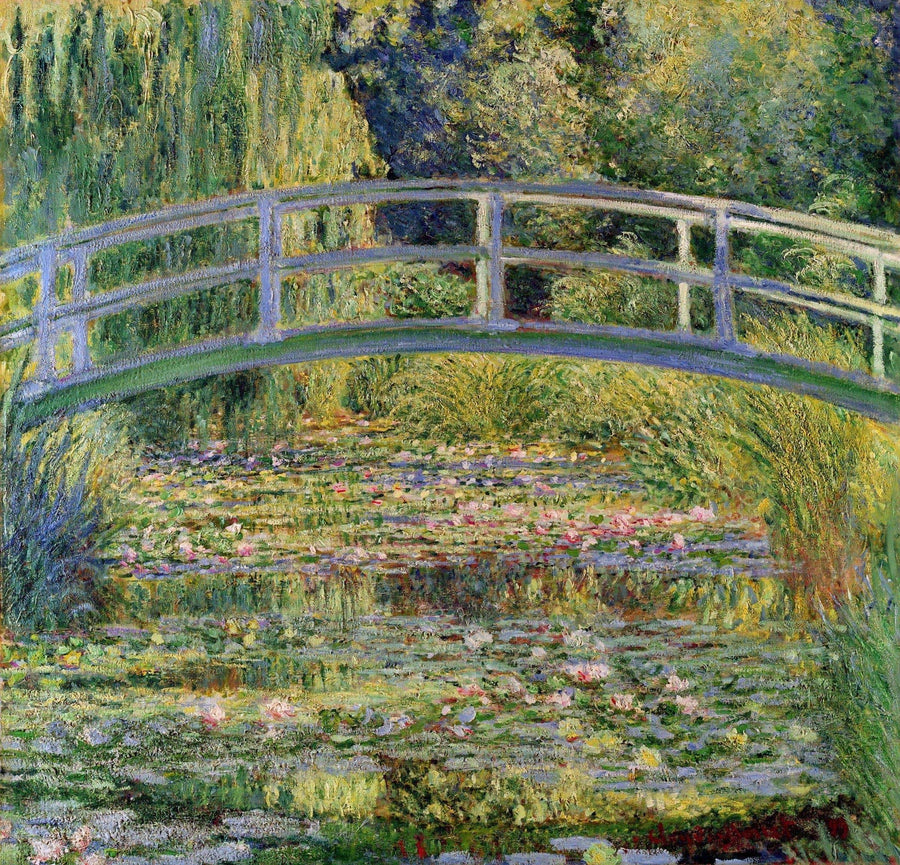
The original
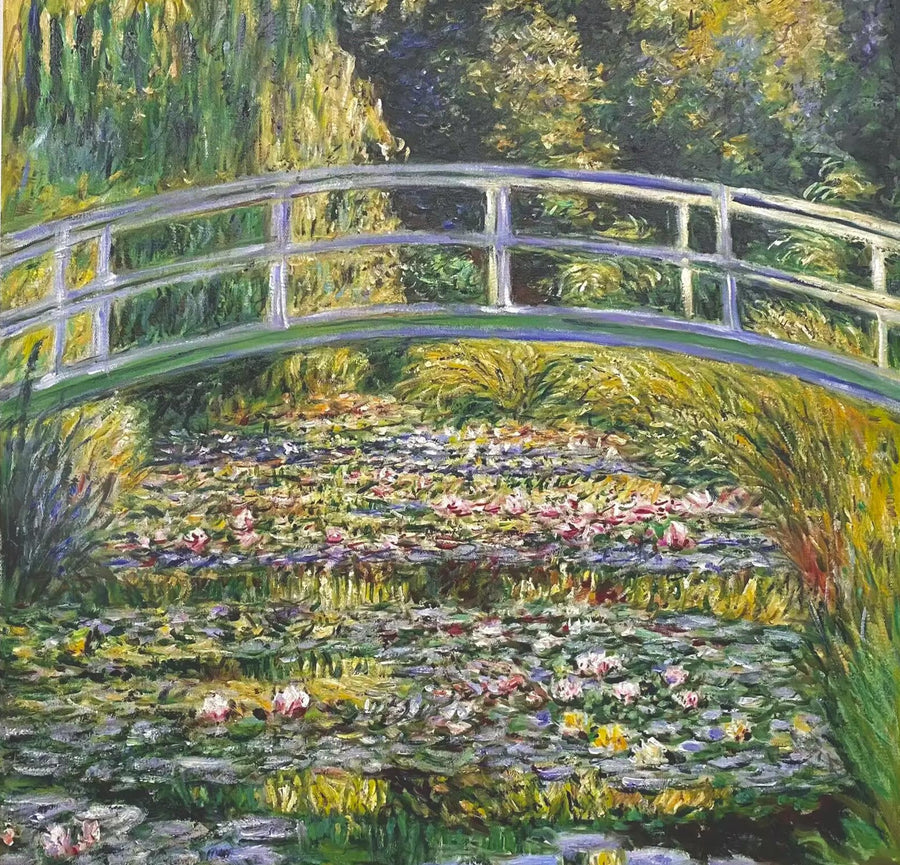
Our reproduction, painted by hand in oil
The Starry Night, painted in June 1889, also starts from observation and then leaves it. MoMA, which owns it, explains that Van Gogh took the view from his window at the Saint-Paul-de-Mausole asylum in Saint-Rémy but painted it in several sessions during the day. The village below the hills comes from other views and could not be seen from his window, the cypress is much closer than it really was, and he altered the shapes in the sky and added their glow. With it, the museum says, Van Gogh heralded modern painting's "new embrace of mood, expression, symbol, and sentiment." The twelve months he spent at the asylum are the subject of our article on Van Gogh's year at Saint-Paul-de-Mausole.
The original and our hand-painted copy
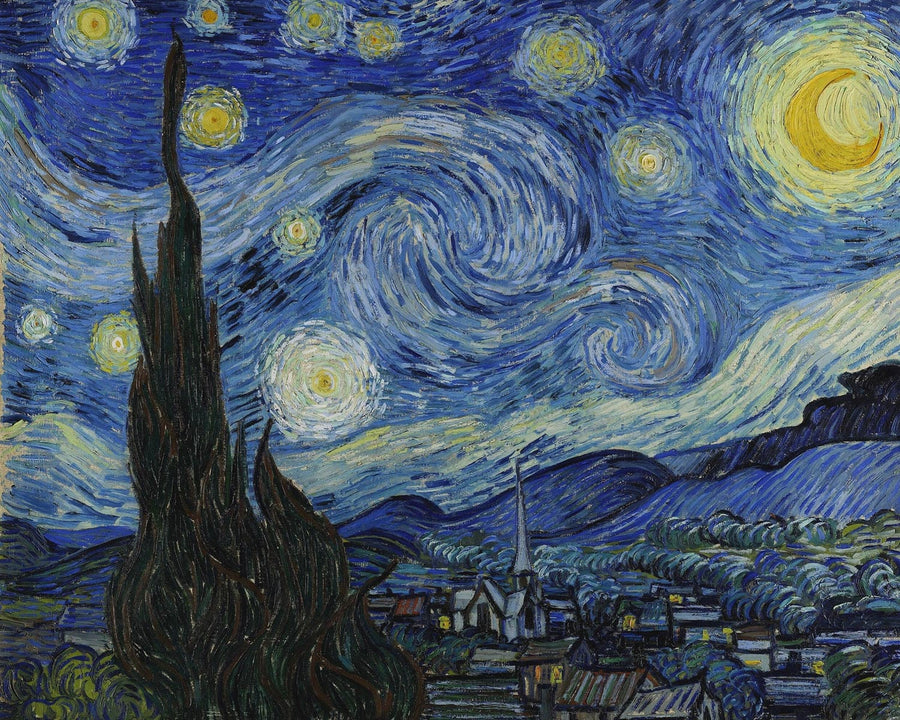
The original
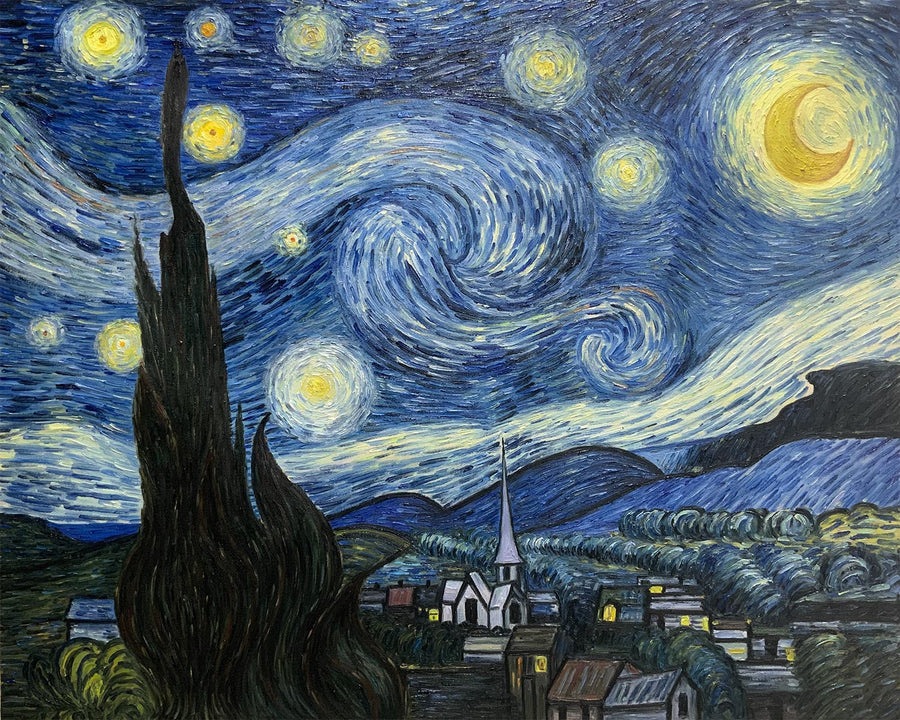
Our reproduction, painted by hand in oil
Was Van Gogh an Impressionist, and was Monet a Post-Impressionist?
The Starry Night is Post-Impressionist, and MoMA files it under that heading. Van Gogh passed through Impressionism on the way: Britannica says that after arriving in Paris in 1886 he quickly adapted Impressionist technique and color, then turned its short strokes into curving, vibrant lines, and the Met points to his Self-Portrait with a Straw Hat (1887), painted in divided strokes close to those of his friend Paul Signac. Monet, for his part, was never a Post-Impressionist. The National Gallery counts about 250 paintings from his water garden, the main subject of the last part of his life. Our piece on why Monet is called the father of Impressionism follows him through eight paintings.
A real scene versus an imagined one: Degas and Gauguin
Degas was a founding member of the Impressionist group, but the Musée d'Orsay calls him an essentially urban painter, drawn to stage shows, leisure and cafés. In L'Absinthe (1875–1876), which the museum catalogues as Dans un café, a man and a woman sit side by side at La Nouvelle Athènes on the place Pigalle, each shut in silence. The off-center framing, taken from Japanese prints, slices off the man's pipe and hand and makes the scene feel like a snapshot from the next table. That feeling is contrived, the Orsay adds: Degas painted it in his studio, with an actress and an engraver he knew posing for the figures. Still, nothing in it is impossible; it could have happened on any afternoon in Paris.

Zoom
Hand-painted oil reproductionSee sizes ›
Gauguin painted something that could only happen inside people's heads. In Vision of the Sermon (1888), also known as The Vision after the Sermon, Breton women in regional costume have just heard a sermon on Genesis 32, in which Jacob wrestles all night with a mysterious angel, and the fight appears before them. The National Galleries of Scotland, which own it, note that he painted it at Pont-Aven in Brittany. Writing to Van Gogh about the picture that September, Gauguin described what he had invented: the ground "pure vermilion", an apple tree crossing the canvas, a cow "tiny by comparison with reality". Britannica explains the look: with the young painter Émile Bernard, Gauguin borrowed the flat color and heavy outlines of medieval stained glass, and after showing with the Impressionists in 1886 he renounced "the abominable error of naturalism."
“For me, the landscape and the wrestling exist only in the imagination of the people at prayer after the sermon”

Zoom
Hand-painted oil reproductionSee sizes ›
Where the line blurs
The two camps shared people as well as paint. The Met notes that Pissarro was the only artist to show in all eight Impressionist exhibitions, held between 1874 and 1886, and that by the last of them he had brought in Seurat and Signac and taken up their technique of points of pure color. Cézanne learned Impressionism from Pissarro, and the two painted out of doors together, on and off, until 1874. Meanwhile Monet and Renoir, the core of the group, were showing in venues where their work sold more easily. So read the labels as a description of what a painting does, not a verdict on the painter. For one key picture by each member of the first group, see the most famous Impressionist painters.
Impressionism, Post-Impressionism and Expressionism
Expressionism is the next step, and it is mostly German. Britannica defines it as art that depicts not objective reality but the emotions that objects and events arouse in a person, through distortion and exaggeration. Its roots lie in the work of Van Gogh, Edvard Munch and James Ensor between 1885 and 1900, and its main wave began about 1905, when Ernst Ludwig Kirchner and his friends formed Die Brücke ("The Bridge") in revolt against what they saw as the superficial naturalism of academic Impressionism. The Met calls the technique Van Gogh developed in Arles proto-Expressionist.
Put the three in a row and the line is clear. The Impressionist records the light. The Post-Impressionist rebuilds the scene, colors it with a feeling or loads it with a symbol. The Expressionist bends it until the emotion is the subject. Cézanne and Seurat, with their structure and system, sit far from Expressionism; Van Gogh sits right next to it. See where each one falls on our art movements timeline.
A passing hour or a lasting idea
For a wall that holds one hour of light, start with the Impressionist paintings; for one that holds a mood or an idea, start with the Post-Impressionist collection. Several of the works above are also among the most famous paintings in the world, and three of them, the Renoir, the Degas and the Cézanne, are kept at the Musée d'Orsay, whose Impressionist highlights we cover in a separate guide.
Sources
- The Met, Heilbrunn Timeline of Art History: Post-Impressionism (James Voorhies)
- The Met, Heilbrunn Timeline of Art History: Impressionism: Art and Modernity (Margaret Samu)
- Britannica: Post-Impressionism
- Britannica: Paul Cézanne
- Britannica: Expressionism
- Musée Marmottan Monet: Claude Monet, Impression, soleil levant (inv. 4014)
- Musée d'Orsay: Paul Cézanne, Les Joueurs de cartes (1893–1896)
- Musée d'Orsay: Auguste Renoir, Bal du moulin de la Galette (1876)
- Art Institute of Chicago: Georges Seurat, A Sunday on La Grande Jatte, 1884
- National Gallery, London: Claude Monet, The Water-Lily Pond (NG4240)
- MoMA: Vincent van Gogh, The Starry Night (1889)
- Musée d'Orsay: Edgar Degas, Dans un café, also called L'Absinthe
- National Galleries of Scotland: Paul Gauguin, Vision of the Sermon (Jacob Wrestling with the Angel)
- Van Gogh Museum, Vincent van Gogh: The Letters: Paul Gauguin to Vincent van Gogh, letter 688 (about 26 September 1888)