4.9/5
4.9/5


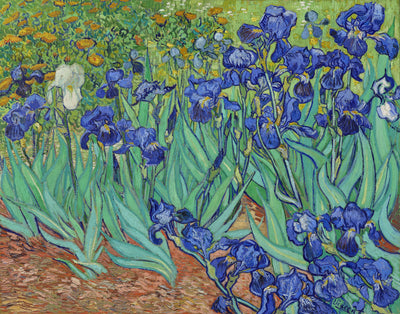
Look at Van Gogh's Irises for ten seconds and you'll notice something odd for a landscape: there's no sky. The flowers crowd right up to the frame, get sliced off at the edges, and sit in broad fields of flat color held together by wavy outlines. That's the fingerprint of Japanese prints, the cheap woodcuts Van Gogh had been buying, pinning up and studying for four years before he painted it.
He started the canvas in May 1889, within his first week at the asylum in Saint-Rémy, working straight from the plants in the garden. It's oil on canvas, 74.3 × 94.3 cm, and it now hangs in the Getty's galleries in Los Angeles. The cropped design, split into broad areas of color with the irises spilling past the borders, owes more to Japanese woodblocks than to any European flower painting. Once you know what he owned and what he wrote about it, the debt is hard to miss. Irises also happens to be one of the Van Gogh paintings people most want on their walls, and the Japanese logic is a big part of why the garden canvas from Saint-Rémy still reads so clearly from across a room.

A dealer's attic in Paris
Van Gogh bought his first Japanese prints in Antwerp in 1885 and used them to decorate his room. The real haul came later. After moving into Theo's Paris flat in early 1886, he went through the attic of the dealer Siegfried Bing, where thousands of prints were on sale for very little, and in the winter of 1886–87 he walked out with 660 woodcuts.
He didn't go for rarities. He picked bright colors and pleasing subjects: geishas in kimonos, landscapes, birds and flowers. The plan was to trade them, and when that went nowhere he started looking at them as a painter instead. They went up on the studio walls with pins, and you can still see the pinholes in a surprising number of them, along with the odd smear of paint. The brothers looked after the prints, then Theo's widow Jo van Gogh-Bonger did, and most of them ended up in Amsterdam, where you can browse what he bought from Bing print by print.
In the autumn of 1887 he copied three of them in oil. Two came from Hiroshige's One Hundred Famous Views of Edo (a plum orchard at Kameido and a bridge in a sudden shower), and one was a courtesan after Eisen. He didn't copy faithfully. For the plum orchard he kept only the three primaries and the three secondaries, dropped Hiroshige's blacks and grays, and filled the leftover width of his canvas with orange bands of Japanese characters borrowed from another print.
What he actually borrowed
Not the subjects, mostly. What stuck were ways of building a picture:
- Cropping things hard at the edge of the image, so the scene seems to carry on past the frame.
- Leaving out the horizon, or pushing it so high it barely counts, and blowing up whatever sits in the foreground.
- Laying color down in large, flat areas and fencing them in with strong contours, an idea his friend Émile Bernard was pushing hard at the time.
- Choosing small, everyday things from nature (a flower, an insect, a branch) and looking at them close up.
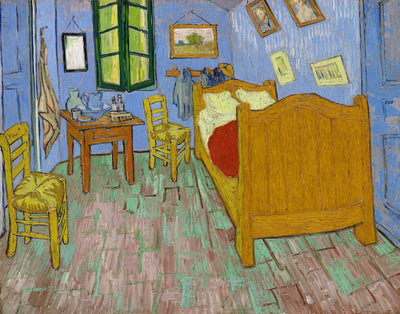
He didn't give up his own hand to do it. The flatness comes with his thick, swirling brushwork on top, which is why a Van Gogh never looks like a print even when it's organized like one. By October 1888 he was describing the painting of his bedroom in Arles as done in flat, plain tints like Japanese prints, with the shadows taken out.
Arles, the Japan he went looking for
In February 1888 he left Paris for Arles, hoping the south would give him the clear air and cheerful color he saw in the prints. He left the collection with Theo. He didn't need it anymore; he'd learned to see the way the prints saw, and you can follow that change in a good essay on his Japanese years.
The first irises came out of that trip. In May 1888 he painted a field near Arles with a band of irises across the front, 54 × 65 cm, all yellow against purple, cut by a sharp diagonal and with the flowers pushed up close. That earlier field of irises is the rehearsal. The Saint-Rémy canvas, a year later, drops the town and the sky and keeps only the flowers.
That September he wrote Theo a long passage about the Japanese artist who spends his life studying a single blade of grass, and from there works up to plants, seasons, animals and people. Then this, in his letter of 23 or 24 September 1888:
"Isn't it almost a new religion that these Japanese teach us, who are so simple and live in nature as if they themselves were flowers?"
Eight months later he was shut inside an asylum garden with nothing to paint but plants. Read that line first and Irises looks less like a consolation and more like a program he'd already written for himself. (If you want more of the correspondence, there's a guide to the letters worth reading first.)
Reading Van Gogh's Irises against Japanese prints
Put the painting next to Hiroshige's Horikiri Iris Garden, from the same Edo series he'd copied in Paris, and the family resemblance is plain. Hiroshige puts the iris stems right in your face, lets them run off the top of the sheet, and shrinks the visitors in the garden to tiny figures behind. Van Gogh goes further and removes the people and the distance altogether.

Here's what to look for on the canvas itself:
The crop. Irises spill over the left and right edges and the top. Nothing is centered, and there's no sky to rest your eye on.
The outlines. Every petal and leaf has a dark, curling contour, so the shapes read as silhouettes. Each iris is different; he worked out a whole vocabulary of twisting, wavy edges instead of repeating one flower.
The color fields. Blue-violet flowers, green blades, an orange strip of earth. Big blocks of color that sit side by side, the way they would on a woodblock.
The white iris. One pale flower among the violet ones, off to the left. It's the kind of single odd note a Japanese designer would place on purpose, and it's where most people's eyes land first.
He also collected the subject in Japanese form. His own prints include Kunisada's 1865 triptych of the iris garden at Horikiri, with figures on a veranda among the flowers.
Was Irises copied from a Japanese print?
No. Irises isn't a copy of anything; he painted it from living plants in the garden, and there are no known drawings for it. He thought of it as a study. The Japanese part is the design thinking he brought to the motif, not a borrowed image.
Shown in Paris that September
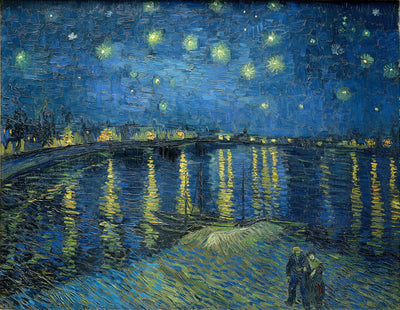
Theo liked it enough to send it to the Salon des Indépendants in September 1889, next to the starry night he'd painted over the river at Arles. The narrow room didn't suit the night scene, but Theo was delighted with the flowers, as his letter of 5 September 1889 makes clear:
"They've placed it on the narrow side of the room and it strikes you from a long way off. It's a fine study, full of air and life."
The critic Félix Fénéon, reviewing the show for La Vogue, put it more violently: "His Irises violently shred their purple parts over their lath-like leaves." Both reactions are about distance and silhouette, which is exactly what the flat, outlined design delivers.
Père Tanguy, the paint dealer, sold it in 1891 to the critic Octave Mirbeau, its first owner. Nearly a century later, on November 11, 1987, it came up at Sotheby's in New York as lot 25 and made a record $53.9 million. The buyer, Alan Bond, couldn't hold on to it, and the Getty acquired it in 1990.
The last Japanese picture
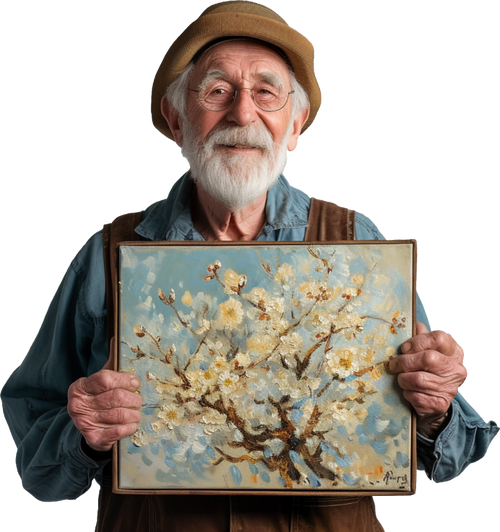
After his breakdown in Arles, Japan faded from his letters, and he stopped taking the bold risks of 1888. The prints didn't leave the paintings, though. In February 1890, still in Saint-Rémy, he painted the blossoming branches he made for Theo's newborn son: 73.3 × 92.4 cm, the subject, the bold outlines and the placement of the tree all borrowed from Japanese printmaking. Set it beside Irises and you can see the same idea twice, once on the ground and once against the sky.

Both are now among the canvases nearly everyone recognizes, and both sit high in any ranking of his best-known work. Not bad for two pictures built on lessons from prints he bought by the stack.
Irises in your own room
The things that make Irises work in a gallery, the hard crop, the outlines and the flat blocks of violet and green, are the things a painter has to get right by hand. Our studio paints a hand-painted copy of the 1889 iris garden in oil on canvas, stroke by stroke, so the contours keep their curl and the white iris still catches your eye first.
Sources
- J. Paul Getty Museum: Irises, 1889
- Van Gogh Museum: Why Did Van Gogh Collect Japanese Prints?
- Van Gogh Museum: Inspiration from Japan
- Van Gogh Museum: Van Gogh Under the Spell of Japan
- Van Gogh Letters: letter 686, to Theo
- Van Gogh Letters: letter 799, from Theo
- UPI Archives: Irises sold for record $53.9 million