4.9/5
4.9/5


Goya's art style changed more than almost any painter's of his century. He began with sunny tapestry designs and polished court portraits, turned private and savage after an illness left him deaf in the early 1790s, painted the Napoleonic war like a witness, and finished with fourteen murals so dark they were never meant to leave his house.
That is five painters in one career, from the 1770s to his death in Bordeaux in 1828. If you want to tell his phases apart in a museum, or you're deciding which of the Goya paintings copied most often would suit a room, it helps to know which Goya you're looking at. Here's the route, in order, with the pictures that show each turn.
Sunlight for the royal walls

The first Goya most people would never guess is Goya. Between 1775 and 1792 he painted full-size oil designs for the Royal Tapestry Factory of Santa Barbara near Madrid, and weavers turned them into tapestries for the royal palaces. The subjects are picnics, hunts, fairs and games, rural and popular entertainment pitched to the taste of Charles III and the young Prince and Princess of Asturias. Most of the cartoons are in the Prado today.
Study The Parasol (c. 1777). A young woman in French dress sits on the ground with a fan in her right hand and a small dog in her lap, while a young man dressed as a majo holds a parasol to shade her face. It was made for the dining room of the future Charles IV and Maria Luisa at El Pardo. Look for the green shade falling across her face. He already cared more about light than about finish.
The work paid badly and carried little prestige, but it got him noticed. Over five years he designed some 42 patterns, and the largest cartoons ran more than 8 by 10 feet. That is a lot of practice at arranging crowds of ordinary Spaniards, which he would need later for far darker crowds.
The court painter who looked too closely
Goya got a salaried post as painter to Charles III in 1786, became court painter to Charles IV in 1789, and in 1799 reached Primer Pintor de Cámara, the top rank a Spanish court painter could hold. His models were old masters, above all Velázquez and Rembrandt, whom he called his masters.
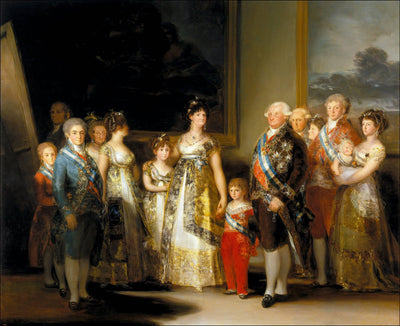
The Velázquez debt is plainest in the royal family group of 1800–1801. The canvas is 280 by 336 cm, holds fourteen figures, and borrows one idea straight from Las Meninas: Goya put himself at the left, in shadow, at his easel. Queen Maria Luisa stands at the center, not the king. The French writer Théophile Gautier called it a picture of "the corner grocer who has just won the lottery," and the satire reading stuck. I don't fully buy it. The court accepted the picture, and nothing in it is caricature; what unsettles people is that Goya painted plain faces plainly. That habit is what makes his portraits look modern.
The same years produced his notorious reclining nude, La maja desnuda (c. 1797–1800), probably commissioned by the prime minister Manuel Godoy. It has been called the first totally profane life-size female nude in Western art, with no goddess or myth as cover. The Inquisition later confiscated it and its clothed pair as obscene, and they were not returned until 1836.
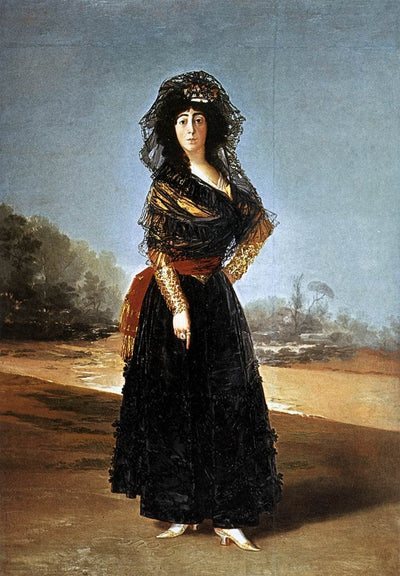
Then there is the Duchess of Alba in mourning black, painted in 1797 and now in the Main Court of the Hispanic Society in New York. She wears black maja dress, her two rings read "Alba" and "Goya", and she points at the sand, where restoration uncovered the words "solo Goya". A state portrait with a private message painted into it: that is exactly where his style was heading.
Deafness and the private pictures
Sometime between late 1792 and early 1793, an undiagnosed illness left Goya permanently deaf. His work grew steadily darker and more pessimistic from there.
While recovering he painted a set of small pictures on tin that nobody had ordered. The best known is a madhouse yard he remembered from Zaragoza, now in the Meadows Museum in Dallas: shackled inmates, two naked men fighting while a warden beats them, all under a grey and green light. Goya wrote to a friend that these pictures served "to occupy my imagination, tormented as it is by contemplation of my sufferings," and that they showed things that normally find no place in commissioned work.
That letter is the hinge of his whole career. From here on Goya ran two practices side by side: official portraits for the court, and a private art of satire, madness and nightmare.
The private art went public, briefly, in February 1799 with Los Caprichos, 80 prints in etching and aquatint that mocked the nobility and the clergy, superstition and the Inquisition. They were on sale for fourteen days, and only 27 sets sold before Goya withdrew them. Plate 43, The Sleep of Reason Produces Monsters, shows the artist slumped over his desk while owls and bats crowd in behind him.
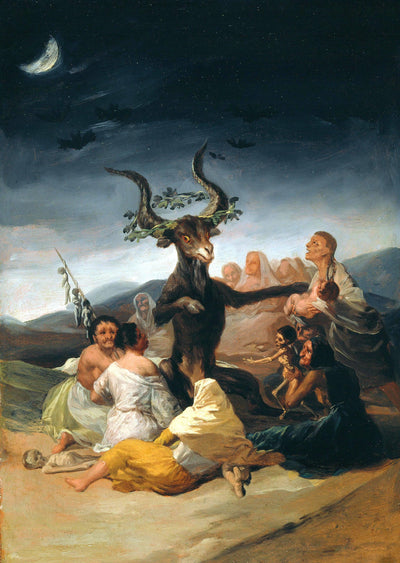
The same mood reached paint in the small witches' coven of 1798, a canvas of 43 by 30 cm that the Duke and Duchess of Osuna bought that year with five other witchcraft pictures. A goat crowned with grape leaves presides over a circle of women under a quarter moon, bats overhead, while an old woman holds up a starved infant. It hangs in the Museo Lázaro Galdiano in Madrid, and it reads best as an attack on the superstition the Inquisition fed on. Keep it in mind. Goya painted the same goat again twenty years later, and the comparison shows how far he traveled.
Painting the war as a witness

The French invasion of 1808 and the Peninsular War gave Goya his most famous subject. In February 1814, with the French gone, he asked the provisional government for permission to record the uprising with his brush. He painted two canvases: The Second of May 1808 and the night executions on the third.
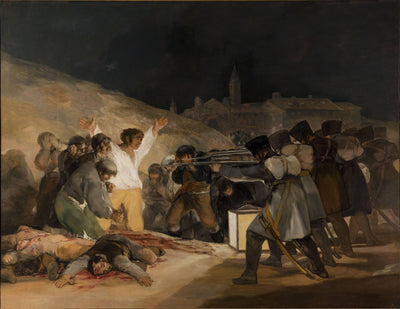
Look at how The Third of May is built. A square lantern on the ground throws the only light. The firing squad is seen almost from behind, a row of shakos and bayonets with no faces at all. The victim flings up his arms in a white shirt, and his right hand carries marks like stigmata. The brushwork is rough and the palette is earth tones and black. Kenneth Clark called it "the first great picture which can be called revolutionary in every sense of the word, in style, in subject, and in intention."
What is Goya's most famous painting?
For most people it's The Third of May 1808, a canvas of 268 by 347 cm painted in 1814 and hanging in the Museo del Prado in Madrid. It is often counted among the first paintings of the modern era, and it fed directly into Manet and into Picasso's Guernica.
The prints went further than the paintings. Between 1810 and 1820 Goya made the 82 plates of The Disasters of War, and nobody saw them as a set in his lifetime. The Royal Academy of San Fernando published them in 1863, 35 years after his death, when it was finally safe to circulate images that condemned both the French and the restored Bourbons.
The Colossus belongs to these years too: a giant striding through clouds while a crowd and cattle scatter in the valley below. Its authorship has been fought over. The Prado gave it to Goya's assistant Asensio Julià in 2008, then attributed it back to Goya in 2021. Whoever held the brush, it shows how fear was being painted in Goya's circle.
What are Goya's Black Paintings?

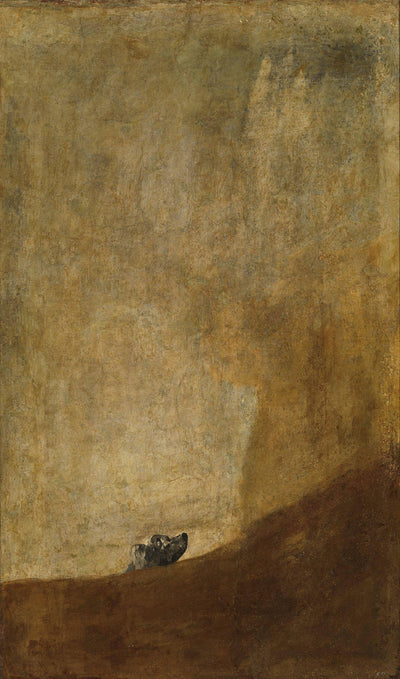
The Black Paintings are 14 murals Goya painted in oil directly on the plaster walls of his house outside Madrid between about 1819 and 1823. Nobody commissioned them and they were never meant to leave the house. They are the last and most extreme stage of his development: black grounds, smeared and scraped figures, and almost no color beyond ochre, grey and flesh.
He moved into the two-storey house in 1819, at 72. It stood on the banks of the Manzanares near the Segovia bridge. The ground floor held the Saturn that everyone remembers, one of six works in the dining room, and Leocadia, a portrait of his companion Leocadia Zorrilla in a dark, almost funereal maja dress, leaning on a mound that some critics read as a grave. Upstairs, to the right of a door, was the half-buried dog: a small head looking up over a dark slope into an empty ochre field. An old photograph shows two birds in the sky above it that disappeared when the mural was moved to canvas. Knowing that, the picture feels a little less empty and a lot sadder.
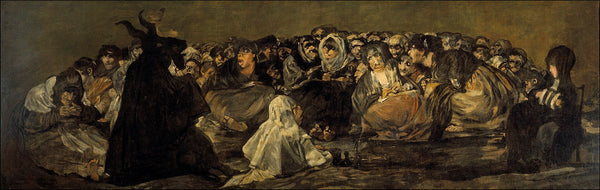
The goat is back, too. The later witches' sabbath, 140.5 by 435.7 cm, filled a whole wall of the ground floor. Put it beside the 1798 coven and you have Goya's development in two pictures. In 1798 the devil is a colorful, almost storybook goat in a wreath. By the 1820s it is a black silhouette addressing a packed crowd of distorted faces, painted in violent, rapid strokes, and the joke is gone.
Why are Goya's paintings so dark?
Only the late ones are. The Black Paintings are dark because Goya painted them for himself, on his own walls, in his seventies and deaf, after the Napoleonic wars and in the middle of Spain's political upheavals. Their themes track his fear of insanity and his bleak view of people. There's a physical reason as well: the murals were cut from the plaster and moved onto canvas, starting in 1874, so what you see now is not exactly what Goya left on the wall.
Where are the 14 Black Paintings now?
All 14 are in the Museo del Prado in Madrid. Baron Frédéric Émile d'Erlanger, who owned the house, had them transferred to canvas under the restorer Salvador Martínez Cubells, hoped to sell them at the 1878 Paris World's Fair, and gave them to the Spanish state in 1881 instead. A probable fifteenth, Heads in a Landscape, was separated from the group and is in the Stanley Moss collection in New York.
Bordeaux: a last turn toward light
Goya left Spain in 1824 and settled in Bordeaux with Leocadia. You might expect the darkness to deepen. It didn't. The Milkmaid of Bordeaux (1825–1827, Prado) shows a young woman in a shawl with her head lowered, painted in soft, bright color, so unlike the Black Paintings that some historians have doubted it is his. A stroke left him paralyzed on his right side, and he died in Bordeaux on 16 April 1828, aged 82.
How to recognize him in a gallery
- Faces that are not idealized. Kings, duchesses and soldiers get the same frank treatment. If a royal portrait looks slightly unflattering, check the label.
- Light from one source. The lantern in The Third of May, the parasol's shade in the cartoon: Goya builds scenes around where the light falls.
- Loose, visible brushwork that gets rougher with age. The Black Paintings look scraped up close.
- Crowds with no single hero. Witches, pilgrims, soldiers: from the 1790s on, the mass of people is often the real subject.
Picasso and Dalí both drew on the Caprichos and the Black Paintings, which is why Goya is so often called the last of the Old Masters and the first of the moderns. To see him beside the other names on the museum circuit, start with the paintings people ask about most.
Bringing a Goya home
If one of these phases has stayed with you, a hand-painted copy is the closest you can get without a trip to Madrid. You'll find every Goya the studio can paint for you, from the bright court years to the Black Paintings, each made in oil on canvas by hand and sized to your wall.