4.7/5


Renoir's best-known paintings, among them Bal du moulin de la Galette, Luncheon of the Boating Party, La Loge and The Umbrellas, show Parisians at leisure: bathing and boating on the Seine, dancing in Montmartre, sitting in a theater box, lunching on a restaurant balcony. The eight below run in order of date, from the summer he spent painting beside Monet in 1869 to the waltzing couple of Dance at Bougival in 1883, each with its size and where it hangs this season. Several of them, hand-painted on canvas, are in our Renoir oil painting collection, and a few sit among the most famous paintings in the world. Up first, a table lists them by the size of each original, biggest first, and gives Renoir's age when he painted it.
Pierre-Auguste Renoir was born in Limoges on February 25, 1841, and grew up in Paris. In 1862 he started lessons in the studio of the Swiss painter Charles Gleyre, where Claude Monet, Alfred Sisley and Frédéric Bazille became his friends. He died at Cagnes on December 3, 1919, aged 78. Autumn 2026 is an unusual moment to see him: the National Gallery in London, together with the Musée d'Orsay and the Museum of Fine Arts, Boston, is showing Renoir and Love from October 3, 2026, to January 31, 2027, and four of the eight pictures below are in it.
Top 8 Renoir paintings, from the biggest canvas to the smallest
| By size | Renoir canvas | Size of the original | Year | Renoir's age |
|---|---|---|---|---|
| 1 | Madame Georges Charpentier and Her Children | 153.7 × 190.2 cm (60.5 × 74.9 in) | 1878 | 37 |
| 2 | Bal du moulin de la Galette | 131.5 × 176.5 cm (51.8 × 69.5 in) | 1876 | About 35 |
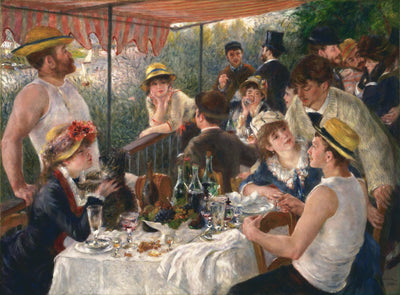
| 3 | Luncheon of the Boating Party | 130.2 × 175.6 cm (51.3 × 69.1 in) | 1880–1881 | 39 to 40 |
| 4 |  The Umbrellas |
180.3 × 114.9 cm (71.0 × 45.2 in) | About 1881–1886 | About 40 to 45 |
| 5 | Dance at Bougival | 181.9 × 98.1 cm (71.6 × 38.6 in) | 1883 | About 42 |
| 6 |  Two Sisters (On the Terrace) |
100.4 × 80.9 cm (39.5 × 31.9 in) | 1881 | About 40 |
| 7 |  La Grenouillère |
66.5 × 81 cm (26.2 × 31.9 in) | 1869 | 28 |
| 8 | La Loge | 80 × 63.5 cm (31.5 × 25.0 in) | 1874 | About 33 |
Sizes are the owning museums' figures. Ages count from Renoir's birthday, February 25, 1841, so a few could be off by a year.
The three largest canvases all come from 1876 to 1881, when Renoir was between about 35 and 40. The two smallest are his earliest pictures here, painted in his late twenties and early thirties.
The Impressionist years, 1869 to 1876
01La Grenouillère (1869)

Zoom
Did Monet and Renoir paint together? Yes, and this canvas is the proof. In the summer of 1869 the two friends set up their easels at La Grenouillère, a boating and bathing resort on the Seine not far from Paris, and on September 25 Monet noted that Renoir had just spent two months there and wanted to paint the same subject. The Met's own La Grenouillère by Monet closely resembles this Renoir, which belongs to the Nationalmuseum in Stockholm.
Renoir's version is modest in size, 66.5 × 81 cm (26.2 × 31.9 in), and its water is a mesh of short, separate touches of color. The Stockholm museum notes that to people at the time the picture looked unfinished, a mere sketch. This summer the National Gallery in London hung it beside its own Monet of the resort, reuniting two of the Grenouillère paintings for the first time in nearly twenty years, and then moved it into the Renoir exhibition. Monet's half of the story is told in our account of how Monet arrived at Impressionism.
02La Loge (1874)

Zoom
Renoir showed La Loge (The Theatre Box) at the first Impressionist group exhibition, held in Paris in 1874. A fashionable couple at the theater had never been the subject of a serious painting, and the tight crop makes the scene feel like a snapshot, the Courtauld explains. The woman has become the thing everyone looks at, while the man trains his glasses on someone else.
He set the scene up in his studio. A model called Nini Lopez posed for the woman and Renoir's brother Edmond for the man, and the gallery describes the aim as a "symphony in black and white." Some critics admired the color; others saw the sitter as overdressed and over-made-up, a woman trying to push her way into society. The canvas measures 80 × 63.5 cm (31.5 × 25.0 in). Its first owner after Renoir was Martin of Paris, who bought it in 1875; Samuel Courtauld acquired it in May 1925 and left it to the Courtauld in 1948, where it hangs in the Weston Gallery on Level 3.
03Bal du moulin de la Galette (1876)

Zoom
Renoir's Sunday dance garden on the Butte Montmartre measures 131.5 × 176.5 cm (51.8 × 69.5 in). He showed it at the Impressionist exhibition of 1877, and it belongs to the Musée d'Orsay. This season it is one of the loans in London, its first time on view in the UK, so anyone heading to the Orsay for it should wait until the exhibition closes. The hand-painted Bal du moulin de la Galette in our catalog follows the Orsay composition.
Renoir also made a second version of the dance. That one sold at Sotheby's New York on May 17, 1990, for $78.1 million, which Guinness World Records lists as the most ever paid for a Renoir at auction. How the Orsay canvas reached Paris, and its season away, are covered in our guide to the Musée d'Orsay's Impressionist paintings.
Portraits and lunches by the river, 1878 to 1881
04Madame Georges Charpentier and Her Children (1878)

Zoom
The publisher Georges Charpentier commissioned this family portrait, and Renoir is said to have worked on it for about a month before finishing it on October 15, 1878. The fee has been reported as 1,000 or 1,500 francs. Marguerite Charpentier, whose literary salons drew Flaubert, the Goncourts and Zola, used her influence to win it a good place at the Salon of 1879, and the painter Henri Gervex, then on the jury, later recalled Alexandre Cabanel ordering a guard to move it from a poorly lit second-tier spot to eye level.
Paul, aged three, still has uncut curls and wears the same dress as his sister Georgette, as fashion then required, and Georgette sits on Porthos, the family's Newfoundland, named after one of Dumas's three musketeers. The canvas measures 153.7 × 190.2 cm (60.5 × 74.9 in). At the Charpentier estate sale at the Hôtel Drouot on April 11, 1907, Durand-Ruel bid 84,000 francs for it on behalf of the Met, and Roger Fry, who handled the purchase, called Renoir the "Gainsborough of the nineteenth century" in a letter that week, according to the Met's catalogue entry.
05Luncheon of the Boating Party (1880–1881)

Zoom
Hand-painted oil reproductionSee sizes ›
The setting is the Restaurant Fournaise in Chatou, a village on the Seine that Renoir thought the perfect place for good company away from Paris. The Phillips Collection names the cast: Aline Charigot, his future wife, with her terrier; Gustave Caillebotte sitting backward on his chair; Alphonse Fournaise Jr., the owner's son, leaning on the railing; the actress Ellen Andrée; Charles Ephrussi and Jules Laforgue behind her; and Jeanne Samary and Paul Lhote at upper right.
The canvas is 130.2 × 175.6 cm (51.3 × 69.1 in). Duncan Phillips paid $125,000 for Luncheon of the Boating Party in 1923, a purchase that, by the museum's own account, used up the money set aside for buying both art and property. It is on view in Washington today, and it is the picture our guide to the famous Impressionist painters chooses to introduce Renoir.
06Two Sisters (On the Terrace) (1881)

Zoom
Hand-painted oil reproductionSee sizes ›
Painted at the same Chatou restaurant, Two Sisters is among the last pictures Renoir set there, says the Art Institute of Chicago. Despite the title, the two are not sisters: he paid unrelated models. The older one wears the blue flannel of a woman's boating outfit under a red hat, and the little girl's flowered hat is echoed by the bright skeins of yarn in the basket she touches.
Look at the faces, painted with tight, controlled strokes into a surface as smooth as porcelain, against the loose river, boats and blossoming trees behind the railing. Renoir sold On the Terrace to Durand-Ruel in July 1881 for 1,500 francs and showed it at the Impressionist exhibition of 1882. Annie Swan Coburn of Chicago bought it in 1925 for $100,000 and bequeathed it to the museum, which received it in 1933. It measures 100.4 × 80.9 cm (39.5 × 31.9 in).
The turn toward line, 1881 to 1886
07The Umbrellas (about 1881–1886)

Zoom
Hand-painted oil reproductionSee sizes ›
The Umbrellas shows Renoir changing his mind on a single canvas. The National Gallery in London explains that he painted it in two stages around four years apart, most likely 1880–1 and 1884–5. The mother and daughters on the right keep the soft, broken Impressionist touch. The young woman on the left was repainted with clear outlines and precisely drawn features, and her dress only came into fashion around 1885.
In between, Renoir traveled to Italy in 1881–82, where Raphael's frescoes in the Villa Farnesina in Rome and the ancient wall paintings of Naples impressed him, and he came to admire the drawings of Ingres. He later told the dealer Ambroise Vollard: "I had come to the end of Impressionism, and was reaching the conclusion that I didn't know how either to paint or draw." He finished the picture for a New York exhibition of Impressionist painting that opened in April 1886.
The canvas measures 180.3 × 114.9 cm (71.0 × 45.2 in). Sir Hugh Lane bought it from Durand-Ruel in November 1907, and it came to the National Gallery with his bequest in 1917; the gallery now credits it in partnership with the Hugh Lane Gallery in Dublin. Once the London exhibition closes, the gallery's record lists it on long loan to Dublin until February 2031.
08Dance at Bougival (1883)

Zoom
The open-air cafés of Bougival, a town on the Seine west of Paris, drew city people and the Impressionists alike. In this one, the Museum of Fine Arts, Boston, points out, the floor is littered with cigarettes, burnt matches and a small bouquet, while an amateur boatman sweeps his partner into a waltz, their gloveless hands touching. The son of a tailor and a dressmaker, Renoir delighted in details of fashion, down to her red bonnet trimmed with purple fruit.
The canvas is tall and narrow, 181.9 × 98.1 cm (71.6 × 38.6 in), and signed "Renoir. 83." Boston bought it in April 1937 for $150,000. In London it shares a room with Dance in the Country, another dancing couple from 1883, lent by the Orsay, and the exhibition's Boston showing runs from February 20 to June 13, 2027.
After 1883: the bathers and the piano
The change visible in The Umbrellas ends in The Large Bathers (1884–1887), where one woman threatens to splash a friend, yet every figure looks as solid as sculpture. The Philadelphia Museum of Art says Renoir labored over it for three years and, faced with criticism of his new style, never again put such painstaking effort into a single work. The canvas, 117.8 × 170.8 cm (46.4 × 67.2 in), came to Philadelphia with the Mr. and Mrs. Carroll S. Tyson, Jr., Collection in 1963, and it hangs in the last room of the London exhibition.
In 1892 the French state bought Girls at the Piano directly from Renoir for the Musée du Luxembourg, after an informal commission. That canvas, 116 × 90 cm (45.7 × 35.4 in), is now in the Musée d'Orsay, which counts three more finished versions of the composition, an oil sketch at the Musée de l'Orangerie and a pastel. One of the finished versions, 111.8 × 86.4 cm (44.0 × 34.0 in), is in the Robert Lehman Collection at the Met.
One of his last pictures, The Bathers, painted in 1918 and 1919, measures 110 × 160 cm (43.3 × 63.0 in). The models posed in the garden of Les Collettes, his house at Cagnes; the Orsay notes that it is often read as his final testament, and his three sons gave it to the French state in 1923. Between these big canvases, in 1887, he painted Berthe Morisot's daughter holding her cat, a portrait with its own entry in our list of famous cat paintings.
What kind of art did Renoir make?
Mostly oil paintings of people. Britannica describes his early work as Impressionist snapshots of real life, full of sparkling color and light, and says that by the mid-1880s he had broken with the movement for a more disciplined, formal technique in portraits and figure paintings, particularly of women. He painted landscapes too, such as a garden view titled Versailles, dated 1900–1905, in the Met's Lehman Collection.
He began as a craftsman. At 13 his parents apprenticed him to a porcelain factory, where he decorated plates with bouquets of flowers, and he went on to paint fans and religious hangings for missionaries before he could afford art lessons. In his later years he also made prints and sculpture: the Met owns his color lithograph The Hat Pinned with Flowers (1898) and a bronze Washerwoman of 1916, credited to Renoir and the young sculptor Richard Guino together.
Renoir's friends, and a Renoir at home
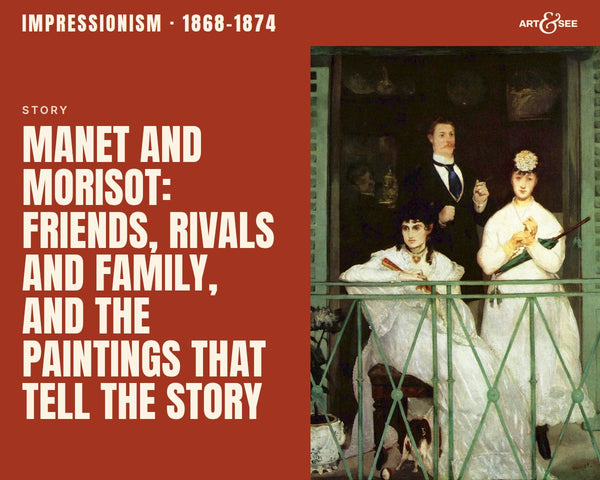
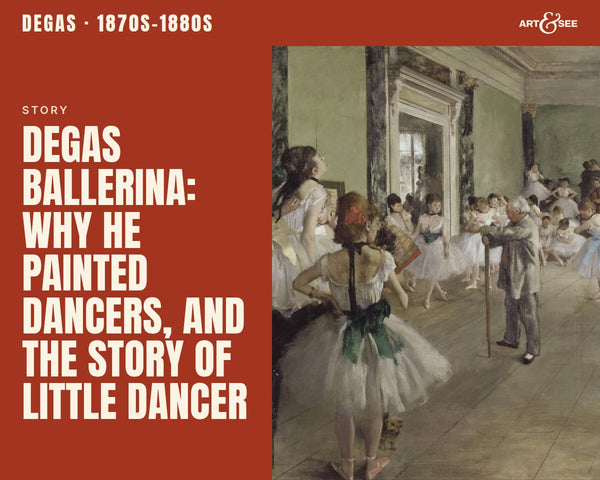
The faces in these pictures belong to Renoir's circle, and two of the painters closest to it have their own stories here: Degas and his ballerinas and Manet and Morisot. For a Montmartre dance or a riverside lunch of your own, the Renoir collection has them painted by hand in oil.
Sources
- Britannica, Pierre-Auguste Renoir
- Nationalmuseum, Stockholm, La Grenouillère (Google Arts & Culture)
- The Met, Claude Monet, La Grenouillère (1869), collection record
- National Gallery, London, Monet and Renoir: Painting Side by Side (2026)
- National Gallery, London, Renoir and Love (press release)
- The Courtauld, La Loge
- The Courtauld, La Loge, collection record P.1948.SC.338
- Musée d'Orsay, Bal du moulin de la Galette
- Guinness World Records, most expensive painting by Renoir sold at auction
- The Met, Madame Georges Charpentier and Her Children, collection record and catalogue entry
- The Phillips Collection, Luncheon of the Boating Party
- The Phillips Collection, Phillips Flashback: A New York State of Mind
- Art Institute of Chicago, Two Sisters (On the Terrace)
- National Gallery, London, The Umbrellas (NG3268)
- Museum of Fine Arts, Boston, Dance at Bougival (37.375)
- Philadelphia Museum of Art, The Large Bathers (Google Arts & Culture)
- Musée d'Orsay, Jeunes filles au piano
- The Met, Two Young Girls at the Piano (Robert Lehman Collection)
- Musée d'Orsay, Les Baigneuses
- Barnes Foundation, About the Barnes Foundation
- The Met, Renoir, Versailles (1900–1905)
- The Met, Renoir, The Hat Pinned with Flowers (1898)
- The Met, Renoir and Richard Guino, Washerwoman (1916)