4.9/5


Ten canvases painted between 1849 and 1875 tell the story of Realism best: Courbet's The Stone Breakers and A Burial at Ornans, Rosa Bonheur's The Horse Fair, Millet's The Gleaners and The Angelus, Manet's Olympia, Daumier's The Third-Class Carriage, Repin's Barge Haulers on the Volga, Whistler's portrait of his mother and Eakins's The Gross Clinic. Each one comes with its story below, and many of them are among the Realism paintings in our collection. Before the stories, a chart sorts all ten by how many language versions of Wikipedia carry an article on it, and it notes what made each one stand out when it was new.
If you want a single answer to which Realism painting is the most famous, it is A Burial at Ornans: the Musée d'Orsay, which owns it, calls it a manifesto of the new aesthetic. For what the movement was and why it took off around 1848, read our guide to Realism art; this list sticks to the pictures, in the order they were painted. Several of them also appear among the most famous paintings in the world.
The ten Realism paintings, from most to least known worldwide
| Rank | Painting | Painter | 🌍 Language versions | Why it stood out in its day |
|---|---|---|---|---|
| 1 |  Olympia |
Édouard Manet | 40 | Manet turned Venus into a Paris prostitute who stares right back, and critics mocked her. |
| 2 | Barge Haulers on the Volga | Ilya Repin | 35 | Men in harness drag a barge, lined up in a row like a carved frieze. |
| 3 | A Burial at Ornans | Gustave Courbet | 32 | Plain villagers fill a life-size canvas, and the red-faced churchwardens made Paris laugh. |
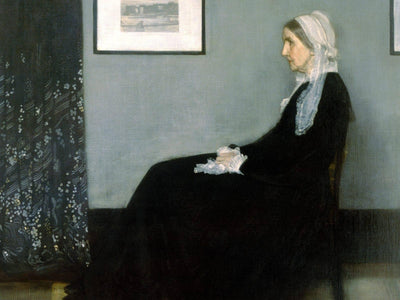
| 4 |  Arrangement in Grey and Black No. 1 (Whistler's Mother) |
James McNeill Whistler | 29 | Its title, an arrangement in grey and black, puts tone and harmony ahead of the woman sitting for it. |
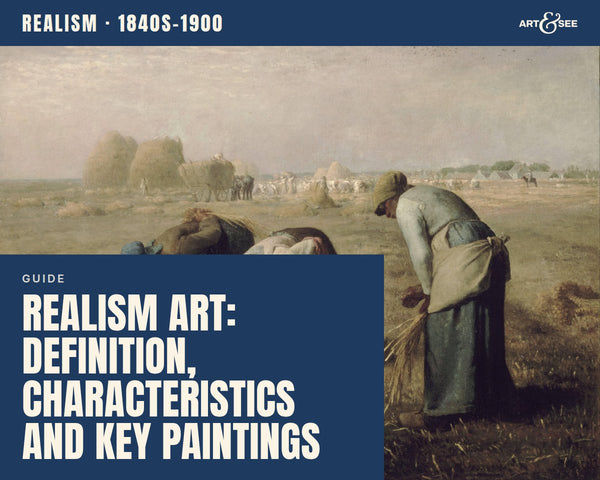
| 5 |  The Gleaners |
Jean-François Millet | 25 | Three poor women picking up leftover wheat are the whole subject. |
| 6 |  The Stone Breakers |
Gustave Courbet | 21 | Two road workers in torn clothes turn their faces away, and nothing softens the scene. |
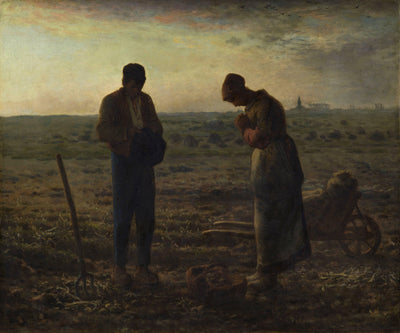
| 6 |  The Angelus |
Jean-François Millet | 21 | Two field hands at prayer look as solid as monuments on a small canvas. |
| 8 | The Horse Fair | Rosa Bonheur | 14 | Bonheur studied horses in places mostly closed to women, wearing trousers with police permission. |
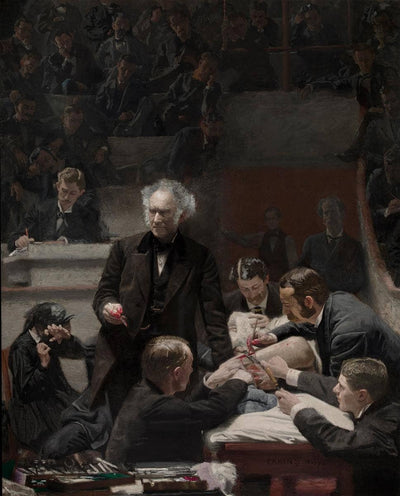
| 9 |  The Gross Clinic |
Thomas Eakins | 13 | The art jury turned it away, perhaps because the surgery looked too bloody. |
| 10 | The Third-Class Carriage | Honoré Daumier | 11 | Critics kept pointing out its loose, half-finished look. |
Each figure is the number of Wikipedia language versions that cover that painting, counted in October 2026. Two paintings tie for sixth place.
The museum and the count do not agree. The Musée d'Orsay calls A Burial at Ornans a manifesto, yet Olympia reaches eight more languages.
The ten paintings
01The Stone Breakers, Gustave Courbet (1849)

Zoom
Courbet painted two road workers from the bottom of the rural economy and left them there without comment: an old man on one knee, hammer raised over a heap of stones, and a boy carrying away the broken pieces. Their clothes are torn, their faces are turned away, and nothing in the picture explains or softens what they do. That refusal to soften or explain is the heart of what Realism meant.
You cannot see the original. It belonged to Dresden's picture gallery and was lost in February 1945, during the Allied bombing of the city, so it is known today from photographs and painted copies such as our hand-painted Stone Breakers.
02A Burial at Ornans, Gustave Courbet (1849–1850)

Zoom
Courbet's own title was longer: Painting of Human Figures, the History of a Burial at Ornans. He painted the villagers of his home town at life size, a privilege reserved for biblical and mythological figures, across 315 × 668 cm (124.0 × 263.0 in), and he improved no one. According to the Musée d'Orsay's notes on the painting, the two churchwardens, their faces as red as their robes, made Paris critics burst out laughing.
The paint carried the argument too. Courbet laid it on thick with brush and palette knife and used deep blacks, where the Academy wanted smooth surfaces and transparent glazes. Before Paris saw the canvas at the Salon of 1850–1851, he showed it in 1850 in Ornans, in the chapel of the seminary, and in Besançon and Dijon. His sister Juliette gave it to the French state in 1881, after his death.
03The Horse Fair, Rosa Bonheur (1852–1855)
Zoom
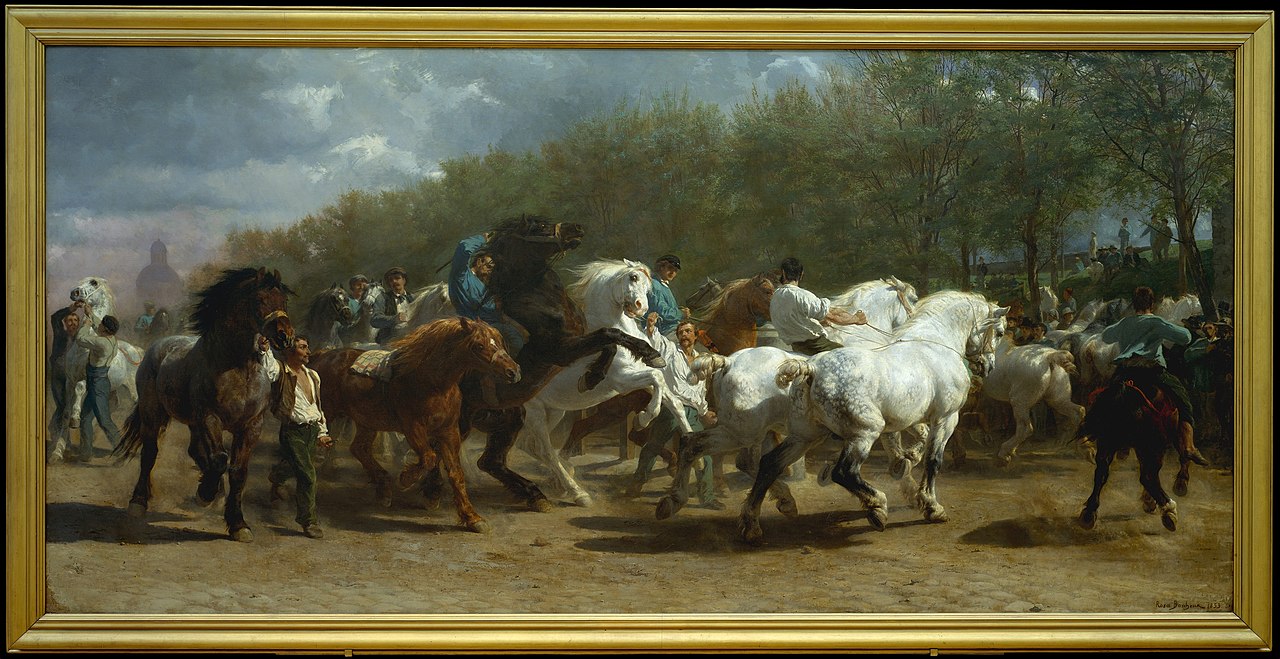
Bonheur gave working horses and their grooms a canvas 244.5 × 506.7 cm (96.3 × 199.5 in), more than five meters of rearing, stamping draft animals. It is Realism by way of close study: Britannica describes how she sketched animals on farms, in stockyards, at horse fairs and in slaughterhouses, places largely closed to women, and how by 1852 she had police permission to wear the trousers and loose blouse she worked in.
Cornelius Vanderbilt bought the painting in 1887 for a record sum and gave it to the Metropolitan Museum of Art that year. It is one of the stars of our list of famous horse paintings, next to Stubbs and Géricault.
04The Gleaners, Jean-François Millet (1857)

Zoom
Millet's women stand for the rural poor. Gleaners were allowed to pass quickly through the fields at sunset and pick up, one stalk at a time, the wheat the harvesters had missed. Millet splits that single motion among his three women: one bends, one picks up, one straightens again. Behind them the real harvest goes on in bright light, with haystacks, sheaves, a loaded cart and a crowd of workers, made distant by an abrupt jump in scale.
The Gleaners was shown at the Salon of 1857 and measures 83.5 × 110 cm (32.9 × 43.3 in). Its collection record at the Orsay shows that it reached the French state in 1890, as a gift from Madame Pommery, and that it has hung at the Musée d'Orsay since 1986.
05The Angelus, Jean-François Millet (1857–1859)
Two field workers stop digging potatoes when the evening bell rings and bow their heads, tools and sacks around their feet. The canvas is small, 55.5 × 66 cm (21.9 × 26.0 in), yet the two figures, alone on an empty plain with their faces in shadow, read as monuments. The Musée d'Orsay adds a detail worth knowing: Millet was not a churchgoer, and the scene grew out of a memory of childhood rather than a wish to glorify faith.
Its later life was stranger than its subject. The museum notes that Salvador Dalí venerated it, that a madman slashed it in 1932, and that it became a world-famous image in the 20th century. You can order The Angelus hand-painted in oil.
06Olympia, Édouard Manet (1863)

Zoom
Hand-painted oil reproductionSee sizes ›
Manet signed and dated the canvas 1863, but it was first exhibited at the Salon of 1865. The Musée d'Orsay lists what he borrowed, Titian's Venus of Urbino, Goya's Maja desnuda and the theme of the odalisque with a Black servant, which Ingres among others had painted, and then sums up what he did with it: "Venus has become a prostitute, challenging the viewer with her calculating look."
Critics attacked the "yellow-bellied odalisque," and only a small group led by Émile Zola defended it. The model was Victorine Meurent, who also posed for Le Déjeuner sur l'herbe. Olympia measures 130.5 × 191 cm (51.4 × 75.2 in). For how Manet's way of painting differs from his near-namesake's, see Manet vs Monet: how to tell them apart.
07The Third-Class Carriage, Honoré Daumier (1864)

Zoom
Daumier made his name with lithographs, not oils. From 1832 he drew for the Paris daily Le Charivari, and that same year two lithographs mocking King Louis-Philippe, Gargantua among them, earned him a six-month prison sentence, the Musée d'Orsay's Daumier retrospective recalls. After the paper fired him in 1861, collectors began buying his watercolors.
This canvas, which the Metropolitan Museum of Art dates to 1864, puts us inside the cheapest class of train: a young mother, an old woman and a boy on a hard wooden bench, a packed crowd of passengers behind them. It measures 65.4 × 90.2 cm (25.7 × 35.5 in) and came to the Met with the Havemeyer bequest in 1929. Its loose, half-finished look, which critics never failed to point out, is typical of Daumier's painting. Friends organized a show of his work at the Durand-Ruel gallery in 1878; it failed, and he died the following February.
08Barge Haulers on the Volga, Ilya Repin (1870–1873)
Repin lined up his haulers like a frieze, men in harness leaning into the towline as they drag a barge along the riverbank. The canvas, 131.5 × 281 cm (51.8 × 110.6 in), has belonged to the State Russian Museum in Saint Petersburg since 1918. How Repin found his models, and what the picture did for his career, is told in our guide to famous Russian paintings, next to his Ivan the Terrible and His Son Ivan.
09Arrangement in Grey and Black No. 1 (Whistler's Mother), James McNeill Whistler (1871)

Zoom
Hand-painted oil reproductionSee sizes ›
Whistler painted it in the summer of 1871 in his London studio at 2 Lindsey Row. The Musée d'Orsay reads the double title as a turning point: the Realism of his early years pared down to line, tone and a grey-and-black harmony. Soon afterward he gave his pictures only musical titles, as if the subject mattered less than the arrangement.
The French state bought it from the artist in 1891 for the Musée du Luxembourg; it moved to the Louvre in 1925 and to the Orsay in 1986. The museum calls it one of the most famous works by an American artist kept outside the United States. Whistler's Mother measures 144.3 × 163 cm (56.8 × 64.2 in). For more pictures from his side of the Atlantic, see these famous American paintings.
10The Gross Clinic, Thomas Eakins (1875)

Zoom
Hand-painted oil reproductionSee sizes ›
Eakins painted the surgeon Samuel D. Gross teaching in the operating theater of Jefferson Medical College, and he made the picture for Philadelphia's Centennial Exhibition of 1876. The Philadelphia Museum of Art records what happened next: the fair's art jury rejected it, perhaps finding the subject too bloody for the art building, and it hung instead in a model U.S. Army field hospital. On June 16, 1876, a critic in the Philadelphia Evening Telegraph blamed "the squeamishness of the Selection Committee."
Philadelphia kept the picture in 2007, when 3,600 donors from every state chipped in to buy it. The museum and the Pennsylvania Academy of the Fine Arts show it in alternating five-year periods, and the museum scheduled its move out for March 2026, so check both before you go. A hand-painted Gross Clinic keeps the operating-room drama at home.
The Realist painters to know
The ten pictures come from eight painters: Courbet, Millet, Bonheur, Manet, Daumier, Repin, Whistler and Eakins. Two more round out a list of ten Realist artists. In Berlin, Adolph Menzel spent weeks sketching in Upper Silesia before painting The Iron Rolling Mill (1872–1875), a factory hall of steam and glowing iron now in the Alte Nationalgalerie. In the United States, Winslow Homer left a lone sailor on a dismasted boat among sharks in The Gulf Stream, which the Met dates to 1899, reworked by 1906.
Realism or realistic?
A list of the most lifelike paintings would look different from this one, because the word has two meanings. Tate separates them: Realism is the mid-19th-century movement above, while "realism" is also used for any work painted in an almost photographic way. For the second kind, look at Photorealism, which Tate dates to the late 1960s in Europe and the United States, with artists such as Chuck Close, Richard Estes and Malcolm Morley.
Twentieth-century American Realism sits between the two. Edward Hopper's Nighthawks (1942), an all-night diner seen through a wide window, belongs to the Art Institute of Chicago and measures 84.1 × 152.4 cm (33.1 × 60.0 in). To see where Realism falls among the other movements, try our art movements timeline, and for the painters who came next, from Cézanne to Van Gogh, our guide to Post-Impressionism.
Realism for a room you live in
These painters hid their meaning in small things, a bent back, a red face, a cat's raised tail, and those are the details that keep paying off on a wall you pass every day. Browse the Realism collection, or start with Millet's The Sower, a field hand striding downhill as he scatters seed.
Sources
- Musée d'Orsay, Gustave Courbet, Un enterrement à Ornans (collection record)
- Musée d'Orsay, Jean-François Millet, Des glaneuses (collection record)
- Musée d'Orsay, Jean-François Millet, L'Angélus (collection record)
- Musée d'Orsay, Édouard Manet, Olympia (collection record)
- Musée d'Orsay, James McNeill Whistler, Arrangement en gris et noir n°1 (collection record)
- Musée d'Orsay, Daumier (exhibition, 1999–2000)
- The Metropolitan Museum of Art, Rosa Bonheur, The Horse Fair
- The Metropolitan Museum of Art, Honoré Daumier, The Third-Class Carriage
- The Metropolitan Museum of Art, Winslow Homer, The Gulf Stream
- Britannica, Rosa Bonheur
- Philadelphia Museum of Art, Thomas Eakins, Portrait of Dr. Samuel D. Gross (The Gross Clinic)
- Philadelphia Museum of Art, The Gross Clinic by Thomas Eakins
- State Russian Museum, Ilya Repin, Barge Haulers on the Volga
- Allison McNearney, "Gustave Courbet's The Stonebreakers: the masterpiece destroyed when the Allies bombed Dresden," The Daily Beast (2019)
- Alte Nationalgalerie, Staatliche Museen zu Berlin, Adolph Menzel, The Iron Rolling Mill (Google Arts & Culture)
- Art Institute of Chicago, Edward Hopper, Nighthawks
- Tate, Realism (art term)
- Tate, Photorealism (art term)