4.9/5
4.9/5


Raphael had twenty years. He left Urbino for Perugia in 1500, and he died in Rome on his 37th birthday, April 6, 1520. Between those dates he painted altarpieces, Madonnas, portraits and whole rooms of the Vatican, and the Raphael paintings that survive trace a career that moved faster than almost any other in European art. You can see him learning from Perugino, then absorbing Leonardo, then setting the standard that academies copied for three centuries.
This guide follows him city by city, because that's how his work actually changes. If you already know which picture you're after, the Raphael paintings the studio copies by hand are grouped in one place; if you want the highlights reel, there's a separate piece on the fifteen pictures everyone knows. What follows is the whole arc.
Urbino and Perugia: the Umbrian altarpieces
He was born in Urbino in 1483, the son of Giovanni Santi, a court painter. Urbino gave him Piero della Francesca and Mantegna to look at early. Perugia gave him Perugino, whose calm figures and soft hills run through Raphael's early altarpieces.
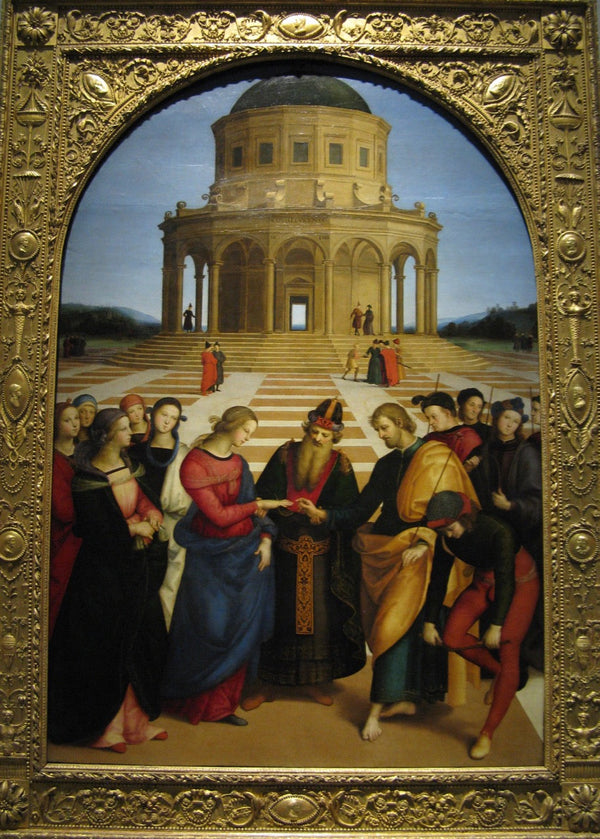
The picture that shows him pulling away is the Marriage of the Virgin, signed and dated 1504. He painted it for the church of San Francesco at Città di Castello, and he clearly had Perugino's altarpiece of the same subject in mind: the temple, the crowd, the ring passing between Mary and Joseph. But look at the building. Every line of the pavement runs to the temple door, and infrared scans show the perspective lines he scored underneath. Perugino set his figures inside a correct space. Raphael made the space the subject. He signed it RAPHAEL URBINAS, a young painter announcing where he came from.

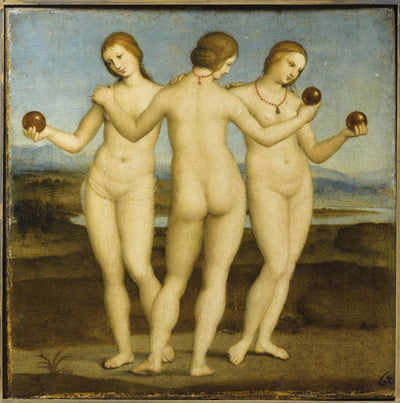
Two more pictures belong to this moment. The Ansidei Madonna, painted in 1505 for a family chapel in San Fiorenzo in Perugia, went to London's National Gallery in 1885 with a special grant from Parliament. And the square little Three Graces, now at Chantilly, is a secular picture from the same years: three nudes holding golden apples, borrowed from an ancient marble. Underdrawing shows he started it as a Judgment of Paris and changed his mind.
Florence, 1504–1508: Madonnas and portraits
Until 1508 Raphael's base was Florence, and Florence meant Leonardo and Michelangelo. He went there to learn, and he learned faster than anyone.
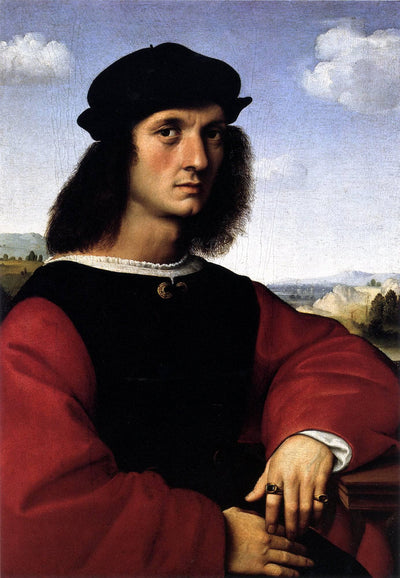
The clearest proof is his portrait of the merchant Agnolo Doni. Doni married Maddalena Strozzi on January 31, 1504, and ordered a pair of portraits, each on a panel 63.5 by 45 cm. Maddalena's pose is lifted almost straight from the Mona Lisa, close enough that Raphael must have studied Leonardo's panel in person. What he left out is the fog. Where Leonardo blurs, Raphael gives you clean edges and clear color: Agnolo's rings, the calm hills behind him. On the backs, another painter added the Flood and the story of Deucalion and Pyrrha, and since 2018 the Uffizi has hung both Doni portraits so you can walk around them, next to Michelangelo's Tondo Doni, painted for the same couple.
The Madonnas start here too. The Madonna of the Goldfinch was a wedding gift for his friend Lorenzo Nasi, who married on February 23, 1506. In 1547 a landslide destroyed the Nasi house and broke the panel into seventeen pieces. It was pieced back together, probably by Michele di Ridolfo del Ghirlandaio, and it still hangs in the Uffizi. That pyramid of mother, child and infant Baptist became his formula, and the traits that make it unmistakable get their own treatment in what gives his work its look.
Rome, 1508–1520: the Vatican years
In 1508 Pope Julius II called him to Rome. He was 25 and he never left.
The rooms
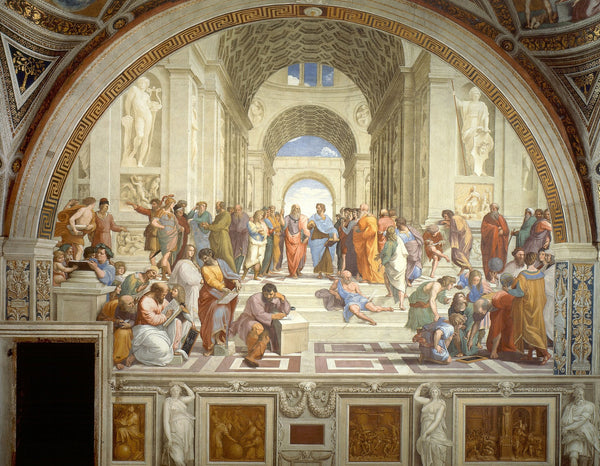
His first job was a room Julius used as a library and private office. Between 1508 and 1511 Raphael covered it with frescoes on theology, philosophy, law and poetry, including the School of Athens, and these are the frescoes that open the High Renaissance. Three more rooms followed, and each has its own tour in a fresco-by-fresco walk through the Stanze.
The altarpieces
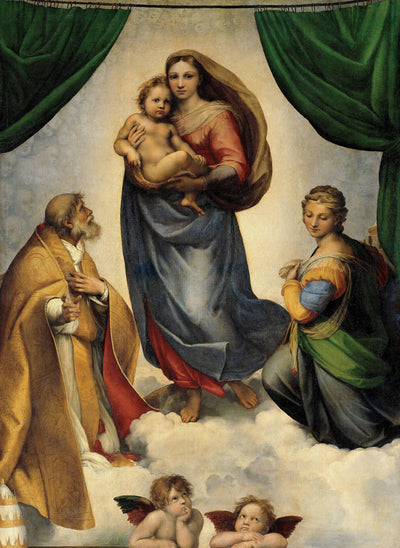
Rome didn't stop him painting panels. The Madonna of Foligno, commissioned in 1511, thanks the Virgin for saving the donor's house from lightning; you can see the strike in the background. Then came the Sistine Madonna of 1512–1513, another commission from Julius II, for the high altar of the monastery of San Sisto in Piacenza. It stayed there almost 250 years, barely known, until Augustus III of Saxony bought it for Dresden in the 1750s. Adolph Menzel later drew the moment of its arrival and titled the pastel with the words the king is supposed to have spoken: "Make room for the great Raphael!" The two bored cherubs at the bottom edge left the picture around 1800 and went solo; Dresden tells how the angels ended up on everything, from porcelain to kitsch.

In 1514 he was also named architect of St Peter's. A year later Leo X ordered ten full-size designs for tapestries in the Sistine Chapel, scenes from the lives of Peter and Paul, each cartoon about 5 meters wide. Seven survive. The future Charles I brought them to Britain in the 17th century, and they've hung in London since 1865, where the cartoons fill their own court at the V&A.
His last years ran on a big workshop. The Louvre's large Saint Michael of 1518, a gift from the pope to Francis I, is a canvas nearly 2.7 meters tall and probably had help from Giulio Romano.
The last picture
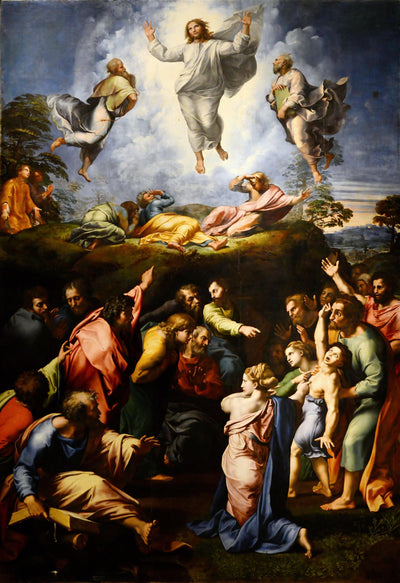
Cardinal Giulio de' Medici ordered an altarpiece for Narbonne Cathedral in 1515. Raphael worked on it from 1516 until he died, on a panel 410 by 279 cm: the Transfiguration, his final work. The top half shows Christ lifted in light above the mountain. The bottom half, full of shouting apostles and a possessed boy, shows the next episode in the Gospel. It never went to France. The cardinal kept it and gave it to San Pietro in Montorio. Under the Treaty of Tolentino it went to Paris in 1797, and it came back in 1816. Giorgio Vasari called it "the most famous, the most beautiful and most divine" of all his works. I'd agree with the first two.

What is the most famous Raphael painting in the Vatican?
If you mean a fresco, it's the School of Athens in the Stanza della Segnatura. If you mean a painting you can walk up to, it's the Transfiguration, which hangs in Room VIII of the Vatican picture gallery with the Madonna of Foligno and the Oddi altarpiece from his Perugia years. That one room covers his whole career.
Where Raphael's paintings hang today
The major works are spread across Europe, and one museum can't give you the full picture. Here's where the pictures in this guide are.
| Work | Date | Where it is |
|---|---|---|
| The Marriage of the Virgin | 1504 | Pinacoteca di Brera, Milan |
| The Three Graces | 1503–1508 | Musée Condé, Chantilly |
| Ansidei Madonna | 1505 | National Gallery, London |
| Portraits of Agnolo and Maddalena Doni | about 1504–1507 | Uffizi, Florence |
| Madonna of the Goldfinch | before 1506 | Uffizi, Florence |
| Stanza della Segnatura frescoes | 1508–1511 | Vatican Museums |
| Madonna of Foligno | 1511–1512 | Vatican Museums |
| Sistine Madonna | 1512–1513 | Gemäldegalerie Alte Meister, Dresden |
| Tapestry cartoons | from 1515 | V&A, London |
| Saint Michael | 1518 | Louvre, Paris |
| The Transfiguration | 1516–1520 | Vatican Museums |
How many paintings did Raphael paint?
Nobody can give you a firm number, and anyone who does is guessing. He ran a huge workshop, pupils like Giulio Romano finished what he started, and scholars still argue over attributions. When Rome marked the 500th anniversary of his death in 2020, the Scuderie del Quirinale put together the largest Raphael show ever held, and even there master and shop weren't always separated picture by picture. The honest answer is a short list of undisputed panels, the Vatican frescoes and the cartoons, surrounded by a long, shifting list of workshop pictures.
He was buried in the Pantheon. Twenty years of work is the reason his pictures sit at the center of the paintings people ask to own most.
Bringing one home
Most of these pictures are on panel, several are taller than a person, and none of them travel. If one of them has stayed with you, Art & See's painters work by hand in oil, at the size you choose, from the altarpieces of Umbria to the Vatican panels. You can browse every Raphael we paint to order and start from the one you'd want to see every day.
Sources
- Pinacoteca di Brera, The Marriage of the Virgin
- Uffizi, Portraits of Agnolo and Maddalena Doni
- Vatican Museums, Room of the Segnatura
- Vatican Museums, The Transfiguration
- Gemäldegalerie Alte Meister, The Sistine Madonna
- V&A, The Raphael Cartoons
- National Gallery, Raphael
- Vatican News, Raphael 500th anniversary