4.7/5


Pick up a real Rembrandt etching and the first surprise is the size. Many are small enough to cover with your hand. The second surprise is that no two impressions of the same plate look quite alike, because Rembrandt kept scratching, polishing and re-inking his copper for years. That habit is the key to Rembrandt etchings: each one is a record of decisions he kept changing, printed one sheet at a time.
He etched from 1626 until 1660, the year money trouble forced him to sell his printing press. In those decades he made Bible scenes, landscapes, street scenes, a seashell and dozens of faces, many of them his own. If you know him through the big Rembrandt canvases in Amsterdam, the prints show the same man working faster, stranger and more privately.
First, how a plate was made and what "state" means. Then twelve prints worth knowing, with the detail to look for in each.
How Rembrandt's etchings were made
The process started with a copper plate coated in a mix of resin and beeswax. Rembrandt drew into that coating with a needle, scratching until the copper showed through, and then let acid bite the exposed lines into the metal. The Rijksmuseum walks through the process in ten short steps, from the wax ground to plates that wore out. He sometimes made a drawing first. More often he worked straight on the plate, in small steps.
Two other tools changed the look of his work. With drypoint he scratched bare copper directly, which throws up a ragged ridge of metal called burr. Burr holds ink and prints as a soft, velvety black. It also flattens fast, so the first impressions of a drypoint are the richest. The burin, an engraver's tool, cut clean grooves he used to firm up passages. Many plates below mix all three.
Then there's the printing. He pulled impressions on ordinary paper, on Japanese paper (a favorite, warm in tone), and even on vellum. He also left a thin film of ink on parts of the plate instead of wiping it clean, a trick called plate tone. Two sheets from one plate, one wiped and one toned, can look like different pictures.
What does "state" mean on a Rembrandt print?
A state is a version of the plate. Every time Rembrandt changed the copper and printed again, the new impressions form a new state. In the 1650s his large plates often went through several, as many as eleven, and some changes were drastic. Curators write it as a fraction: "iv/v" means the fourth of five known states. One more quirk: the plate prints in reverse, so everything he drew comes out mirrored on paper.
The twelve prints, and what to look for in each
The list runs in the order he made them, with one exception saved for last. The table gives the one thing to check when you stand in front of each.
| # | Year | Look for | |
|---|---|---|---|
| 1 | An old woman, probably his mother | 1620s | The face he practiced on first |
| 2 | Self-Portrait Leaning on a Stone Sill | 1639 | The velvet cap and the fur |
| 3 | The Three Trees | 1643 | Storm on the left, sun on the right |
| 4 | Six's Bridge | 1645 | How few lines it takes |
| 5 | Jan Six | 1647 | How far five states can push one plate |
| 6 | Self-Portrait Etching at a Window | 1648 | Rembrandt at work, no costume |
| 7 | The Hundred Guilder Print | c. 1648 | Greys from black to near white |
| 8 | The Shell | 1650 | The spiral turns the wrong way |
| 9 | A Scholar in His Study (Faust) | c. 1652 | The apparition in the window |
| 10 | The Three Crosses | 1653 | Which state you are looking at |
| 11 | Christ Presented to the People | 1655 | Is the crowd in front still there? |
| 12 | The Angel Appearing to the Shepherds | 1634 | The animals reacting to the light |
1. An old woman, probably his mother, 1620s
His very first etchings show an elderly woman who may well be his mother. Next to the late plates they look careful and modest, a young artist finding out what a needle can do with an aging face. Start here and everything after looks bolder.
2. Self-Portrait Leaning on a Stone Sill, 1639
Rembrandt in his early thirties, dressed in lace and fur under a velvet cap, one arm on a stone ledge. The print shows how much he admired Titian's portraits, and the message is plain: an Amsterdam painter placing himself beside the Italians. The V&A puts it well when it describes that swagger velvet cap. The plate is only about 21 by 16.5 cm. Put it next to one of his painted self-portraits and you see the same appraising stare, minus the color.
3. The Three Trees, 1643

This is the largest and most painterly landscape he ever etched. A thunderstorm clears on the left while a low sun lights the fields from the right, and the three trees most likely stood on a dike along the Zuiderzee. Look in the lower right: a pair of lovers is tucked into the brush. The dense hatching still starts arguments over whether it shows rain or rays of light. The Amsterdam impression, printed with a light plate tone, measures 213 by 279 mm.
4. Six's Bridge, 1645
A small bridge on a riverbank, drawn with almost nothing. The story goes that Rembrandt scratched it straight into the etching ground while he and his patron Jan Six waited for a servant to fetch a pot of mustard. True or not, the print shows he carried prepared plates with him. Nobody is sure of the exact spot, and the sheet kept in Amsterdam is just 129 by 224 mm.
5. Jan Six, 1647
The same patron, now as a formal portrait, which Rembrandt took through five states. Six also sat for a painted portrait by Rembrandt, so the pair is a rare chance to compare his two media on one sitter. Impressions are in Amsterdam, London and St. Petersburg.
6. Self-Portrait Etching at a Window, 1648
No fur, no velvet. Nine years after the stone-sill portrait, he shows himself in work clothes, busy on a plate at a window. The Rijksmuseum impression is printed on Chinese paper and measures just 160 by 130 mm. Of all his self-portraits it's the most honest about the job.
7. The Hundred Guilder Print, c. 1648

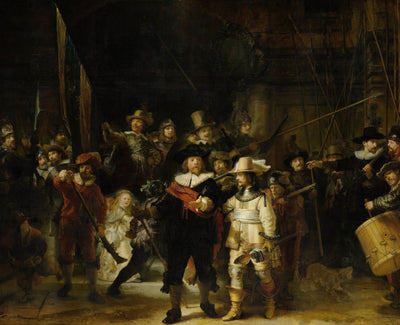
The print most people mean when they say "Rembrandt etching." It packs a chapter of Matthew 19 into one sheet: Christ healing the sick, debating with scholars, calling the children to him, with rich and poor, healthy and sick all grouped around him. Rembrandt worked on it in stages through the 1640s, the decade in which he finished the Night Watch militia portrait in 1642. The result is a range of greys, from velvety black to almost white, that nobody had printed before.
The name comes from its price. A letter of 1654 mentions that it had "been sold various times for 100 guilders and more," a huge sum for a print. Around 1775 William Baillie heavily reworked Rembrandt's original plate and printed an edition of 100, so a "Hundred Guilder Print" at auction can be a very different object from a sheet Rembrandt pulled himself.
8. The Shell, 1650
His only still-life etching: a marbled cone shell shown about life size, 6.4 cm long. Look at the spiral. It turns counterclockwise, but every real shell of this species turns clockwise. Rembrandt drew it as he saw it and the press reversed it, so he printed a shell that doesn't exist in nature. The plate is known in three states.
9. A Scholar in His Study (Faust), c. 1652
A scholar stands transfixed by an apparition of light in his window, and the light falls across his head and shoulders. The scene reads best as an allegory of faith: divine wisdom that people can grasp only indirectly and imperfectly. Impressions on Japanese paper with plate tone give the light a warm glow, and the sheet is only about 21 by 16 cm.
10. The Three Crosses, 1653
This one has to be seen in two states. The early versions, all drypoint, show the crowd of onlookers around the crosses. The burr wore down after about 40 impressions of the first three states, so Rembrandt went back into the plate and rebuilt it. In the fourth state, slashing strokes bury the spectators in darkness and only Christ stays lit, a literal picture of Luke's "darkness over all the earth." Same subject, far more ominous atmosphere, on a sheet about 38 by 45 cm.
11. Christ Presented to the People, 1655
A second huge drypoint, about 38.7 by 45.4 cm, scratched straight into the copper. Pilate, holding a long staff, points at Christ and leaves the crowd to choose between him and the murderer Barabbas. It exists in eight states. In the later ones Rembrandt scraped away the crowd below the platform, which leaves you, the viewer, standing where the mob stood.
12. The Angel Appearing to the Shepherds, 1634
Out of order on purpose, because this is the one to finish on once the rest make sense. It's a night scene: a host of angels fills the sky and, on the ground, the shepherds and their flocks react to the sudden light. He built it in etching, drypoint and burin on a plate about 26 by 22 cm. Everything he later did with darkness in The Three Crosses is already here in outline, nearly twenty years earlier.
What does an original Rembrandt etching cost?
It depends on the print, the state and when the sheet was pulled, and the top of the market is rare air. Only eight impressions of the first state of Christ Presented to the People are known, and seven belong to museums, from the British Museum to the Albertina. Christie's offered the last one left in private hands in London in July 2018, and it sold for £2.2 million, a record at the time for any Old Master print.
Lower down, the questions are practical. Plates were reworked and reprinted long after the first pulls, and restrikes such as Baillie's exist. Before buying, ask which state a sheet is, when it was printed, and how much of the drypoint burr survives.
Is Rembrandt Baroque or Renaissance?
Baroque. He was born in 1606 and died in 1669, well after the Renaissance, and he belongs to the Dutch Golden Age, the Dutch Republic's 17th century. Dutch painting of that period sits inside the European Baroque, though most of it skips the idealized splendor of neighboring Flanders. Rembrandt fits that description: real bodies, real rooms, theatrical light. Prints spread his name across Europe in his lifetime, and they still make an easy entry point to the paintings everyone recognizes from that century.
From the print room to your wall
Originals live in museum print rooms and change hands at auction. If you'd rather live with Rembrandt's light in oil, the studio paints every Rembrandt in the collection by hand, including his stormy Sea of Galilee boat, so the drama you learned to read in his prints hangs on your wall in full color.
Sources
- Rijksmuseum, 10 things to know about Rembrandt's etchings
- Rijksmuseum, Christ Healing the Sick (Hundred Guilder Print)
- Rijksmuseum, The Three Trees
- Rijksmuseum, Christ Presented to the People
- Cleveland Museum of Art, The Three Crosses
- Victoria and Albert Museum, Self portrait leaning on a stone sill
- Christie's release on Christ Presented to the People, 2018