4.9/5
4.9/5


A young man in a plumed velvet beret twists round on his chair, grins straight at you and lifts a glass nearly as long as his forearm. A young woman sits on his lap in silk and pearls, glancing back over her shoulder as if she has just been caught. That's Rembrandt's Prodigal Son in the Tavern, painted about 1635, and the grinning drinker is Rembrandt himself. The woman is Saskia van Uylenburgh, his wife of roughly a year.
It's a strange thing for a newly married painter to do: cast himself as the Bible's best-known wastrel, the son who takes his inheritance and spends it on wine and women. Keep that in mind, because about thirty years later Rembrandt went back to the same story and painted its last scene, the ragged son kneeling at his father's feet, in the huge canvas now in St. Petersburg. The two pictures belong together, and the tavern scene is the one most people have never looked at closely. It also sits a little apart from the Rembrandt paintings people usually hang at home: loud, theatrical, a bit embarrassing, and very human.
What you are looking at

The canvas is big, 161 by 131 cm, so the two figures are close to life size. Rembrandt fills almost all of it with the couple and leaves the room around them dark.
Look at the details he picked. The glass is the tall, narrow kind used in drinking contests. On the table at left, a pie is topped with a whole peacock, the showiest dish a Dutch kitchen could put out. A sword hangs at his hip with its gilded hilt catching the light. The heavy curtain at right makes the whole thing feel like a stage set, which is exactly how it plays: two people performing a good time for an audience, and the audience is you.
Saskia is the more interesting of the two. She doesn't laugh. Her pose is stiff, her face composed, and she looks out at the viewer with something closer to caution than pleasure. Susan Donahue Kuretsky, writing on the painting in 2007, called the couple "prideful celebrants in a tavern interior" and read in it "a touch of uncertainty about the extravagant way of life that was suddenly his." I think that's right. The joke is on him, and he knows it.
Why the prodigal son?
The parable is in Luke 15:11–32. A younger son asks his father for his share of the estate, leaves for a far country and wastes it in riotous living. When the money runs out he ends up feeding pigs, comes to his senses and walks home to beg for a servant's job. His father sees him coming and runs to meet him.
Dutch painters of the early 1600s loved the first half of that story, because it let them paint a bawdy tavern party and call it a sermon. The Utrecht painters who had studied Caravaggio were especially keen: Dirck van Baburen painted the subject in 1622, Gerrit van Honthorst in 1623. Their prodigals drink and flirt with hired women while a band plays. Buyers got the fun and the moral in one frame.
Rembrandt took that formula and did something unusual with it: he put his own face on the sinner and his own wife in the place of the tavern girl. Nothing in the picture spells out the Bible. There's no pig, no father, no halo. The title is a reading of the scene, but it's the reading the pose, the costume and the feast all push you toward.
Is it really Rembrandt and Saskia?
Yes. The man is plainly the same face Rembrandt painted and etched dozens of times in the 1630s (set it next to one of his self-portraits and the nose and moustache give him away). The Dresden catalogue itself titles the picture after the two of them.
The timing matters. Rembrandt married Saskia on 22 June 1634 in the church at Sint Annaparochie in Friesland. She was the niece of Hendrick van Uylenburgh, the Amsterdam art dealer Rembrandt had lodged with since 1632, the same year he painted Dr. Tulp's anatomy lesson, his first group portrait. In 1635 the couple rented a house on the Nieuwe Doelenstraat. Their first son, Rombartus, died that year at two months old.
So this is a man at the top of his early fame, newly married into a better family, living well, and already acquainted with loss. Painting himself as the prodigal reads less like a boast than a private joke with a sting in it.
A picture he kept changing
The painting you see isn't the painting Rembrandt started. Technical examination shows he changed the composition while he worked, and at some point before it reached Dresden the canvas was trimmed and a strip was added along the bottom edge. The Rembrandt Research Foundation described it bluntly as "a poorly preserved painting that has undergone changes in format and whose composition has been altered."
That history is why the Dresden conservators opened a full technical study of the canvas in April 2023, with the Rijksmuseum and the Doerner Institute in Munich among the partners, running to December 2025. The aim is to sort out how the picture was built up and to plan its restoration.
Earlier pigment analysis already gives a good idea of his palette here: lead white, lead-tin yellow, madder lake and red ochre for the costume and flesh, bone and charcoal black, green earth, and small amounts of smalt and natural ultramarine. You can see the full list of pigments and paint layers broken down layer by layer.
Where it hangs and how it got there
The painting is in the Gemäldegalerie Alte Meister in Dresden, gallery number 1559. It was bought for the Saxon court in the middle of the eighteenth century. In 1749 the Paris agent Théodore Le Leu described it as a "grand tableau" with Rembrandt's portrait seated with his wife on his lap, and it first appears in the Dresden inventory in 1754.
The same son, thirty years later
Rembrandt didn't leave the story alone. In 1636, the year after the tavern picture, he made a small etching of the homecoming, just 155 by 136 mm, signed "Rembrandt f. 1636." It skips the party entirely and goes straight to the end: the filthy, half-naked son kneeling on the steps while his father bends over him. If you like the prints, there's more on the etchings worth knowing.
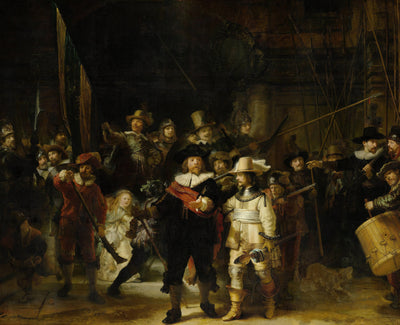
Then came the three decades that made him the Rembrandt of legend. He finished the militia company painting now called the Night Watch in 1642, the same year Saskia fell ill and died on 14 June, aged 29. Their son Titus, born in September 1641, was the only one of their four children to survive infancy. Rembrandt was declared bankrupt in 1656 and his house and collection went to auction. Titus married in February 1668 and died a few months later. Rembrandt died on 4 October 1669.

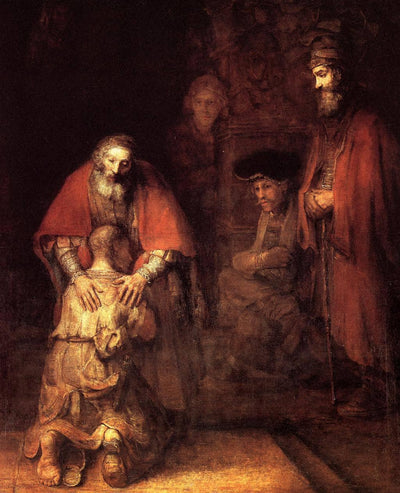
Somewhere in those last years, around 1668, he painted the Return of the Prodigal Son in the Hermitage: 262 by 205 cm, no commission, no buyer waiting. Catherine the Great's collection brought it to St. Petersburg in 1766, and it hangs in Room 254 of the New Hermitage. The Hermitage draws the line between the two pictures itself: "At one moment in his youth," Rembrandt "depicted himself in one of his many self-portraits as a reveller and spoilt child of fortune at the height of his fame and his powers, with a goblet in his hand and his beloved woman in his lap." The late painting is "a sort of finale to that story."
Put the two side by side and the change is total. The Dresden son faces out, showing off. The Hermitage son faces in, toward his father, and we only see the back of his shaved head and the soles of his broken shoes. The feathers and the silk are gone. What remains is the father's hands.
It's tempting to read the pair as autobiography: the young show-off and the old man who had lost his wife, his house and his son. Rembrandt left no letter saying so. But he chose both subjects himself, thirty years apart, and he put his own face in the first one. If you're looking for more pictures with that kind of weight, the hundred or so paintings everyone recognizes is a good place to wander.
Two ends of one story, on your wall
The Dresden canvas and its St. Petersburg sequel are best understood together, and most people only ever see one of them. Art & See's studio paints a hand-painted copy of the late homecoming in oil on canvas, and you can browse every Rembrandt the studio paints by hand if the young reveller or the Night Watch speaks to you more.
Sources
- SKD Research Channel, technical study of Rembrandt and Saskia in the Parable of the Prodigal Son
- State Hermitage Museum, Return of the Prodigal Son
- Rijksmuseum, The Return of the Prodigal Son (etching, 1636)
- Rembrandt House Museum, Rembrandt's life and work: important dates
- Canadian Journal of Netherlandic Studies, Kuretsky 2007
- ColourLex, Rembrandt, Self-Portrait with Saskia