4.9/5
4.9/5


Fewer than 20 of Leonardo da Vinci's paintings survive, and the list scholars broadly agree on has 17. He painted more than that, but some works are lost, the Battle of Anghiari mural among them, and a few pictures sold under his name are still argued over. For a man this famous, it's a startlingly short list.
That's also why the same handful of images comes up again and again when people look for a Leonardo da Vinci to hang at home: there simply isn't much to choose from.
How many paintings did Leonardo da Vinci paint, exactly?
Seventeen, give or take one. Martin Kemp, one of the leading Leonardo scholars, put it this way in his 2025 guide to every painting: "around 16 paintings that were predominantly or wholly by the master himself, with a further four or five works in which he intervened."
Two things keep the number from being rounder. Some early work is shared: in Verrocchio's Baptism of Christ at the Uffizi, only the angel on the left is Leonardo's. And some of his best-known compositions are drawings, like the big chalk cartoon of the Virgin and Saint Anne in London, which never count as paintings. The Louvre, with five, holds more than any other museum.
The 17, in the order he painted them
Dates are approximate, and several overlap, because he worked on some panels for years.
| Painting | Date | Where it hangs |
|---|---|---|
| The Annunciation | c. 1475 | Uffizi, Florence |
| Ginevra de' Benci | c. 1476–1478 | National Gallery of Art, Washington, DC |
| Madonna of the Carnation | c. 1477 | Alte Pinakothek, Munich |
| Benois Madonna | c. 1480 | Hermitage Museum, St. Petersburg |
| The Adoration of the Magi | c. 1481, unfinished | Uffizi, Florence |
| Saint Jerome in the Wilderness | c. 1481, unfinished | Vatican Museums |
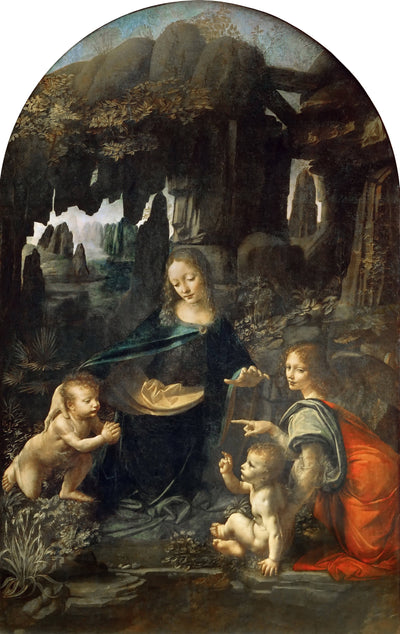
| The Virgin of the Rocks (first version) | begun 1483 | Louvre, Paris |
| Portrait of a Musician | c. 1485, unfinished | Pinacoteca Ambrosiana, Milan |
| La Belle Ferronnière | c. 1486 | Louvre, Paris |
| Lady with an Ermine | c. 1490 | Czartoryski Museum, Kraków |
| The Virgin of the Rocks (second version) | c. 1496–1508 | National Gallery, London |
| The Last Supper | 1496–c. 1498 | Santa Maria delle Grazie, Milan |
| Sala delle Asse (painted ceiling) | c. 1498–1499 | Castello Sforzesco, Milan |
| Madonna of the Yarnwinder | c. 1501–1508 | Scottish National Gallery, Edinburgh |
| Mona Lisa | 1503–c. 1516 | Louvre, Paris |
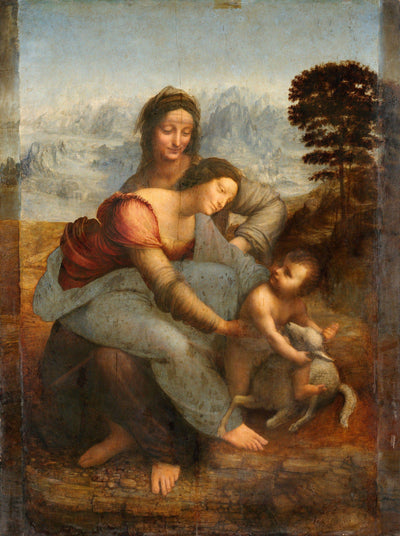
| The Virgin and Child with Saint Anne | c. 1507–1516 | Louvre, Paris |
| Saint John the Baptist | c. 1508–1516 | Louvre, Paris |
Florence, 1472–1482: the early panels
Leonardo entered Verrocchio's workshop at about 14 and was a master in the painters' guild by 1472, at 20. The first six paintings come from the decade that followed.
The Annunciation, c. 1475, Florence
It reached the Uffizi in 1867 labeled as a Ghirlandaio. Look at the angel's wings: Leonardo painted them like a bird's, and another hand later lengthened them.
Ginevra de' Benci, c. 1476–1478, Washington

It's the only Leonardo painting on public view in the Americas. The National Gallery of Art paid between $5 million and $6 million for it in 1967, then a record for a painting. The juniper behind her head is a pun on her name: ginepro in Italian.
Madonna of the Carnation, c. 1477, Munich
It was first taken for a Verrocchio. The red carnation in Mary's hand stands for the Passion.
Benois Madonna, c. 1480, St. Petersburg
Named for the family that sold it to the Hermitage in 1914. The baby grasps a cross-shaped sprig of flowers.
The Adoration of the Magi, c. 1481, Florence
Augustinian monks commissioned the big altarpiece he abandoned in Florence in July 1481, and he left for Milan before finishing it, so most of what you see is underdrawing. The panel hangs in its own Leonardo room at the Uffizi. On the far right, a young man looking out is often read as a self-portrait at about 30.
Saint Jerome in the Wilderness, c. 1481, Vatican
Unfinished and drafted in monochrome. A Roman dealer once cut the head out to sell it separately; Napoleon's uncle, Cardinal Fesch, had the pieces put back together.
Milan, 1482–1499: the Sforza years
Leonardo worked in Milan from 1482 until 1499, and seven of the 17 date from those years.
The Virgin of the Rocks, begun 1483, Paris and London
A Milan confraternity ordered the grotto altarpiece he ended up painting twice in 1483, then fought him over the fee. The likeliest story is that he sold the first panel privately and painted the London one to fill the order. To tell them apart: in Paris the angel points at the infant John; in London the hand rests on the knee and haloes appear.
Portrait of a Musician, c. 1485, Milan
His only portrait of a man was long taken for Duke Ludovico Sforza, until a 1904–1905 cleaning uncovered a hand holding sheet music.
La Belle Ferronnière, c. 1486, Paris
The sitter wears a ferronnière, a thin band across the forehead, and a title in use by the 17th century made her an ironmonger's wife. A copy that spent decades in an Omaha vault sold at Sotheby's in 2010 for $1.5 million.
Lady with an Ermine, c. 1490, Kraków

The sitter in the portrait of Cecilia Gallerani was a mistress of Ludovico Sforza, and the ermine was his emblem after he joined the Order of the Ermine in 1488. It's one of only four portraits of women by Leonardo, and it now hangs on the second floor in Kraków.
The Last Supper, 1496–c. 1498, Milan
He skipped true fresco and painted in tempera over gesso, pitch and mastic, so the paint began to flake soon after he finished on 9 February 1498. After the 1978–1999 restoration, visits are booked ahead in short, timed slots.
Sala delle Asse, c. 1498–1499, Milan
Look up: 18 mulberry trees spread their branches across the vault of this room in the Sforza castle, decorated in 1498. A long restoration began in 2012.
The last twenty years, 1499–1519
After 1499 he moved between Florence and Milan, spent 1513–1516 in Rome, and entered the service of Francis I of France in 1516. He died at Clos Lucé, near Amboise, on 2 May 1519.
Madonna of the Yarnwinder, c. 1501–1508, Edinburgh
Leonardo painted this one with an assistant. Thieves posing as tourists stole it from Drumlanrig Castle in 2003; it was recovered in 2007 and has been on show in Edinburgh since 2009.
Mona Lisa, 1503–c. 1516, Paris

He was still working on it as late as 1517, and it has been at the Louvre since 1797, apart from 1911–1914, when a Louvre employee, Vincenzo Peruggia, stole it. Since 2005 it has hung in the Salle des États, behind bulletproof glass. The Louvre's other four Leonardos make up the largest group of his paintings anywhere.
The Virgin and Child with Saint Anne, c. 1507–1516, Paris
Probably commissioned by Louis XII, the Saint Anne picture was never delivered and never finished. The lamb stands for the Passion; its cleaning in 2011–2012 was fierce enough that two members of the advisory committee resigned.
Saint John the Baptist, c. 1508–1516, Paris
His last painting, as far as anyone can tell, has John smiling the Mona Lisa's smile, with his right hand pointing up toward heaven.
Why he finished so few
The National Gallery in London puts it bluntly: he "became even more notorious for not finishing anything" (its Leonardo biography). He experimented with techniques that failed and put things off. The Adoration stopped when he left for Milan, and the Last Supper was flaking by 1517. Late in life his right hand was partly paralyzed, which may be why the Mona Lisa never got its last touches.
The ones experts still fight over
The same gallery adds that he completed so few works "that a whole industry sprang up around the search for 'real Leonardos.'" Four pictures sit at the center of it.
Salvator Mundi sold for £45 in 1958 as a work by his pupil Boltraffio, and for $1,175 in 2005. In 2017 it made $450,312,500 with fees in New York, a record for any painting at auction. Plenty of specialists still give most of it to Boltraffio or to Bernardino Luini, and it hasn't been shown in public since the sale.
Madonna Litta, in the Hermitage, is catalogued there as Leonardo's own; many scholars see Boltraffio's hand instead. La Scapigliata, a small unfinished head in Parma, is accepted by most specialists, not all. La Bella Principessa is a drawing on vellum that sold in 1998 for $21,850 as a 19th-century German piece; a forger later claimed he made it.
The paintings that are gone
He certainly painted more than 17. In 1504 Florence commissioned the Battle of Anghiari for the Hall of the Five Hundred, with Michelangelo assigned the opposite wall. His experiment with walnut oil failed, he gave up in 1505, and Vasari's frescoes later covered the wall. A 16th-century drawing of the central scene, extended by Rubens, is in the Louvre.
Leda and the Swan, a standing Leda he painted in 1508, was last seen at Fontainebleau in 1625, split across three panels, and was probably destroyed on purpose. Copies survive, one of them at the Philadelphia Museum of Art.
Where are his paintings today?
In ten cities. Paris leads with five, all at the Louvre. Milan has three, led by The Last Supper, alongside the painted ceiling and the Musician. The Uffizi in Florence has two. London, Edinburgh, Munich, Kraków, St. Petersburg, the Vatican and Washington have one each, and the Washington one, Ginevra de' Benci, is the only Leonardo on public view in the Americas.
Which ones are the most famous?
The Mona Lisa, by a wide margin; it has a fair claim to being the best known and most visited work of art in the world. The Last Supper is next, one of the most recognizable images in Western art. After those two, the Salvator Mundi is famous for its price, and Lady with an Ermine traveled more widely than any other Leonardo in the second half of the 20th century.
Bringing one home
Art & See paints hand-made copies of museum masterpieces, and every da Vinci subject in the studio includes several of the pictures above, from the Saint Anne to Cecilia Gallerani with her ermine. For other artists, start with the paintings people ask for most.
Sources
- The Art Newspaper, How to see every painting by Leonardo da Vinci
- The Art Newspaper, Salvator Mundi sale at Christie's (2017)
- Musée du Louvre, Leonardo da Vinci exhibition
- Musée du Louvre, press kit
- The National Gallery, London, Leonardo da Vinci
- Gallerie degli Uffizi, Adoration of the Magi
- National Museum in Kraków, Czartoryski Museum