4.9/5
4.9/5


Leonardo da Vinci's most expensive painting is Salvator Mundi, his Christ holding a crystal orb, an oil on walnut panel about 26 inches tall. Christie's sold it in New York on November 15, 2017, for $450.3 million with fees. No painting has ever sold for more, at auction or in a private deal.
Rarity did most of the work. Christie's billed the panel as the last privately owned Leonardo, and fewer than 20 of his paintings survive. Nearly all the other Leonardo da Vinci paintings belong to museums and churches from Kraków to Washington, D.C., so for a private buyer this panel was effectively the whole market.
Nineteen minutes at Christie's

Christie's put the estimate at $100 million. Bidding opened at $70 million and hit $200 million within two minutes, to gasps from a packed saleroom. When it passed $300 million, ten minutes in, the room applauded.
For most of the contest it was two telephone bidders, each talking through a Christie's specialist. After about 19 minutes one of them ended it with a jump bid of $400 million, $30 million above the last offer. Fees of $50,312,500 brought the bill to $450,312,500, more than four times the estimate. Scott Reyburn, who was in the room, later wrote a first-hand account of that night that is still the best read on it.
The seller was Dmitry Rybolovlev, the Russian billionaire who had paid $127.5 million four years earlier. The Picasso that had held the auction record since May 2015, Les Femmes d'Alger (Version O), fetched $179.4 million. Salvator Mundi beat it by more than two and a half times.
Why nobody stopped at $100 million
Almost no Leonardos are left to buy
Scarcity has set records before. In February 1967 the National Gallery of Art in Washington paid between $5 million and $6 million for Ginevra de' Benci, then the highest price for any painting. It's still the only Leonardo on public view in the Americas. With a supply of one, the price is whatever the second most determined bidder will pay.
An Old Master sold like contemporary art
Christie's put a painting from around 1500 into one of its marquee evening sales of contemporary art, which widened the pool of bidders well beyond Old Master collectors. The campaign carried an urgent name, "the Last da Vinci," and hidden cameras below the panel filmed viewers' faces for social media. The work won two D&AD Pencils in 2018. More than 27,000 people saw the painting on its pre-sale tour, a record for a single work by Christie's count.
A buyer who wanted a centerpiece
The winning bidder was Saudi Prince Badr bin Abdullah, soon identified as an intermediary for Crown Prince Mohammed bin Salman. What the crown prince wanted it for came out in 2024, through his friend Bernard Haykel, a Princeton professor: "I want to build a very large museum in Riyadh. And I want an anchor object that will attract people, just like the Mona Lisa does." Nobody shopping for a Mona Lisa stops at the estimate.
From £45 to $450 million

The panel's paper trail runs through the English royal collection: in 1649, the year Charles I was executed, it was recorded as belonging to his wife, Henrietta Maria. By the early 1900s it was buried under overpaint, and the prices that followed read like a lottery ticket.
| Year | What happened | Price |
|---|---|---|
| 1958 | Sold at auction in England as the work of Leonardo's pupil Boltraffio | £45 (about $125 then) |
| 2005 | Bought at St. Charles Gallery, New Orleans, catalogued "After Leonardo da Vinci," by dealers Alexander Parish and Robert Simon | $1,175 |
| 2013 | Sold to Swiss dealer Yves Bouvier | $80 million |
| 2013 | Resold by Bouvier to Dmitry Rybolovlev | $127.5 million |
| 2017 | Sold by Rybolovlev at Christie's New York | $450.3 million |
Two things turned a $1,175 lot into an $80 million Leonardo. Dianne Dwyer Modestini restored it at New York University, and the National Gallery in London hung it in its 2011 show of Leonardo at the court of Milan, which the museum billed as the most complete display of his surviving paintings ever held.
The second 2013 sale left a long legal tail. Rybolovlev paid $127.5 million without knowing Bouvier was the seller, and his suit against Sotheby's over that deal ended in January 2024, when a U.S. federal jury found for the auction house.
Is it really by Leonardo?
Possibly in part, and specialists still argue over how much. Some leading scholars think he painted only certain passages; others think the extensive restoration makes a firm attribution impossible.
The case for Leonardo starts with Martin Kemp, one of the leading Leonardo experts, who helped authenticate it and was convinced on first sight of the restored panel. Infrared photographs also show a pentimento: the thumb of the blessing hand was first painted more upright, a change a copyist would have no reason to make. Even the crystal orb, which shows none of the distortion a solid clear sphere would produce, has a defender in Walter Isaacson, who calls it "a conscious decision on Leonardo's part."
The doubters are just as serious:
- Frank Zöllner, author of the catalogue raisonné, sees sfumato closer to the manner of a talented pupil.
- Jacques Franck, a Paris-based Leonardo specialist, called it "a good studio work with a little Leonardo at best."
- Matthew Landrus of Oxford puts Leonardo's share at 5–20% and gives the work to Bernardino Luini.
- Charles Hope, a British art historian, rejects the attribution outright.
Museums split too. The Prado's 2021 catalogue filed it among "attributed works, workshop of authorized and supervised by Leonardo." The Louvre's press kit for its 2019 Leonardo exhibition lists it among the works he painted, yet it never appeared in the show: the Saudi owners wanted it hung beside the Mona Lisa, which security made impossible.
Where the panel is now
Nobody outside the owner's circle knows for sure, and it hasn't been exhibited in public since the auction. Its planned unveiling at the Louvre Abu Dhabi was called off indefinitely in September 2018. It spent time in Paris on loan to Louvre curators, then hung on the crown prince's yacht, Serene, until late 2020, before moving to a secret location in Saudi Arabia. In August 2024 Haykel put it in storage in Geneva, waiting for a Riyadh museum that hadn't been built.
Where are Leonardo da Vinci's paintings?

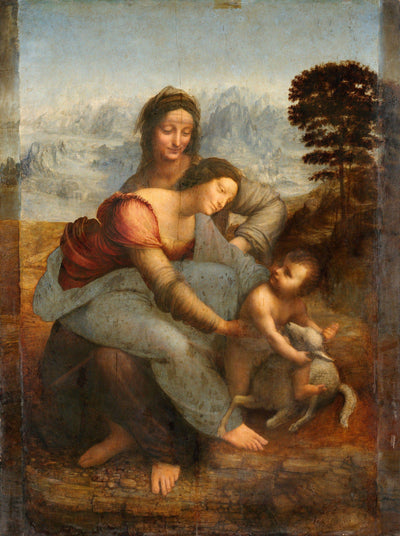
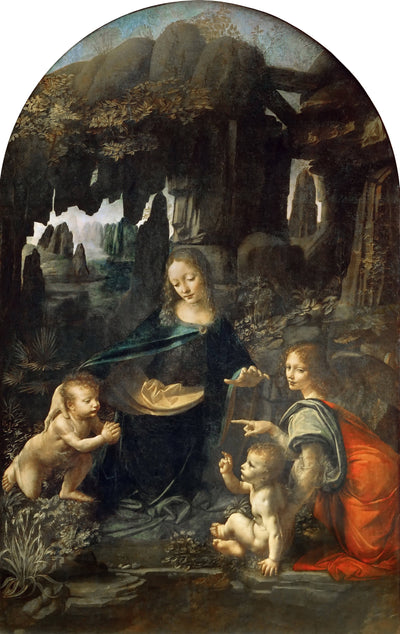
Mostly in European museums. The Louvre holds five of them, the largest group anywhere, along with 22 of his drawings: the Mona Lisa, La Belle Ferronnière, his late Virgin and Child with St. Anne, the St. John the Baptist of his final years and the earlier of the two Virgin of the Rocks panels. The rest are spread across Florence, Milan, London, Kraków, Munich, St. Petersburg and the Vatican, plus one in Washington.
| Painting | Date | Where it is |
|---|---|---|
| Mona Lisa | c. 1502–1516 | Louvre, Paris |
| The Last Supper | c. 1492–1498 | Santa Maria delle Grazie, Milan |
| Lady with an Ermine | c. 1489–1491 | its home in Kraków (Czartoryski Museum) |
| Portrait of a Musician | c. 1483–1487 | Pinacoteca Ambrosiana, Milan |
| the unfinished Adoration of the Magi | c. 1478–1482 | Uffizi, Florence |
| The Virgin of the Rocks | c. 1483–1493; c. 1491–1508 | Louvre, Paris; National Gallery, London |
| The Virgin and Child with St. Anne | c. 1501–1519 | Louvre, Paris |
| St. John the Baptist | c. 1507–1516 | Louvre, Paris |
| Ginevra de' Benci | c. 1474–1480 | National Gallery of Art, Washington, D.C. |
| Salvator Mundi | c. 1499–1510 | Not on public view |
If you go to Paris, La Belle Ferronnière and the Saint Anne hang in Room 710 of the Denon wing.
What are the most famous paintings by Leonardo da Vinci?
The Mona Lisa is the most famous painting in the world, and The Last Supper is the most reproduced religious painting ever made. After those two, Cecilia Gallerani and her ermine is the portrait most people recognize. For the rest of the canon, start with the paintings everyone knows by sight.
Bring Salvator Mundi home
The original may stay in a vault for years. A copy painted by hand in oil, the medium Leonardo used on the walnut panel, puts the same face and orb on your wall, and the whole da Vinci collection is painted the same way, from the Lady with an Ermine to both Virgins of the Rocks.
Sources
- NBC News, Salvator Mundi sells for record $450M (2017)
- PBS NewsHour, Rare da Vinci painting sells for $450 million (2017)
- The Art Newspaper, Five years since the $450m Salvator Mundi sale (2022)
- The Art Newspaper, Where is Salvator Mundi? (2024)
- D&AD Awards, Christie's: The Last da Vinci
- Musée du Louvre, Leonardo da Vinci exhibition press kit (2019)
- National Gallery, London, Leonardo da Vinci: Painter at the Court of Milan
- National Museum in Kraków, Lady with an Ermine