4.9/5
4.9/5


The complete Vincent van Gogh letters are free to read at the online letters edition built by the Van Gogh Museum and Huygens ING: all 903 surviving letters, each with the original text, a new English translation, notes and a facsimile of the manuscript. For a book, start with a one-volume selection, not the six-volume set.
Those 903 are lopsided. Vincent wrote 820 of them, 651 to his brother Theo, but only 83 letters to him survive, because he threw letters away or burned them. He probably wrote more than 2,000 in all. About a third are in French and only 6 in English, so you'll almost certainly read them in translation. Many of the Van Gogh paintings people know best appear here first, described to Theo while he was still working on them, often with a quick pen sketch.
Where to read Vincent van Gogh's letters, free and in print
Six options, two of them free.
| Where | What you get | Best for |
|---|---|---|
| vangoghletters.org (free) | All 903 letters: original text, new translation, notes, facsimile | Any letter, any quote |
| WebExhibits (free) | Over 900 letters, mostly in Jo van Gogh-Bonger's older translation, with a topic index | Browsing by theme |
| Ever Yours: The Essential Letters (Yale University Press, 2014) | 265 letters and 87 reproduced letter pages | The best single book |
| Vincent van Gogh: A Life in Letters (Thames & Hudson, 2020) | 76 letters, richly illustrated | A first book or a gift |
| The Letters of Vincent van Gogh (Penguin Classics) | Ronald de Leeuw's selection, 560 pages, linked by short biographical passages | Reading them as a life story |
| Vincent van Gogh: The Letters (2009) | Everything, in six volumes: 2,180 pages, over 4,000 illustrations | Libraries |
Start with the free site. Its browse menu can show only the letters with sketches (there are more than 240), the fastest way in if you came for the paintings, and the editors still post corrections: the current version is dated December 2024.
For a book, get Ever Yours, chosen by the three editors of the complete edition, Leo Jansen, Hans Luijten and Nienke Bakker. Its title is the English of his usual sign-off to Theo, "tout à toi". Leave the six volumes to libraries: the print set carries brief notes, and the website has the full ones.
Why one letter can carry three numbers
Open the Cuesmes letter of June 1880 and its title reads 155 (154, 133): the 2009 number, the 1990 Dutch edition's, and the old number from the 1952–1954 edition, also used by the 1958 English Complete Letters. WebExhibits goes by the old one, so there it's letter 133, dated July 1880. The 2009 edition dates it between about 22 and 24 June 1880.
The words move too. Here's the fire passage in Jo van Gogh-Bonger's older translation:
"There may be a great fire in our soul, but no one ever comes to warm himself by it, all that passers-by can see is a little smoke coming out of the chimney, and they walk on."
And in the 2009 translation:
"Someone has a great fire in his soul and nobody ever comes to warm themselves at it, and passers-by see nothing but a little smoke at the top of the chimney and then go on their way."
Jo, Theo's widow, first published the letters to Theo in 1914 and translated about two-thirds into English before she died in 1925. The 2009 translation stays as close to the meaning of the original as it can, and gives up literary polish to do it. If a quote you found online won't match, the concordance on the letters site lines up old and new numbers. W7, for example, is letter 678 to his sister Willemien.
Where to see the original letters
Mostly in Amsterdam, and rarely. The Van Gogh Museum holds more than 800 of them, and because they're fragile they seldom go on display; the 2020 show "Your Loving Vincent" put some 40 on view, 9 October 2020–10 January 2021. In New York, the Morgan Library & Museum's Thaw Collection has the letter he sent Gauguin with a bedroom sketch, dated 17 October 1888.
Ten letters to start with
In date order, from a 27-year-old who insists "I'm good for something, even so!" to the last week of his life. Starting from the pictures instead? Pair this list with a ranking of his best-known canvases.
1. "A great fire in his soul": Cuesmes, June 1880
Start here. Letter 155 opens with an apology for his long silence, "It's with some reluctance that I write to you, not having done so for so long", then makes his case: a man with a fire inside that nobody comes near, and a caged bird in spring that "knows very well that there's something he'd be good for". Three months later, in letter 158 of 24 September 1880, he decides: "I'll pick up my pencil that I put down in my great discouragement and I'll get back to drawing."
2. "What am I in the eyes of most people?": The Hague, July 1882
Two years into drawing, letter 249 asks the question and answers it bluntly: "A nonentity or an oddity or a disagreeable person". Then he turns it around: "through my work I'd like to show what there is in the heart of such an oddity, such a nobody." If you read one letter about why he kept going, make it this one.
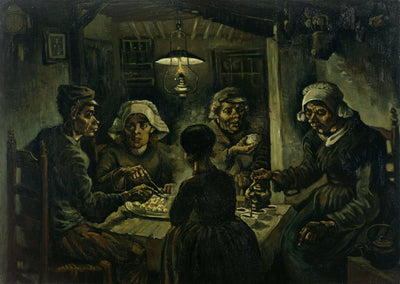
3. The Potato Eaters: Nuenen, April 1885

Read letter 497 of 30 April 1885 before you look at the dark peasant supper in Nuenen. He wanted people to "get the idea that these folk, who are eating their potatoes by the light of their little lamp, have tilled the earth themselves with these hands they are putting in the dish." Three weeks earlier, letter 492 had sent Theo the sketch above: "See, this is what the composition has now become."
4. Taking death to a star: Arles, July 1888
Arles, late at night. The key passage in letter 638 starts with "the sight of the stars always makes me dream" and lands here: "Just as we take the train to go to Tarascon or Rouen, we take death to go to a star." Dying peacefully of old age "would be to go there on foot." Keep it in mind for every night sky he painted afterward.
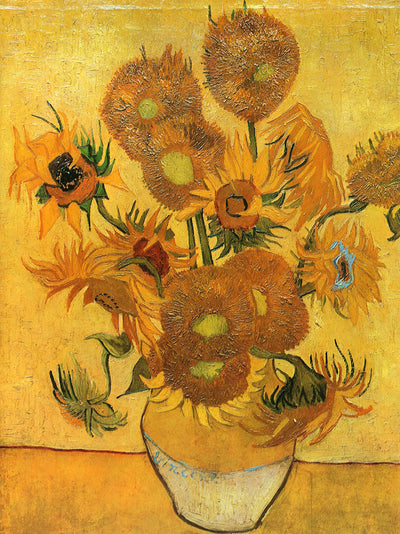
5. Sunflowers: Arles, August 1888
The most cheerful letter here. In letter 666 he's "painting with the gusto of a Marseillais eating bouillabaisse, which won't surprise you when it's a question of painting large Sunflowers." The plan is to fill a studio he hopes to share with Gauguin with "Nothing but large Sunflowers", a dozen or so panels, "a symphony in blue and yellow". He works on them from sunrise, "Because the flowers wilt quickly". Keep it open beside the vase of fifteen sunflowers.
6. Cafe Terrace at Night: to his sister, September 1888
Not every great letter went to Theo. Writing to Willemien in letter 678, he describes the café he has been painting, where "A huge yellow lantern lights the terrace, the façade, the pavement". Then comes the line that explains his café on the Place du Forum: "Now there's a painting of night without black." Older books number it W7.
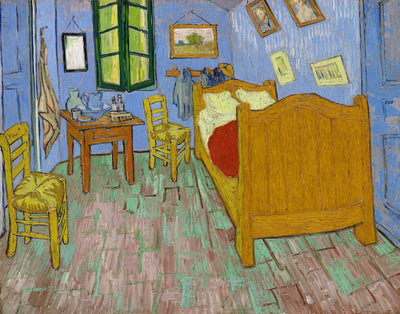
7. The Bedroom: Arles, October 1888

Letter 705, written on 16 October 1888 with a sketch, is the one to read beside the painting of his room in Arles, whose October 1888 version hangs in the Van Gogh Museum: "This time it's simply my bedroom, but the colour has to do the job here". He lists the colors one by one, from "fresh butter yellow" to "very bright lemon green", and states the aim: "looking at the painting should rest the mind, or rather, the imagination."
8. The Starry Night: Saint-Rémy, June 1889
He had admitted himself to the asylum near Saint-Rémy on 8 May 1889. In letter 777: "This morning I saw the countryside from my window a long time before sunrise with nothing but the morning star, which looked very big." That spring Venus rose before dawn over Provence, close to its brightest. Around 18 June, letter 782 mentions "a new study of a starry sky", which became the night sky over Saint-Rémy, at the Museum of Modern Art in New York since 1941.
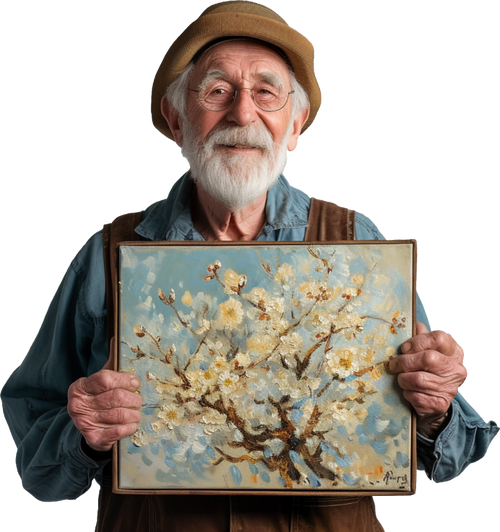
9. Almond Blossom: to his mother, February 1890

Theo and Jo named their baby Vincent. On 19 February 1890, in a letter to his mother, Vincent wishes the boy had been named after his father, "but anyway, as it's been done now I started right away to make a painting for him, to hang in their bedroom. Large branches of white almond blossom against a blue sky." That became the blossom painting for his nephew. The baby, Vincent Willem, went on to found the Van Gogh Museum.
10. The last letter and the draft he carried: Auvers, July 1890
On 23 July 1890 he mailed letter 902 from Auvers-sur-Oise, the last of his letters that has been found. It's practical: sketches of canvases of "immense stretches of wheat after the rain", and a paint order for someone else. Two weeks earlier, in letter 898, he had called the same fields a way "to express sadness, extreme loneliness." An unfinished draft of letter 902, RM25, was on him when he wounded himself on 27 July; Theo wrote as much in pencil on the manuscript. It holds the line "Ah well, I risk my life for my own work and my reason has half foundered in it". He died on 29 July.
Flowers in the letters
What did Van Gogh say about flowers?
In Paris they were his color exercises. In letter 569, written in English in 1886 to Horace Mann Livens, a fellow student from the Antwerp Academy, he describes "a series of colour studies in painting simply flowers, red poppies, blue corn flowers and myosotys", made while "Trying to render intense COLOUR and not a grey harmony."
What was Vincent van Gogh's favorite flower?
The sunflower is the one he claimed. In January 1889 he told Theo: "You know that Jeannin has the peony, Quost has the hollyhock, but I have the sunflower, in a way." Blossom branches against a blue sky were another of his favorite subjects. For more of the pictures behind these letters, see the paintings people ask about most.
A letter on your wall
Reading the letters tends to send you back to the pictures. Art & See paints hand-painted copies of his work in oil, including several canvases from this list. Hang one where you read, and pencil its letter number on the back of the stretcher, the way Theo penciled a note on his brother's last draft.
Sources
- Vincent van Gogh: The Letters (Van Gogh Museum and Huygens ING)
- Vincent van Gogh: The Letters, Concordance
- Vincent van Gogh: The Letters, letter 706 to Paul Gauguin (Morgan Library & Museum)
- Van Gogh Museum, Van Gogh's Letters
- Van Gogh Museum, Your Loving Vincent
- Van Gogh Museum, Almond Blossom
- WebExhibits, Van Gogh's Letters, letter 133