4.9/5
4.9/5


Van Gogh's last painting was most likely Tree Roots, an unfinished canvas he worked on in Auvers-sur-Oise on July 27, 1890, the day he shot himself. He died two days later. Wheatfield with Crows, the painting usually given that title, was already finished by about July 10, roughly two and a half weeks earlier.
He arrived in Auvers on May 20, 1890, and painted about 70 canvases there in roughly as many days, some of the Van Gogh paintings people know best. Putting that last run in order comes down to a few letters and one brother-in-law's memory. In 2020, a hillside at the edge of the village supplied the missing piece.
Why the crows came too early to be Van Gogh's last painting

On or about July 10, 1890, Van Gogh wrote from Auvers to Theo and his wife, Jo. Since visiting them in Paris on July 6, he had painted "another three large canvases." Two were "immense stretches of wheatfields under turbulent skies, and I made a point of trying to express sadness, extreme loneliness." The third was Daubigny's Garden. The two wheatfields are almost certainly Wheatfield under Thunderclouds and Wheatfield with Crows, so the famous canvas was done by then. Van Gogh lived until July 29.
The last-painting story is a persistent myth, and at least seven Auvers oils came after the crows. The harvest agrees: in Wheatfield with Crows the wheat is still standing, and his canvases of sheaves and stacks could only come after it was cut. By the time of the shooting the painting had most likely already gone to Theo in Paris.
Where the crows legend came from
Two things did most of the work. In the introduction to her 1914 edition of the letters, Jo van Gogh-Bonger described his last paintings as works "in which one feels imminent disaster, coming closer like the black birds that race across the field in the storm." Then Vincente Minnelli's 1956 film Lust for Life showed Van Gogh painting Wheatfield with Crows just before shooting himself.
Stand in front of that sky and the story is easy to believe. But the July 10 letter pairs the sadness with something else: the canvases "will tell you what I can't say in words, what I consider healthy and fortifying about the countryside." That same week, writing to his mother and sister, he was "wholly in a mood of almost too much calm."
Tree Roots, the canvas he left unfinished

At first sight Tree Roots barely reads as a picture of anything: a jumble of bright color and abstract forms that resolves into a slope of trunks and roots, timber trees growing in a marl quarry. It measures 50.3 by 100.1 centimeters, the stretched double-square format he used only in June and July 1890.
Two pieces of evidence put it last.
First, it was left unfinished. In 2012 the Van Gogh Museum's senior researcher Louis van Tilborgh and the vegetation specialist Bert Maes argued that Tree Roots is one of only two unfinished works from his final days. The other is Farms near Auvers. Van Gogh rarely left a canvas incomplete, so an unfinished one from late July stands out.
Second, a family account puts it on the last morning. Andries Bonger, Jo's brother, named Farms near Auvers as the final work in 1891, then later wrote: "The morning before his death, he had painted a sous-bois [forest scene], full of sun and life." That fits Tree Roots. The researcher Wouter van der Veen places it on Sunday, July 27, begun in the morning, with the last touches added late in the afternoon, when the light in the picture was falling. That evening Van Gogh left the inn with a revolver.
The Van Gogh Museum now calls Tree Roots probably his very last painting, and its 2016 exhibition said as much on the wall label.
Is Tree Roots a farewell?
Maybe. The roots are laid bare, torn from the earth and hanging, and the July 10 letter contains the line "my life, too, is attacked at the very root." Curator Nienke Bakker was more cautious in 2016: it's "hard to say that van Gogh painted it intentionally as a farewell," since that "would be too rational." The symbolism is open to debate. The order of the paintings is much less so.
Where he painted it: 48 rue Daubigny
For 130 years nobody knew where the roots were. In 2020, with France in COVID-19 lockdown, van der Veen was studying old postcards of Auvers and found one titled Rue Daubigny, dated 1900–1910, showing trunks and roots growing on a hillside. On May 15, 2020, once travel reopened, he found the spot, just outside number 48, and the largest stump from the painting was still there.
The bank is about 150 meters (roughly 500 feet) from the Auberge Ravoux, the inn where Van Gogh spent the last 70 days of his life. Van Gogh Museum researchers judged the location highly likely to be right and announced the find on July 28, 2020. A historical photograph found in 2021 confirmed it.
The hillside has since landed in court. In March 2025 an appeals court in Versailles upheld a 2023 ruling that the roots are private property, not part of the public road. The owners of number 48 had been offering $9 guided tours of the site since 2020.
The final weeks, canvas by canvas

| Date (1890) | Painting | Where it is now |
|---|---|---|
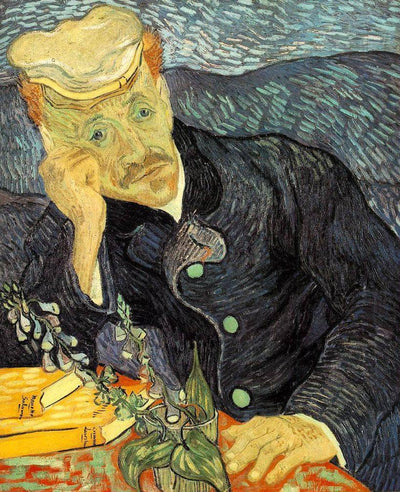
| June | his two portraits of Dr. Gachet | Second version: Musée d'Orsay, Paris |
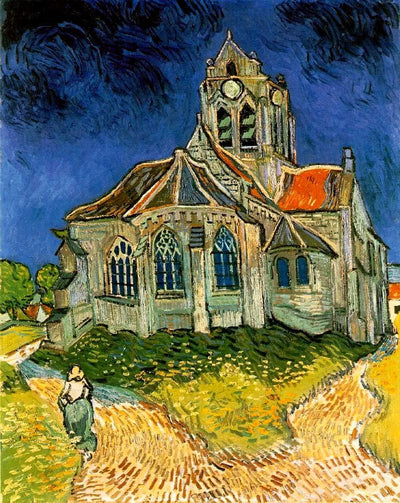
| June | the village church, seen from behind | Musée d'Orsay, Paris |
| Early July | Wheatfield under Thunderclouds | Van Gogh Museum, Amsterdam |
| By about July 10 | Wheatfield with Crows | Van Gogh Museum, Amsterdam |
| July 6–23 | Daubigny's Garden (two large versions) | Kunstmuseum Basel; Hiroshima Museum of Art |
| About July 26 | Farms near Auvers | National Gallery, London (Room 43, on loan from Tate) |
| July 27 | Tree Roots | Van Gogh Museum, Amsterdam |
Four of these have been called the last painting of Van Gogh at one time or another. Farms near Auvers is the strongest alternative to Tree Roots: perhaps the second-last painting, made at Cordeville, a hamlet on the edge of Auvers, around July 26, and its blank sky suggests he never finished it. Daubigny's Garden also gets named. Van Gogh called it "one of my most deliberate canvases" when he sketched it for Theo on July 23.
Very little of this sold while he lived. The only sale documented by name is The Red Vineyard, bought by the painter Anna Boch for 400 francs in Brussels in 1890, and two days before the shooting Theo was still hoping someone would buy a couple of the new canvases.
What did Van Gogh say about wheat?
He wrote about wheat as comfort and as mortality. In a single July 1890 letter he called his stormy Auvers fields both sad and healthy. To his mother and sister he pictured "the vast expanse of wheatfields against the hills, large as a sea, delicate yellow, delicate pale green."
The darkest line is older. In September 1889, working on a reaper at the asylum in Saint-Rémy, he told Theo he saw in it "the image of death, in this sense that humanity would be the wheat being reaped." Then he turned it around: "But in this death nothing sad, it takes place in broad daylight with a sun that floods everything with a light of fine gold."
Why did Van Gogh paint wheatfields?
Wheat runs through his whole career, from Wheat Sheaves in the Netherlands in 1885 to the harvest at Auvers, dozens of paintings in all. He admired the peasant pictures of Jean-François Millet and Jules Breton, the "voices of the wheat," and he read the fields through the Bible's parables of sowing and reaping as a picture of the human life cycle. He even saw storms as restorative, a sign of "the better times of pure air and the rejuvenation of all society." Keep that in mind before reading the storm in Wheatfield with Crows as an omen.
At Saint-Rémy that meant pictures like the cypresses beside a ripening field, painted in June and July 1889 and now at the Metropolitan Museum of Art. At Auvers it meant thirteen large canvases of the July harvest. If you want to follow him field by field, the towns that shaped his countryside pictures make a good map, and a ranking of his best-known canvases shows where the Auvers work sits among the rest. For other masterpieces with a story like this one, start with the paintings people ask about most.
Bring the Auvers summer home
The last canvases stay in their museums, but the Auvers summer can still hang on your wall. The church, the doctor's portrait and the Saint-Rémy wheat all come as hand-painted copies, and you'll find them alongside every other Van Gogh the studio paints by hand. For the wheat without the storm, start with the cypresses, painted a year before Tree Roots.
Sources
- Van Gogh Museum, Tree Roots
- Van Gogh Museum, Wheatfield with Crows
- Van Gogh Museum, press release on the Tree Roots site, July 28, 2020
- Vincent van Gogh: The Letters, letter 898
- Vincent van Gogh: The Letters, letter 800
- The Art Newspaper, July 28, 2020
- The National Gallery, Farms near Auvers
- Smithsonian Magazine, April 9, 2025