4.9/5
4.9/5


An old man sits on a rush chair by a small fire, bent almost double, his fists pushed into his eyes. You can't see his face and you don't need to. If you want one answer to what is Van Gogh's saddest painting, it's this one, Sorrowing Old Man, better known as At Eternity's Gate, painted in May 1890, a couple of months before he died.
But grief runs all through his work, and it doesn't always look like grief. Sometimes it's a Bible on a black ground, or a chair nobody is sitting in, or a field under a heavy sky. The eight works below are the ones where I think you feel it most. They're not ranked by how dark the paint is. Some of the saddest are among the Van Gogh paintings people hang at home, which tells you something about how sadness and comfort sit together in his pictures.
1. Sorrowing Old Man (At Eternity's Gate), 1890

He painted it at the asylum in Saint-Rémy while recovering from a bout of depression, and it isn't a new idea. It reworks a figure he drew in The Hague in 1882. He changed the composition and probably borrowed the chair and the stove from the asylum itself, and a patient most likely sat for the old man. The canvas is 81.8 × 65.5 cm and it hangs in the Kröller-Müller in Otterlo.
What makes it hard to look at is the date. Eight years earlier, as a struggling beginner, he had made a lithograph of the same old man and sent the first print to Theo with a letter about faith. He thought that the expression of an old man sitting "so quietly in the corner of his hearth" was among the strongest evidence for "something on high", for God and an eternity. You can read the November 1882 letter in full. In 1890, ill and back in a hospital, he went looking for that figure again. Whether he still saw eternity in it is anybody's guess. The man in the painting is covering his eyes.
2. Sorrow, 1882
A naked woman sits hunched on a stump with her head buried in her arms. It's a drawing, not a painting, but it's the image Van Gogh himself built his early idea of sadness around. He sent a version to Theo around 10 April 1882 as thanks for help through a hard winter, and admitted he "didn't hesitate to be somewhat melancholy". What he wanted it to say was a line from Michelet: "But the heart's emptiness remains / That nothing will make full again." He had pressed the outline so hard that it printed through onto two sheets underneath, so there were three versions at once; two survive, one in pencil with wash and one in black chalk. The letter that came with it is only a page long.
A few weeks later he drew a bigger version and paired it with a study of tree roots in sandy soil, half torn up by a storm. Same feeling, he explained, in a figure and in a landscape. That pairing comes back at the very end of his life.
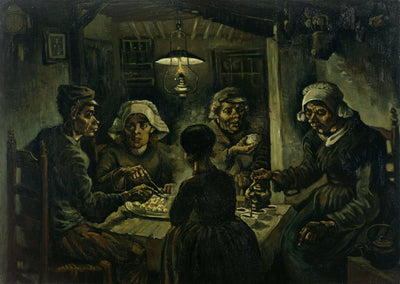
3. The Potato Eaters, 1885

Five people around a table, one lamp, one dish. Van Gogh's father had died in late March 1885, and shortly afterward Vincent moved out of the family home into his studio and began this picture. He wanted his big peasant picture from Nuenen to show people who had "tilled the earth themselves with these hands they are putting in the dish", and he painted them in a color he compared to "a really dusty potato, unpeeled of course".
Is it sad? Not in the way the old man is. It's heavy. The faces are coarse, the hands bony, and nobody in the room looks at anyone else. Critics in his day hated how dark it was and how many mistakes the figures had. Now it's one of his best-known paintings, 82 × 114 cm, in Amsterdam.
4. Still Life with Bible, 1885
This is a mourning picture disguised as a color exercise. The huge open Bible belonged to his father, a Protestant minister, and Vincent painted it just after his death. Beside it he placed his own battered copy of Zola's La joie de vivre, a kind of bible for modern life. Two books, two ways of seeing the world, and one of the men who held them was gone. He painted it in a single day in October 1885, and the canvas in Amsterdam is still a little shocking in person: a black background, off-white pages, and one note of lemon yellow.
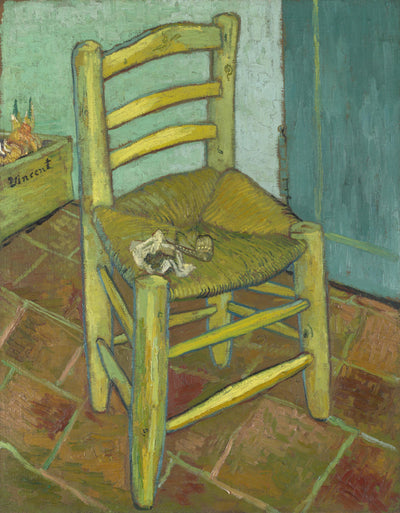
5. Van Gogh's Chair, 1888
No one is in it. There's a pipe and some tobacco on the straw seat, a box of sprouting onions behind, red tiles underneath. He painted it in Arles in late 1888 as a pair with Gauguin's more elegant armchair, the two chairs standing in for the two painters. Then on 23 December came the fight, the razor and the ear. Gauguin went back to Paris and never saw him again.
After two weeks in hospital Van Gogh came home and reworked the yellow chair with his pipe on it. Empty chairs already meant something to him. He had wept at the sight of his father's vacant chair, and he loved Luke Fildes's 1870 engraving of Dickens's empty chair on the day the novelist died. To Theo he once put it bluntly: "Empty chairs – there are many, more will come." The painting is in London now, and the gallery has a long write-up on the pairing with Gauguin's chair.
6. Pietà (after Delacroix), 1889
Mary holds the dead Christ, arms thrown open. It's a copy, in a way, of a lithograph after Delacroix, but the story of why he painted it is pure Van Gogh. The print fell into some oil and paint in his room at the asylum and got ruined. "I was sad about it," he wrote, so he painted it instead. The stained print still exists. His painted version, 73 × 60.5 cm, dates from September 1889, weeks after a new attack struck while he was painting outdoors. He took Delacroix's grief and made it his own with color, at a moment when he had plenty of grief to spare.
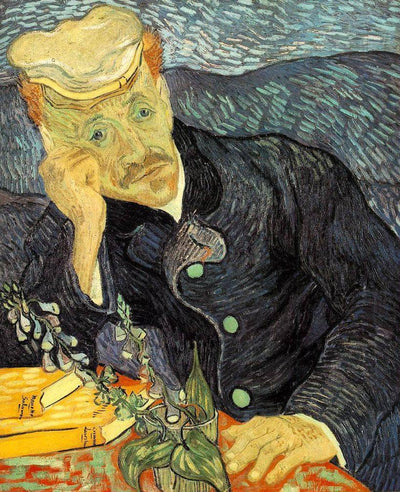
7. Portrait of Dr. Gachet, 1890
The doctor who watched over him in Auvers leans his head on his hand beside a sprig of foxglove, against a cobalt blue background. Van Gogh liked him but saw him clearly. Gachet, he told Theo, seemed "as ill and confused as you or I", older, and a widower of a few years. To his sister Willemien he explained what he was after: an expression of melancholy that might look like a grimace, "sad but gentle but clear and intelligent". You can find it in his June 1890 letter to Willemien.
That's what separates the doctor with the foxglove from the old man by the fire. It's sadness he meant as the face of his own era, not a collapse.
8. Wheatfield under Thunderclouds, 1890

Here's the only painting on this list where Van Gogh told us, in so many words, that sadness was the subject. In early July 1890 he visited Theo in Paris and learned his brother was thinking of leaving his job, which put Vincent's own income at risk. He came back to Auvers badly shaken and painted three large canvases. Two were wheatfields, and about them he wrote: "They're immense stretches of wheatfields under turbulent skies, and I made a point of trying to express sadness, extreme loneliness." The same letter to Theo and Jo goes on to hope they would also show "what I consider healthy and fortifying about the countryside."
This one is almost nothing: a green field, a blue-black sky, a line between them, on a canvas twice as wide as it is tall (50.4 × 101.3 cm). The other wheatfield from that letter, the one with crows, gets all the attention and a lot of myth about being his final work. It wasn't, and the story of what he really painted last is worth knowing before you read the crows as a suicide note. The thundercloud field is the quieter of the two, and to me the lonelier.
So what is Van Gogh's saddest painting?
If you want the one where grief is the literal subject, it's the old man at eternity's gate. If you want the one where Van Gogh named the feeling himself, it's the July wheatfields. I'd pick the old man. The wheatfields still hold on to his hope that the country was "healthy and fortifying". The old man has nothing to hold on to but his own fists.
Why was Van Gogh's life so sad?
Partly illness, partly money, partly bad luck in love and friendship. He was 35 when he cut off his ear, and that was the start of repeated attacks nobody could diagnose. In May 1889 he had himself admitted to the hospital at Saint-Rémy, where he stayed a year and painted around 150 pictures between crises. Writing from there, he admitted that after Arles "nothing would have been so agreeable to me as never to wake up again."
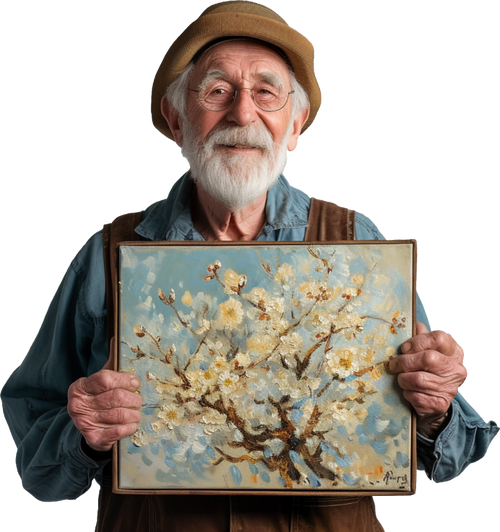
And yet the same year gave us the almond branches against a blue sky, painted in February 1890 for Theo's newborn son, who had been named after him. Sadness never ran his whole output. What finally broke him was the fear, in July 1890, that he'd become a burden on Theo's family and that the attacks would return. On 27 July he walked into a field and shot himself in the chest. He died two days later with Theo beside him. He left over 850 paintings and almost 1,300 works on paper.
What were Van Gogh's final words?
The words passed down by his family are "La tristesse durera toujours": the sadness will last forever. Oddly, he'd copied almost the same idea six years earlier, in a poem by Coppée he sent Theo in 1884: "From then my sadness takes its date, / And will continue, everlastingly." If you want more of his voice, start with the letters worth reading first.
Is there a saddest painting of all time?
No honest list can crown one. Sadness in a picture depends on what you bring to it, and a painting that wrecks one person leaves another cold. What Van Gogh has that most painters don't is the paper trail: he told us, letter by letter, what he felt while he worked, so you can check your reaction against his. Few artists let you do that. If you want to compare his despair with other painters' grief, the masterpieces people come back to is a good place to wander.
Sadness you can live with
These are pictures people want at home, and they usually pick them because of the melancholy, not in spite of it. A chair left empty, a doctor lost in thought, a table of tired farmers. Every canvas in our hand-painted Van Gogh collection is painted by hand in oil, so the thick yellow of that chair and the dusty browns of Nuenen come through as paint, not print.
Sources
- Kröller-Müller Museum, Sorrowing Old Man ('At Eternity's Gate')
- Van Gogh Letters, letter 288 (November 1882)
- Van Gogh Letters, letter 898 (July 1890)
- Van Gogh Museum, Still Life with Bible
- Van Gogh Museum, Pietà (after Delacroix)
- Van Gogh Museum, Wheatfield under Thunderclouds
- National Gallery, Van Gogh's Chair
- Van Gogh Museum, Vincent van Gogh's Final Months