4.7/5


Picture a man walking into a beech wood in the early morning with a square viewfinder cut from cardboard in his pocket. The locals on the Attersee had a name for him: Waldschrat, the forest demon. That was Gustav Klimt on holiday, and those holidays produced nearly all the Klimt landscapes you can see today. He came to this lake in Upper Austria almost every summer from 1900 until 1916, with Emilie Flöge and her family, and painted the water, the orchards and the castle across the bay on square canvases.
The numbers surprise people. Landscapes ended up as nearly a quarter of his œuvre, which is why the 1907 garden that came up in London drew so much attention. Anyone who knows him only from the gold portraits, the side of the Klimt paintings most people picture first, is missing about one picture in four. And almost none of them has a person in it.
Where the summers went, year by year
Klimt kept to three bases on the lake, and each one changed what he painted. The sequence of his stays on the Attersee is easy to follow:
| Years | Where he stayed | What he painted |
|---|---|---|
| 1900–1907 | The Brauhof inn at Litzlberg, north shore | Open water, the island, beech and birch woods, orchards, farm gardens |
| 1908–1912 | Villa Oleander at Kammerl, near Schloss Kammer | The castle (seven times in oil), its park, the avenue of trees |
| 1913 | Mostly away, with brief visits | Little at the lake |
| 1914–1916 | A rented forester's lodge at Weißenbach, south shore | The lodge garden, Unterach across the water |
The first summer, in August and September 1900, came at the invitation of the Paulick family. After that the Flöge household was the constant: Emilie, and her sister, the widow of Klimt's brother, with her young daughter.
The days had a fixed holiday rhythm: an early session of painting, a swim, more painting, lunch, a nap, more swimming or rowing, a snack, and painting again until supper. Work and holiday on the same clock.
Litzlberg, 1900–1907: the lake with no sky
The early Attersee pictures are the strangest. In On Lake Attersee (1900), now in the Leopold Museum in Vienna, there's almost no shore at all. The critic Ludwig Hevesi summed it up as "a frame full of lake water from the Attersee; nothing but short gray and green waves glide through each other." Klimt had lifted the viewpoint so the water fills the canvas and the horizon sits against the top edge.
He had already settled on the square. The switch came with A Morning by the Pond (1899), and from that picture on every landscape he painted was square. Its sister picture, Insel im Attersee (about 1901–1902), goes further: a 100.5 cm square that is nearly all water. It sold at Sotheby's New York in May 2023 for $53.2 million.
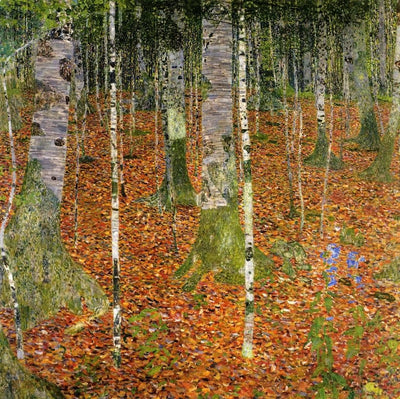
Birch Forest, 1903

Then Klimt walked into the woods. The birch wood he painted in 1903 is almost all trunks and fallen leaves, a carpet of rust and orange with pale verticals running straight off the top of a canvas about 110 cm square. There's no path and no sky. You stand inside the wood rather than looking at it.
It belonged to Ferdinand and Adele Bloch-Bauer, was seized after 1938, and returned to the family's heirs in 2006 together with the gold portrait of Adele and two other landscapes, Apple Tree I and Houses in Unterach on the Attersee. Paul Allen bought it that year. When his collection went to auction at Christie's in November 2022, the birch wood brought $104.6 million, at the time an auction record for Klimt.
The same summer he began Pear Tree (1903), now at Harvard's Busch-Reisinger Museum. He started it at Litzlberg in August and finished it in the Vienna studio, then kept reworking the left side after giving it to Emilie. That habit matters: the Attersee pictures were started outdoors, but many were finished in town.
The farm gardens, 1905–1907
By the middle of the decade the orchards turned into flower beds seen from above, with no ground line. Farm Garden with Sunflowers (1906) and Blooming Poppies (1907) are both in the Belvedere. The historian Frank Whitford described these canvases as unfurling "from top to bottom of the canvas, more like tapestries or rugs than paintings." Stand close to Bauerngarten (1907) and that's exactly the feeling: every flower head is a dab of color and none of them recedes. In March 2017 that 1907 flower garden fetched £47.9 million ($59.3 million) at Sotheby's in London.
The Villa Oleander years, 1908–1912

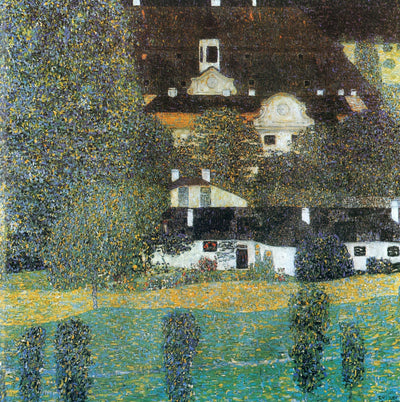
In 1908 the party moved to the Villa Oleander at Kammerl, and Klimt found a single subject he could not leave alone: Schloss Kammer, a castle on a small peninsula. He painted it seven times in oil between 1908 and 1912. From the Villa Paulick in Seewalchen he used a telescope to look across the water at the castle. That is how the distant building ends up pressed flat against the trees, as if both sat on the same sheet of paper.
- Schloss by the Water (1908): the castle reflected in still water, horizon at the top. Bought by the National Gallery Prague after it was shown there in 1910.
- The second Schloss Kammer canvas, from 1909: painted the summer after the Prague picture. Private collection.
- Park at Kammer Castle (1909): now at the Neue Galerie in New York.
- The Park (1910): a 110 cm square at MoMA, bought in 1957 from the dealer Otto Kallir, where foliage takes nearly the whole canvas as a mosaic of green, blue and yellow spots and the trunks sit in a narrow strip at the bottom.
- Schloss Kammer on the Attersee III (1909/10): Belvedere, Vienna.
- Avenue to Schloss Kammer (1912): Belvedere, Vienna.
Look at these next to The Kiss, painted 1907–1908, and the family resemblance jumps out. The same dotted, jewel-like surface. The same refusal of deep space.
The last summers at Weißenbach, 1914–1916
Klimt's final three stays were on the quieter southern shore, at the mouth of the Weißenbach valley. He rented a forester's lodge that still stands, and it gave him two paintings. The second, Forester's House in Weissenbach II (Garden) (1914), is at the Neue Galerie. Across the lake lay Unterach, whose church and houses he painted from the far shore.
The curator Stephan Koja, looking at the 1914 lodge picture, concluded that "in this case, Schiele was the model for Klimt." Then it stopped. Klimt died on 6 February 1918.
How did Klimt paint his landscape?
He framed first and painted second. Klimt carried square viewfinders cut from cardboard to pick a motif, then used a telescope or opera glasses to pull distant subjects close. The result is his signature look: a high or missing horizon, few shadows, and far things as sharp as near ones. He worked outdoors in the morning light and often finished in the studio.
Three habits are worth looking for on any of these canvases:
- The square. From 1899 on, every landscape is square or close to it, a choice tied to his interest in photography.
- The dab. Leaves, blossoms and ripples are separate touches of paint, closer to mosaic tiles than to Impressionist strokes.
- The empty scene. People almost never appear. The farm gardens have no gardener, the castle has no guests.
- The raised eye. Water and meadows climb the canvas instead of receding, so the picture reads as a flat pattern from across a room.
What is Klimt's most famous painting?
The Kiss, bought by the Austrian state in 1908 while still unfinished, hangs in the Upper Belvedere in Vienna. It's a 180 cm square, the same shape as the lake pictures, and the lovers kneel at the edge of a flowering meadow that could have come out of a Litzlberg garden. The other contender is the golden portrait of Adele Bloch-Bauer (1903–1907), which Ronald Lauder bought for $135 million in 2006 for the Neue Galerie.
What is a Klimt landscape worth?
At the top of the market, tens of millions. The birch wood's $104.6 million in 2022 leads the landscapes named here, ahead of Bauerngarten at $59.3 million and Insel im Attersee at $53.2 million. Portraits still go higher: Portrait of Elisabeth Lederer sold at Sotheby's New York for $236.4 million.
Where to see Klimt landscapes now
Most of them are in private hands, but Vienna and New York hold enough for a proper look. In 2024 the Neue Galerie hung a whole show of the summer pictures, built around its own Park at Kammer Castle and the Weißenbach garden.
| Work | Year | Where it is |
|---|---|---|
| On Lake Attersee | 1900 | Leopold Museum, Vienna |
| Beech Grove I | about 1902 | Albertinum, Dresden |
| Pear Tree | 1903 | Busch-Reisinger Museum, Cambridge, Mass. |
| Farm Garden with Sunflowers | 1906 | Belvedere, Vienna |
| Blooming Poppies | 1907 | Belvedere, Vienna |
| Schloss by the Water | 1908 | National Gallery Prague |
| Park at Kammer Castle | 1909 | Neue Galerie, New York |
| The Park | 1910 | Museum of Modern Art, New York |
| Schloss Kammer on the Attersee III | 1909/10 | Belvedere, Vienna |
| Avenue to Schloss Kammer | 1912 | Belvedere, Vienna |
| Forester's House in Weissenbach II | 1914 | Neue Galerie, New York |
If you can only make one trip, make it the Belvedere: four of these landscapes under the same roof as The Kiss. And if the Attersee sends you back to the other canvases everyone knows, start with the paintings people ask about most.
Bring a Klimt summer home
A square landscape is the easiest Klimt to live with: no gold glare, just a wall of leaves or water. The studio paints the birch wood, the Kammer castle and the rest by hand in oil, at the original square format or a size that fits your room. Browse every Klimt the studio copies by hand and pick the summer you like best.
Sources
- Klimt Foundation, Gustav Klimt Database: Attersee
- Klimt Foundation on Google Arts & Culture: Gustav Klimt at Lake Attersee
- Leopold Museum on Google Arts & Culture: Gustav Klimt's Landscapes in the Leopold Museum
- Neue Galerie New York: Klimt Landscapes (2024)
- Sotheby's: Gustav Klimt, Bauerngarten, lot 11, London, March 2017
- CBS News: Paul Allen art collection sale at Christie's (November 2022)
- CBS News: Klimt painting sells in London auction week (March 2017)