4.9/5
4.9/5


Where are most Caravaggio paintings? In Rome. A full catalogue of his work runs to 95 entries, repeat versions and disputed or lost pictures included, and 29 of them are in the city. Florence is a distant second with 8, London third with 6. About 20 of the Roman ones are on public view in museums and churches.
Scholars still argue over which pictures he painted, so any tally depends on whose list you trust. This map counts every entry, then checks the addresses that matter. One of them has already moved. And if a painting here ends up on your wish list, hand-painted copies of these Caravaggio works exist for many of them.
Where most Caravaggio paintings are: the count by city
Cities with two or more entries. The counts include private and disputed pictures.
| City | Entries | Where to see them |
|---|---|---|
| Rome | 29 | Borghese, Barberini, Capitoline, Doria Pamphilj, Corsini, three churches |
| Florence | 8 | Uffizi, Pitti Palace, Fondazione Roberto Longhi |
| London | 6 | National Gallery, Hampton Court Palace |
| New York | 5 | Metropolitan Museum of Art |
| Madrid | 4 | Prado, Thyssen-Bornemisza, Royal Collections Gallery |
| Berlin | 4 | Gemäldegalerie (three destroyed in 1945) |
| Naples | 3 | Pio Monte della Misericordia, Capodimonte, Gallerie d'Italia |
| Vienna | 3 | Kunsthistorisches Museum |
| Paris | 3 | Louvre |
| Valletta | 3 | St John's Co-Cathedral, MUZA |
| Milan | 2 | Biblioteca Ambrosiana, Brera |
| Messina | 2 | Museo Regionale |
Italy holds 49 of the 95 entries, and the Vatican one more. The United States has 11, seven of them owned by museums.
Which city has the most? Rome, with 29
Rome wins because Caravaggio was active there for most of his career. Born in Milan on 29 September 1571, he left for Rome in 1592 and stayed until 1606, when he killed a young man, Ranuccio Tomassoni, on 29 May and fled under a death sentence. (Milan, his home city, has only two: the Basket of Fruit at the Ambrosiana and the Supper at Emmaus at the Brera.) In Rome, several church commissions are still in the chapels they were painted for, and a cardinal collected him early.
Three churches hold six of them

In San Luigi dei Francesi, the Contarelli Chapel has the three Saint Matthew canvases: The Calling of Saint Matthew, where the story starts, The Inspiration of Saint Matthew and The Martyrdom of Saint Matthew. The commission is dated 23 July 1599, and all three still hang in the chapel.
Santa Maria del Popolo has two more on the side walls of the Cerasi Chapel, the Conversion of Saint Paul on the Road to Damascus and the Crucifixion of Saint Peter. Caravaggio was paid for them on 10 November 1601. The sixth is the Madonna of Loreto (about 1604) in Sant'Agostino.
Galleria Borghese: six from one cardinal's collection
Cardinal Scipione Borghese, nephew of Pope Paul V, was an avid collector of Caravaggio, and his gallery still has six: Boy with a Basket of Fruit, Young Sick Bacchus, Saint Jerome Writing, the Madonna dei Palafrenieri, Saint John the Baptist and David with the Head of Goliath.
Two arrived by force. In 1607 Giuseppe Cesari, the painter known as the Cavalier d'Arpino, was accused of illegally owning firearms and had to give up his collection, which Paul V passed to his nephew. The boy with the fruit basket and Young Sick Bacchus came with it. Look for the boy in Room 8, the Silenus Room.
Palazzo Barberini and four more stops
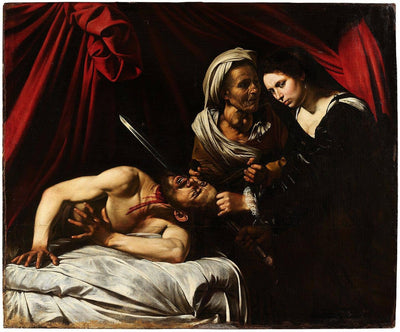
His Judith, sword halfway through Holofernes, hangs in Palazzo Barberini, and the Italian state has owned it since 1971. It has new company: in March 2026 the state paid €30 million for a portrait of Maffeo Barberini, the future Pope Urban VIII, and it now belongs to the palace for good. A Narcissus there is listed as disputed.
The Capitoline Museums have The Fortune Teller (the first of two versions, about 1594) and a Saint John the Baptist. The Galleria Doria Pamphilj has the Rest on the Flight into Egypt, the Penitent Magdalene and a second Saint John. Palazzo Corsini has a third. The Vatican Museums, technically another country, hold The Entombment.
Florence: the shield and the wine god

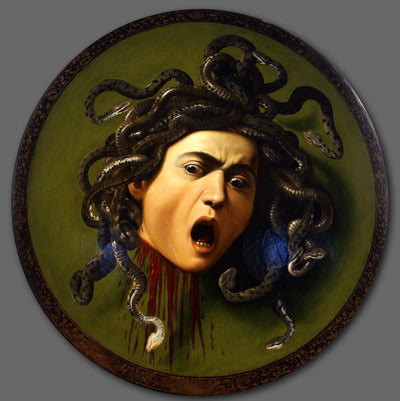
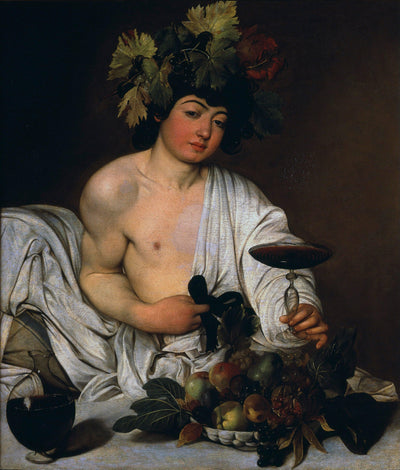
Florence has 8 entries, three of them at the Uffizi. The screaming Medusa is painted on a convex shield of poplar wood. Cardinal Francesco Maria del Monte commissioned it as a gift for Ferdinando I de' Medici, and the face is Caravaggio's own. The Uffizi Bacchus (about 1596) was another Del Monte gift to the Medici. The third is the Sacrifice of Isaac (1603).
The Pitti Palace has the Sleeping Cupid and the Portrait of Fra Antonio Martelli, both dated 1608, plus a disputed Tooth Puller. The Fondazione Roberto Longhi owns a Boy Bitten by a Lizard and a Boy Peeling Fruit.
Southern Italy and Malta: four years on the run

After Rome he kept moving: Naples first, then Malta in 1607, where he was knighted, then arrested in late August 1608 and expelled after escaping; about nine months in Sicily; and Naples again by late summer 1609. He died at Porto Ercole on 18 July 1610. The paintings stayed where he left them.
- Naples. The Seven Works of Mercy (about 1607) is still in the church it was made for, Pio Monte della Misericordia, and the Flagellation of Christ is at Capodimonte. The Martyrdom of Saint Ursula, his last canvas (May 1610), now hangs on Via Toledo at the Gallerie d'Italia. Older maps still send you to Palazzo Zevallos Stigliano, its home from 1999–2022.
- Valletta. The Beheading of Saint John the Baptist (1608) is in the Oratory of St John's Co-Cathedral. It's the largest altarpiece he painted and the only work he signed, in the blood running from the saint's throat. Saint Jerome Writing (1607) hangs in the same cathedral.
- Syracuse. The Burial of Saint Lucy (1608) is still in Santa Lucia al Sepolcro, the Franciscan church he painted it for.
- Messina. The Raising of Lazarus and the Adoration of the Shepherds, both from 1609, are in the Museo Regionale.
- Palermo. Nothing since the night of 17–18 October 1969, when thieves took the Nativity with Saint Francis and Saint Lawrence from the Oratory of Saint Lawrence. It was never recovered; a replica has hung over the altar since 12 December 2015.
Does the Louvre have any? Yes, three
The Louvre owns three, and they hang together among the Italian paintings in the Grande Galerie of the Denon wing: The Fortune Teller (the second version), the Portrait of Alof de Wignacourt and the Death of the Virgin.
Give the Death of the Virgin the most time. Laerzio Cherubini commissioned it in 1601 for Santa Maria della Scala in Trastevere, and the clergy refused the finished picture. It passed to the Duke of Mantua by 1607 and to Charles I of England by 1627, and Louis XIV acquired it in 1671. It stands 3.69 meters tall, in room 712.
London, Madrid, Vienna and the rest of Europe
- London. Trafalgar Square's three London canvases are Boy Bitten by a Lizard, The Supper at Emmaus and Salome Receives the Head of John the Baptist. At Hampton Court Palace, The Calling of Saints Peter and Andrew sat in storage labeled as a copy until it was authenticated in 2006.
- Madrid. David and Goliath is at the Prado, which unveiled an Ecce Homo on 27 May 2024, three years after it was offered at auction for €1,500 as the work of a Ribera associate. Saint Catherine of Alexandria is at the Thyssen-Bornemisza, and a Salome at the Royal Collections Gallery.
- Vienna. The Kunsthistorisches Museum has the Madonna of the Rosary, David with the Head of Goliath and a Crowning with Thorns, all dated 1607.
- Berlin and Potsdam. Amor Victorious is in Berlin's Gemäldegalerie, and The Incredulity of Saint Thomas at the Sanssouci Picture Gallery in Potsdam. Three Berlin pictures, including the rejected first Saint Matthew and the Angel, were destroyed in 1945.
- Dublin. The Taking of Christ, at the National Gallery of Ireland, was attributed to Caravaggio only in 1990.
Rouen, Nancy, Cremona and Montserrat have one each, and so does the Hermitage in St. Petersburg.
The United States: seven paintings in six museums
Six American museums own seven of his paintings between them; the Met in New York is the only one with two. In 2014 the Cleveland Museum of Art counted just eight Caravaggios in the whole country.
| Museum | City | Painting | Date |
|---|---|---|---|
| Metropolitan Museum of Art | New York | The Musicians | about 1595 |
| Metropolitan Museum of Art | New York | The Denial of Saint Peter | about 1610 |
| Kimbell Art Museum | Fort Worth | The Cardsharps | about 1596–1597 |
| Wadsworth Atheneum | Hartford | Saint Francis of Assisi in Ecstasy | about 1595 |
| Detroit Institute of Arts | Detroit | Martha and Mary Magdalene | about 1598 |
| Nelson-Atkins Museum of Art | Kansas City | the brooding Saint John of 1604 | 1604 |
| Cleveland Museum of Art | Cleveland | The Crucifixion of Saint Andrew | 1606–1607 |
Stories behind the labels

The Cardsharps vanished in the 1890s and turned up in a Zurich private collection in 1987, the year the Kimbell bought it. The Met's Denial of Saint Peter is thought to be one of his last two paintings, with the Saint Ursula in Naples. The Wadsworth Atheneum was the first American museum to acquire a Caravaggio. And Cleveland's Saint Andrew is his only altarpiece in America.
How many survive?
Somewhere between 40 and 80, depending on who is counting. In his 1983 monograph, Alfred Moir wrote that the 48 color plates in his book include "almost all of the surviving works accepted by every Caravaggio expert as autograph, and even the least demanding would add fewer than a dozen more." The longest catalogues run to 95 because they also count repeat versions and pictures that are disputed or lost.
The number moves both ways, with losses in Berlin in 1945 and Palermo in 1969 and finds at Hampton Court in 2006 and in Madrid in 2021. If this map has you planning a longer trip, add a few other masterpieces worth a detour to the route.
A Caravaggio for your own wall
Seeing every original on this map would take you from Fort Worth to Valletta. If you'd rather live with one of them, the studio’s Caravaggio copies, all painted by hand cover many of the works in this guide, from the Barberini Judith to the Contarelli Chapel's Calling and the Uffizi's Medusa.
Sources
- Galleria Borghese, Boy with Basket of Fruit
- Gallerie Nazionali Barberini Corsini, acquisition of the Portrait of Maffeo Barberini
- The Art Newspaper, 11 March 2026
- Gallerie d'Italia, Naples
- Musée du Louvre, La Mort de la Vierge
- The National Gallery, London, Caravaggio
- Cleveland Museum of Art, The Crucifixion of Saint Andrew
- Nelson-Atkins Museum of Art, Saint John the Baptist in the Wilderness