4.9/5
4.9/5


Rembrandt left roughly 300 paintings when he died in Amsterdam on 4 October 1669, and the Rembrandt paintings list below walks through them by year, from a crowded martyrdom he painted at 19 to a picture still wet on the easel at 63. Each period gets a short table with the year and the place where you can see the work today. You won't find all 300 in the tables. You will find every one you are likely to hear about, plus a few that deserve more attention than they get.
The count used to be twice as high. Older catalogues credited him with well over 600 canvases and panels. Then a team of Dutch art historians, the Rembrandt Research Project, started in 1968 and examined them one by one until its last volume appeared in 2014, and pictures by pupils and followers came off the list in large numbers. Signed self-portraits alone were cut by half. If you want to see how the survivors look on a wall at home, the Rembrandt paintings copied by hand in oil follow the same chronology.
How the Rembrandt paintings list got shorter, and what it holds now
The accepted list has 348 entries. That is more than 300 because pairs of marriage portraits are numbered separately, because a few early panels are kept as hypothetical, and because some works are only partly his: the catalogue marks dozens of portraits as "Rembrandt and workshop." The list still moves: a small Vision of Zacharias in the Temple of 1633 has been given back to him by the Rijksmuseum.
Sort the entries by the first year given and the shape of his career appears at once:
| Decade | Entries | What was happening |
|---|---|---|
| 1620s (from about 1624) | 34 | Leiden, small panels, first self-portraits |
| 1630s | 153 | Amsterdam, portrait commissions, marriage to Saskia in 1634 |
| 1640s | 51 | Saskia dies in 1642, the year of The Night Watch |
| 1650s | 60 | Hendrickje Stoffels, insolvency in July 1656 |
| 1660s | 50 | The late style, final self-portraits |
One year stands out. 1632, his first full year in Amsterdam, has 31 entries, as many as the seven years 1642–1648 put together. Most are portraits of merchants and their wives, painted fast for good money.
Leiden, 1625–1631: small panels and a young history painter
Born in Leiden on 15 July 1606, Rembrandt worked there until the end of 1631. The early pictures are small, often on oak panel, crowded with figures and lit like a stage. The first one with a firm year is from 1625. Four even smaller panels of the senses, from about 1624, sit at the head of the list as hypothetical works.
| Year | Painting | Where it is |
|---|---|---|
| 1625 | The Stoning of St. Stephen | Musée des Beaux-Arts, Lyon |
| 1626 | Balaam and the Ass | Musée Cognacq-Jay, Paris |
| 1626 | Tobit Accusing Anna of Stealing the Kid | Rijksmuseum, Amsterdam |
| c. 1628 | The Painter in his Studio | Museum of Fine Arts, Boston |
| 1629 | Judas Repentant, Returning the Pieces of Silver | Private collection |
| 1629 | Self-portrait Lit from the Left | Alte Pinakothek, Munich |
| 1630 | Jeremiah Lamenting the Destruction of Jerusalem | Rijksmuseum, Amsterdam |
| 1631 | An Old Woman Reading, probably the Prophetess Anna | Rijksmuseum, Amsterdam |
| 1631 | Simeon in the Temple | Mauritshuis, The Hague |
Look at the Boston painter-in-his-studio panel if you only see one. The artist is tiny, standing far back from a huge easel, thinking rather than painting. The Munich self-portrait is barely 16 cm tall, and half the face is in shadow. He was already using himself as the model who never cost a fee.
Amsterdam, 1632–1639: the busiest years
He moved to Amsterdam at the end of 1631 and was famous within months. The decade gave the list 153 entries, the pendant portraits of rich couples, and his first big group portrait.
| Year | Painting | Where it is |
|---|---|---|
| 1632 | The Anatomy Lesson of Dr. Nicolaes Tulp | Mauritshuis, The Hague |
| 1632 | A Lady and Gentleman in Black | Stolen, Isabella Stewart Gardner Museum |
| 1632–1633 | The Descent from the Cross | Alte Pinakothek, Munich |
| 1633 | The Storm on the Sea of Galilee | Stolen, Isabella Stewart Gardner Museum |
| 1634 | Portraits of Maerten Soolmans and Oopjen Coppit | Rijksmuseum and Louvre, owned jointly |
| 1634 | Flora | Hermitage, Saint Petersburg |
| 1635 | Belshazzar's Feast | National Gallery, London |
| 1635 | Self-portrait as the Prodigal Son in the Tavern | Staatliche Kunstsammlungen, Dresden |
| 1636 | The Blinding of Samson | Städel, Frankfurt |
| 1636, reworked by 1643 | Danaë | Hermitage, Saint Petersburg |
| 1636 | The Standard-Bearer | Rijksmuseum, Amsterdam |

The dissection that made his name
He was 26 and newly arrived when the surgeons' guild hired him to paint Dr. Tulp lifting the tendons of a forearm. The body belongs to Aris Kindt, hanged for armed robbery, and the public dissection can be dated to 31 January 1632. It may also be the first picture he signed "Rembrandt" instead of the monogram RHL. Doctors still argue about the white cord along the little finger; the likeliest answer is a rare extra muscle.
The two paintings you can't see
In the early hours of March 18, 1990, two men dressed as police officers walked into the Gardner Museum in Boston and left with 13 works. The Boston theft took two Rembrandts, cut from their frames: the couple in black and his only seascape, the boat in the storm. Christ sleeps in the stern while the sail tears. One passenger stares straight out at you, and that face is Rembrandt's own. The empty frames still hang in the Dutch Room, and a $10 million reward is still open.
A painting he could not leave alone
He finished the reclining Danaë in 1636 and reworked it by 1643. Saskia was the first model; the face was later changed to that of Geertje Dircx, who lived with him after Saskia died. On 15 June 1985 a visitor threw acid on it and cut it twice with a knife. Restorers worked on it until 1997.
1640–1649: The Night Watch and a quieter decade
Saskia died in 1642. The number of paintings drops to about a third of the previous decade, and he spends more time on etchings, drawings and a handful of landscapes. What he did paint got larger in feeling and freer in handling.
| Year | Painting | Where it is |
|---|---|---|
| 1640 | Self-Portrait at the Age of 34 | National Gallery, London |
| 1641 | The Mennonite Preacher Cornelis Anslo and his Wife | Gemäldegalerie, Berlin |
| 1641 | Saskia as Flora | Staatliche Kunstsammlungen, Dresden |
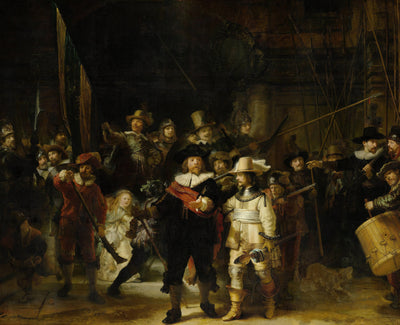
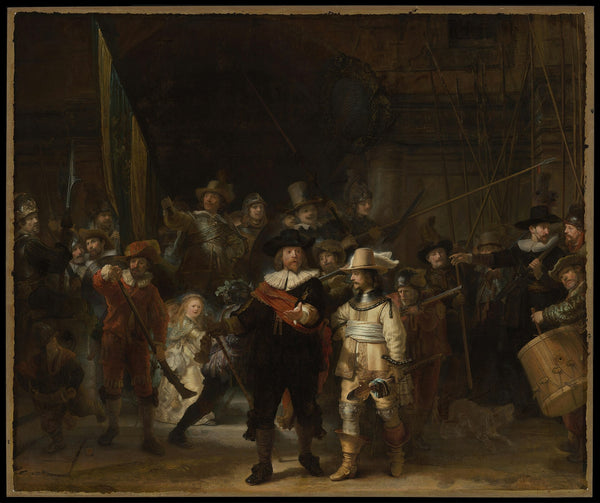
| 1642 | The Night Watch | Rijksmuseum, Amsterdam |
| 1644 | Christ and the Woman Taken in Adultery | National Gallery, London |
| 1645 | Holy Family with Angels | Hermitage, Saint Petersburg |
| 1645 | Girl Leaning on a Stone Window Sill | Dulwich Picture Gallery, London |
| c. 1645 | The Mill | National Gallery of Art, Washington |
| 1648 | The Supper at Emmaus | Louvre, Paris |

Why The Night Watch is called that
Captain Frans Banninck Cocq and seventeen members of his militia company commissioned it around 1639 for their guild hall, and the scene takes place in daylight. The name came later, by the end of the 18th century, when layers of dark varnish made it look like a night scene. Look for the captain in black giving the order to march, a girl who serves as the company mascot, and a dog caught in the rush. In 1715 the canvas was trimmed on all four sides to fit a wall in the Amsterdam Town Hall. It survived knife attacks in 1911 and 1975 and acid in 1990, and the research and restoration known as Operation Night Watch began in July 2019. If you know one Rembrandt, it is probably the militia company marching out.
1650–1659: Bathsheba, Aristotle and the bankruptcy
Hendrickje Stoffels came into his life in 1649. Money did not keep up with his spending, and in July 1656 he declared himself insolvent. The paintings from these years are thicker, warmer and more private.
| Year | Painting | Where it is |
|---|---|---|
| 1653 | Aristotle with a Bust of Homer | Metropolitan Museum of Art, New York |
| 1654 | Bathsheba at her Toilet | Louvre, Paris |
| 1654 | Portrait of Jan Six | Six Foundation, Amsterdam |
| 1654 | A Woman Wading in a Pool | National Gallery, London |
| c. 1655 | The Polish Rider | Frick Collection, New York |
| 1655 | Slaughtered Ox | Louvre, Paris |
| 1655 | Titus at his Desk | Museum Boijmans Van Beuningen, Rotterdam |
| 1656 | Jacob Blessing the Sons of Joseph | Schloss Wilhelmshöhe, Kassel |
| 1656 | The Anatomy Lesson of Dr. Jan Deyman | Amsterdam Museum |
| 1658 | Self-portrait | Frick Collection, New York |
| 1659 | Self-portrait with Beret and Turned-Up Collar | National Gallery of Art, Washington |
The Woman Wading in a Pool is the one to stand in front of. She lifts her shift, looks down at the water, and the whole thing is painted in a few loose strokes. The Frick self-portrait of 1658, two years after the bankruptcy, shows him seated like a king.
1660–1669: the late works
Rembrandt kept painting to the end. Colors got richer and the brushwork more visible, and the late canvases are the ones painters love most, with paint piled up and scratched into.
| Year | Painting | Where it is |
|---|---|---|
| 1661 | Self-portrait as the Apostle Paul | Rijksmuseum, Amsterdam |
| c. 1661–1662 | The Conspiracy of Claudius Civilis | Nationalmuseum, Stockholm |
| 1662 | The Syndics of the Clothmakers' Guild | Rijksmuseum, Amsterdam |
| c. 1660–1665 | The Return of the Prodigal Son | Hermitage, Saint Petersburg |
| c. 1665–1669 | The Jewish Bride | Rijksmuseum, Amsterdam |
| c. 1665–1669 | Self-portrait with Two Circles | Kenwood House, London |
| 1666 | Lucretia | Minneapolis Institute of Art |
| 1669 | Self-Portrait at the Age of 63 | National Gallery, London |
| 1669 | Self-portrait | Mauritshuis, The Hague |
| 1669 | Simeon in the Temple | Nationalmuseum, Stockholm |

The couple in the painting known as the Jewish Bride are probably Isaac and Rebecca; the nickname dates from the early 19th century, when an Amsterdam collector read the scene as a father giving his daughter a necklace. Get close to the sleeve. He built it up thickly and scratched into it with the butt end of the brush.
He painted more than forty self-portraits in all, and three of them come from 1669. In the London portrait of himself at 63 he used a heavily loaded brush for the aged skin and let clots of paint stand for blemishes on the forehead. The face is lit, the rest sinks into shadow. Anyone drawn to his self-portraits should see at least one of these late ones in person; photographs flatten the paint. The last picture on the list, Simeon holding the Christ child, stayed unfinished in his studio after he died.
Is Rembrandt Baroque or Renaissance?
Baroque. He was born in 1606, generations after the High Renaissance, and he belongs to the Dutch Golden Age, the great century of painting in the Dutch Republic. The Baroque marks are all over his work: strong contrasts of light and dark (chiaroscuro), theatrical staging, and figures caught in the middle of an action.
Where most of his paintings hang
Count the museums on the accepted list and Berlin comes first. The Gemäldegalerie has 21 entries, the Rijksmuseum and the Metropolitan Museum of Art 20 each, the National Gallery in London 17, the Louvre 15, the Hermitage 14 and the Mauritshuis 12. The Rijksmuseum and the Louvre also share the full-length Soolmans and Coppit portraits. Readers in America have more choice than they may think: besides the Met, the National Gallery of Art in Washington has 11, the Museum of Fine Arts in Boston 6 and the Getty in Los Angeles 5. And one painting on the list, an apostle of 1661, has no known whereabouts at all.
A Rembrandt on your own wall
Most people meet these paintings on a screen, where the thick late paint turns flat. A copy made the old way, by hand in oil, brings back some of that surface. You can browse the full set of Rembrandt copies, and compare them with the masterpieces people ask for most from other painters.