4.9/5
4.9/5


Rembrandt landscapes are rare on canvas and common on paper. Of the several hundred drawings he made, only about two hundred show the countryside; about thirty of his roughly three hundred etchings do. The paintings don't get past eight, and most of those are places he made up in the studio. If you came looking for the painted ones, you can count them on two hands.
That imbalance is the interesting part. The man who filled Amsterdam's guild halls and anatomy theaters with faces walked out of the city gate with a pen, not a panel. The Rembrandt paintings most people know are portraits and Bible stories. His landscapes mostly live in print rooms.
How many landscapes did Rembrandt paint?
No more than eight survive, and the list shrinks depending on how strict you are about attribution. Nearly all of them date from the late 1630s and 1640s. In 2006, for his 400th birthday, Kassel and Leiden put them together with the drawings and etchings for the first show that united all three.
| Painting | Date | Where it hangs |
|---|---|---|
| Landscape with Arched Bridge | c. 1637–1638 | Gemäldegalerie, Berlin |
| Landscape with a Stone Bridge | c. 1638 | Rijksmuseum, Amsterdam |
| Stormy Landscape | 1638 | Herzog Anton Ulrich Museum, Braunschweig |
| Landscape with the Good Samaritan | 1638 | Czartoryski Museum, Kraków |
| Landscape with a Castle | 1640–1642 | Louvre, Paris |
| The Mill | 1645–1648 | National Gallery of Art, Washington |
| Winter Landscape | 1646 | Gemäldegalerie Alte Meister, Kassel |
| River Landscape with a Windmill | undated | Gemäldegalerie Alte Meister, Kassel |
Kassel is the only museum anywhere with two of them. One more picture used to sit on this list: Landscape with an Obelisk (1638), long credited to Rembrandt and now given to his pupil Govert Flinck. Thieves took it from Boston's Isabella Stewart Gardner Museum on March 18, 1990, along with his only seascape, the storm on Galilee from 1633. Neither has been seen since.
Invented places, lit like a stage

Start with the small panel in Amsterdam. It's 29.5 by 42.5 cm, a road, a canal, a hay barn, a church tower, and one beam of sun breaking through black cloud onto a clump of trees. Every piece looks observed. The place doesn't exist. The Rijksmuseum bought the stone bridge panel in Amsterdam in 1900 for 2,200 guineas, and the museum sums up his output bluntly: only a few landscapes, "mostly imaginary mountain scenes."
The Berlin bridge picture is almost the same size and the same brown and grey. The Braunschweig storm is bigger and wilder, with mountains that have nothing to do with Holland. In Kraków, the Good Samaritan is a tiny figure group lost in a huge valley, on an oak panel 46.2 by 65.5 cm. German troops looted it in 1939; it went back to Kraków after the war.
Where did the mountains come from? Partly from Hercules Seghers, a strange, experimental landscape painter and etcher. Rembrandt owned eight of his paintings. He bought one of Seghers's copper plates, Tobias and the Angel, and reworked it into his own Flight into Egypt, keeping most of the scenery. He even painted over a Seghers mountain view that now hangs in the Uffizi.
The Paris picture is the oddest. The castle panel in the Louvre looks deliberately left unfinished, with the sky fully painted and the rest sketched in, an invented castle standing near a building that recalls the mausoleum of Augustus. Its travels match the mood. A Delft inventory of 1692 lists "a castle by Rembrandt." The Soviet state quietly sold it out of the Hermitage in 1932, and in 1942 its Paris owner, Étienne Nicolas, sold it to Hitler for the museum he planned in Linz. It came back after the war, and Nicolas gave it to the Louvre in 1948.
Is Rembrandt baroque or Renaissance?
Baroque. Rembrandt, born in 1606, is a painter of the Dutch Golden Age, and his work belongs to the Baroque. These landscapes show why. Between 1632 and 1636 he was chasing the drama of Rubens in huge biblical and mythological scenes like the Danaë he later reworked. The storm landscapes of 1638 are that same theater with the actors shrunk to specks: a spotlight, a threat in the sky, a ruin, a road. The Renaissance wanted a balanced, measured view. Rembrandt wanted weather.
The big mill and the tiny winter scene

The largest of the group, and the most argued over, is The Mill in Washington, a canvas of 87.6 by 105.6 cm from 1645–1648. A windmill stands on an old bastion above a moat, catching the last light, while a woman washes linen at the water's edge. For a long time scholars doubted Rembrandt painted it. The attribution has since been restored, though not everyone accepts it.
Its price history tracks Rembrandt's reputation. It sold from the Duc d'Orléans's collection in 1798 for £525. The Marquess of Lansdowne is said to have paid £840 for it. In 1911 Peter A. B. Widener of Philadelphia bought it for £100,000, and his estate gave it to the National Gallery of Art in 1942.
Stand in front of it and look at the four sails. The upright one is light against dark sky, the opposite one dark against light, the one pointing at you dark on dark, the far one light on light. Every possible tonal pairing, on one mill.

Then there's the opposite: a frozen canal in Kassel, 16.6 by 23.4 cm, signed and dated 1646. A horse pulls a sleigh, skaters cross the ice, an old woman walks her dog, and a bearded man leans on a staff. It's the only winter landscape Rembrandt painted. The paint went on wet into wet and looks dashed off outdoors, but he most likely made it in the studio from sketches drawn in front of the real thing. That detail explains a lot about the rest of this story.
Why he drew the countryside instead of painting it
Rembrandt never wrote down why. But the objects answer for him, and I think the answer is simple: when he wanted to invent a world, he painted it; when he wanted to record the one outside his door, he drew it.
From the early 1640s to the mid-1650s, his walks outside the city followed a few favorite routes. He left through a gate on the east side, a short walk from his house on the Breestraat, and went along the Diemerdijk toward the village of Diemen, or down the Amstel toward Ouderkerk. Farms, fields, canals and recognizable buildings went into his sketchbook. Scholars have matched enough of those details to old views of the villages to map where he walked.
A pen and a few sheets fit in a pocket. So does a small prepared copperplate, and Rembrandt apparently carried those too. The etching of 1645 known as the little bridge at Jan Six's estate comes with a story: Rembrandt scratched it straight onto the plate while he and his friend Six waited for a servant to fetch a pot of mustard. True or not, the print looks exactly that fast.
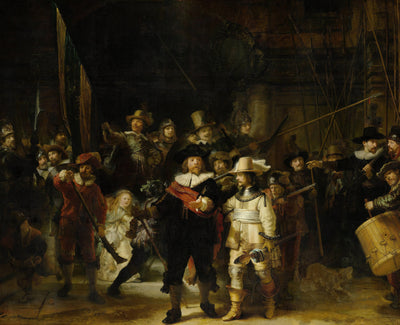
Timing matters as well. He finished the huge militia portrait in 1642. In the decade after it, his painted output dropped sharply while his landscape etchings and drawings rose. The painted landscapes stop around the same years the walking drawings take over.
And the prints carried the ideas further than any panel could. The Three Trees (1643), in etching and drypoint, is his largest and best-known landscape print, and it isn't a real view either: it's a composed scene built from the country around Amsterdam, with dense hatching in the upper left that scholars still read as either rain or sunlight. His small landscape prints largely set the pattern for how artists treated landscape in print until the end of the nineteenth century. Not bad for a sideline.
None of this made him a landscape painter. He built his early fame on people, from the 1632 dissection scene in The Hague onward, and his contemporaries praised his Bible scenes most. Landscape was what he did on the walk home. If you want the canvases everyone recognizes, start with the masterpieces people ask for by name, then come back to these eight small, stormy panels.
A Rembrandt for your own wall
Art & See paints museum copies by hand in oil, and the Rembrandts range from the Amsterdam group portrait to the Galilee storm and the Danaë. You can browse every Rembrandt the studio paints by hand and hang the drama of his light at home. The landscapes above are a good way to train your eye before you choose.
Sources
- Rijksmuseum, Landscape with a Stone Bridge (SK-A-1935)
- Rijksmuseum, Six's Bridge (RP-P-1961-1115)
- Musée du Louvre, Paysage au château (RF 1948 35)
- Gemäldegalerie Alte Meister Kassel, Winterlandschaft (GK 241)
- Ackland Art Museum, Peck Collection, Landscape with Canal and Boats
- CODART, Rembrandt's landschappen exhibition, 2006–2007
- Ernst von Siemens Kunststiftung, Rembrandts Landschaften