4.9/5
4.9/5


Yes, Leonardo da Vinci made sculptures, but none survives that experts agree is his. His giant bronze horse for Milan never got past a full-size clay model, later destroyed. The best candidate for a survivor is a small terracotta Virgin and laughing Child at the V&A in London, and the museum hasn't settled who made it.
Look up Leonardo da Vinci sculptures and you'll mostly find four things: his drawings, disputed attributions, bronzes cast by others, and a modern horse built from his idea.
He trained in a sculptor's workshop, yet nothing is certain

Around age 14, Leonardo joined the workshop of Andrea del Verrocchio, Florence's leading painter and sculptor. Giorgio Vasari wrote that the young artist made "heads in terra-cotta, of women smiling," and heads of children too. In the letter he wrote to Ludovico Sforza, Leonardo put it plainly: "I can carry out sculpture in marble, bronze or clay."
Then the record goes quiet. The curators behind a 2010 Getty exhibition on his sculpture put it bluntly: "no work of sculpture can be definitively attributed to Leonardo." What survives for certain is on paper, plus a small group of paintings by da Vinci such as the portrait known as the Lady with an Ermine.
What happened to Leonardo's horse?

It was never cast, so this da Vinci sculpture only ever existed in clay. In 1482 Ludovico il Moro, Duke of Milan, commissioned a monument to his father, Francesco Sforza, meant to be the largest equestrian statue in the world, nearly 8 meters (26 feet) tall. He gathered 70 tons of bronze for it.
By November 1493 the full-size clay horse was on show at a Sforza wedding. In November 1494 Ludovico gave the bronze to Ercole d'Este to forge cannons against Charles VIII. French troops who invaded Milan in 1499 used the model for archery practice, and rain and frost finished it.
The horse you can visit dates from 1999
A 1977 National Geographic article sent Charles Dent after the lost horse. The result, two bronzes of Nina Akamu's 24-foot design, went up in 1999: at Milan's San Siro hippodrome on September 10, and at Frederik Meijer Gardens in Grand Rapids, Michigan, on October 7.
The one that may survive: a laughing Child in London
The Virgin with the Laughing Child is a terracotta about 20 inches (49 cm) tall, made in Florence in 1460–1475, in the Victoria and Albert Museum since 1858 and long credited to Antonio Rossellino.
In spring 2019 it traveled for the first time, to an exhibition in Florence, where it was presented as the young Leonardo's work from Verrocchio's workshop, around 1472. Francesco Caglioti of Naples University led the case for Leonardo. The Met's Carmen Bambach matched the sculpted drapery to drawings Leonardo made as a student. Put Vasari's smiling terracotta heads next to it and the theory is hard to resist. It isn't new, either: the Leonardo idea goes back to 1899.
The V&A hasn't adopted it, and still keeps Rossellino and Verrocchio among the possible makers. Judge for yourself: it's on display in Room 64a at South Kensington.
Where to see Leonardo da Vinci sculptures today
Each of these gets called one of the sculptures of Leonardo da Vinci somewhere.
| Work | Where | Link to Leonardo |
|---|---|---|
| The Virgin with the Laughing Child, terracotta, 1460–1475 | V&A, London | Proposed as his; not settled |
| Horse and Rider, bronze | Museum of Fine Arts, Budapest | 16th-century cast, possibly after his model |
| John the Baptist Preaching to a Pharisee and a Levite, bronze, 1506–1511 | Museo dell'Opera del Duomo, Florence | Cast by Rustici; Vasari credits Leonardo's advice |
| Monument to Leonardo da Vinci, marble, 1872 | Piazza della Scala, Milan | A statue of him by Pietro Magni |
Scholars take the small bronze horse and rider in Budapest more seriously than most Leonardo attributions. In 1916 Simon Meller published it as a model for his Trivulzio monument, a second horse that was never built.
What da Vinci paintings are in the Louvre?
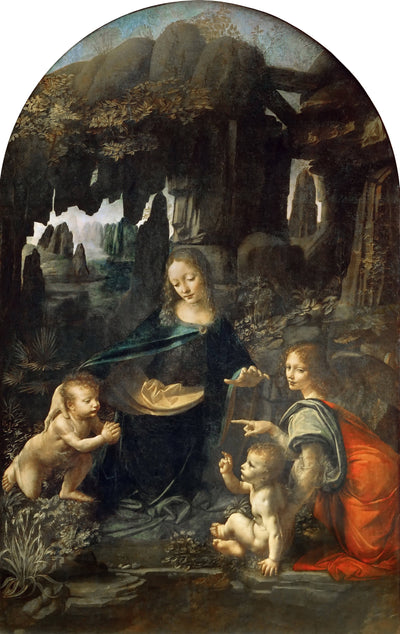
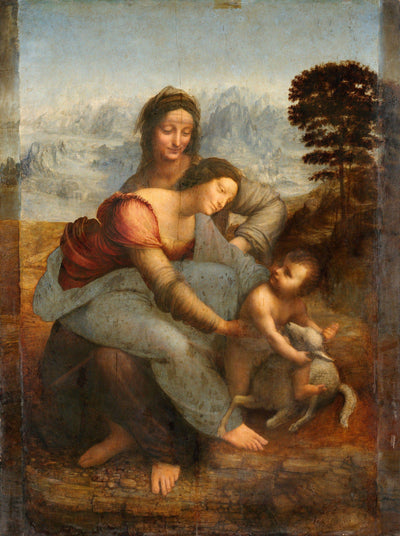
Five, counting the core of its Leonardo holdings: the Paris version of The Virgin of the Rocks, La Belle Ferronnière, the Mona Lisa, his Saint John the Baptist and the Saint Anne, with the Virgin and Child. It is the largest collection of his paintings in the world, plus 22 drawings. Those pictures sit among the paintings everyone recognizes, and they are where his hand survives.
His paintings, on your wall
The horse is gone and the terracotta is still argued over, but the paintings are here to stay. Art & See makes hand-painted copies of da Vinci's work in oil. You can start with a full-size Adoration of the Magi, or pick one of the smaller portraits that first drew you to him. Unlike the clay horse, a canvas holds up.
Sources
- Victoria and Albert Museum, The Virgin with the laughing Child
- J. Paul Getty Museum, Leonardo da Vinci and the Art of Sculpture
- Museum of Fine Arts, Budapest, Leonardo Project: The Statuette
- NPR, Mystery Sculpture Thought To Be The Work Of Leonardo da Vinci Is Unveiled In Italy (2019)
- Musée du Louvre, Leonardo da Vinci exhibition press page
- Richter, The Notebooks of Leonardo da Vinci, section 1340