4.9/5
4.9/5


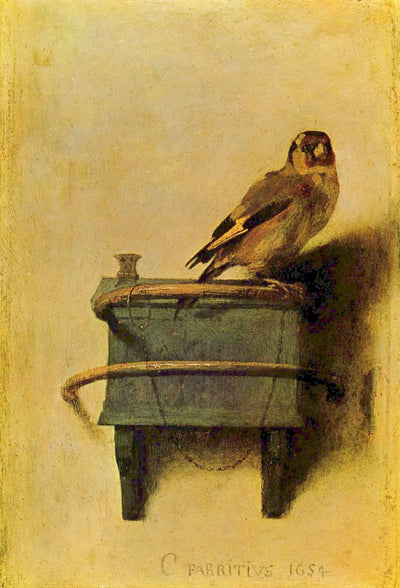
Most people walk up to it and laugh a little, because it's so small. The Goldfinch at the Mauritshuis is a wooden panel 33.5 by 22.8 centimeters, about 13¼ by 9 inches, which is roughly the size of a hardcover novel. On it, a bird sits on top of its feeding box against a pale plaster wall, a fine chain running from its leg. That's the whole picture. People cross oceans to stand in front of it.
Carel Fabritius painted it in 1654, the year he died at 32. Only about a dozen of his paintings survive, and the handful of Fabritius paintings still in existence are scattered across a few museums, which is one reason this one pulls such a crowd. The other reason is harder to put into words. You stand there and the bird looks back.
This guide is about seeing it in person: where it hangs, what to look for once you're in front of the chained goldfinch on its white wall, why it seems to be looking down at you, and how it ended up in The Hague at all.
Room 14, and what hangs around it
The painting is on view in Room 14 of the Mauritshuis, the seventeenth-century city palace on the Plein, right beside the Binnenhof. It's a small museum, and that helps. You won't spend an hour lost in wings of the building looking for one panel.
Two doors worth knowing about. Vermeer's view of his hometown, painted around 1660–1661, hangs in Room 15. Rembrandt's anatomy lesson for Dr Nicolaes Tulp, from 1632, is in Room 9. Fabritius studied under Rembrandt in Amsterdam and later lived in Delft alongside Vermeer, so a walk through those three rooms is a short course in who learned what from whom.

Rooms get rehung and loans come and go, so treat the room number as a starting point. The museum app and the floor map will tell you if the bird has moved.
What you're looking at up close

Get close. The painting rewards it, and there's nothing else going on in the frame to distract you.
The yellow in the wing
Look at the wing first. Between the black and caramel feathers there are a couple of bright yellow ones, and they're not smooth. Fabritius laid two strokes of thick yellow over the black, then dragged the pointed end of his brush through the wet paint so a thin line of black shows through. It's a trick he picked up from Rembrandt, and once you've seen it you'll notice how little else in the bird is described in detail. The head is a few dabs. The breast is a soft smear of warm brown. From a step back it reads as feathers; from a step closer it's paint, and you can see exactly where the brush went.
The red around the beak looks duller than it should. It has discolored over time, and it would originally have been a much stronger accent against the white.
The wall behind the bird
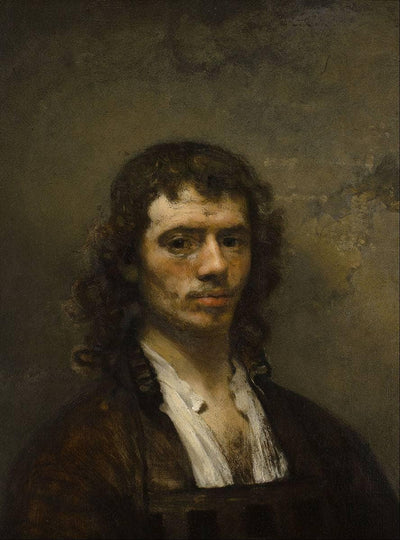
The background is a plastered wall, slightly damaged, with the paint laid on thickly in places so the surface catches the light. Fabritius liked that wall. He put flaking plaster behind people too, which was an odd choice at a time when sitters wanted a handsome backdrop, and it's worth comparing the bare setting here with how he painted himself in a self-portrait. Look for the bird's shadow on the wall, and the shadow of the box. They do more to convince you than any feather.
The signature and the perch
At the bottom, in the center, is the signature: C FABRITIVS 1654, with a V where we would write a U. The lowest perch, the one closest to the signature, was not in the first version. X-ray and infrared images show it was painted later, over the white background, to push the illusion further. The full catalogue entry for inventory number 605 has the details of the panel and its history if you want them on your phone while you look.
The feeder and the chain
The bird is a European goldfinch, and the setup is accurate. Goldfinches were popular pets in the Dutch Republic because they could learn tricks. The Dutch nickname, puttertje, means something like "little water-drawer": the bird could haul up water from a bowl in a bucket about the size of a thimble, and could open its own feeding box with its beak. Real feeders like this one were fixed to a long support on the wall, with a small platform below and a hole for the bucket to drop through. The chain is what makes the picture uneasy. The bird could fly, and it can't.
Is The Goldfinch a real painting?
Yes. People ask because of the novel. Donna Tartt built a best-selling book around this panel, put it on the cover, and called it a "tiny, stand-alone masterpiece." The book is fiction; the painting is real. It hangs in The Hague, dated 1654, and the museum bought it in 1896.
It's also genuinely by Fabritius, which matters more than it sounds. For two centuries after his death, many of his paintings were bought and sold as Rembrandts, sometimes with a fake Rembrandt signature added. This one carries his own name in large letters.
Why the bird looks down at you
Stand directly in front of it and something is slightly off. You are looking up at the bird. The perspective puts your eye below the feeder, as if the panel were meant to hang high on a wall, and that detail has fed a long argument about what the thing was for.
Start with the object itself. The panel is thicker than usual, 8–10 millimeters, and it was sawn from a much larger board. Ten nails once ran around its edge at equal intervals. In its earliest state it had a dark border about two centimeters wide, which Fabritius later painted over in the same white as the plaster, apparently after removing a frame. Those clues point away from a normal picture in a normal frame.
There are four main theories, and none has won:
- Part of a cage or feeder. The panel may have been built into a real wooden setup, with a painted bird instead of a live one, so that flat paint and real wood would trick the eye together.
- A small door to a wall niche. The plaster background and the low viewpoint suit a panel set into a wall, seen from below.
- A shutter over another painting. Protective covers for pictures were fairly common, and the goldfinch could have been the lid on a small cupboard holding a more valuable image inside, perhaps a domestic scene.
- A window piece. Linda Stone-Ferrier's 2016 study of the panel argues it may have been fixed inside a street-facing window, where a passerby on the pavement would glance up and see what looked like a neighbor's pet bird. Real pet goldfinches and their cages lived in the front room of Dutch houses, the room that faced the street.
A simpler idea: Fabritius hung it unframed on the white wall of his own studio, so that a visitor walking in would think for a second there was a live bird there. No better advertisement for a painter. I find that one the most fun, and it fits the low viewpoint less well than the window theory.
What all of them share is the aim. Painting a living creature so well that it fools the viewer was treated as the highest thing a painter could do. Samuel van Hoogstraten, who studied with Rembrandt at the same time as Fabritius, advised painters to go for "depicting something flat on a flat surface," and a bird against a flat wall is exactly that. In 2003 the panel became the first painting examined by CT scan, and the scans are part of why we know as much as we do about its changes.
How it got from Delft to The Hague
Fabritius moved to Delft in 1650. On 12 October 1654, a gunpowder store in the city exploded, and his studio nearby was destroyed. He was pulled from the ruins and died soon after. The goldfinch came through. Much of his work must have gone with the studio.
The painting then drops out of sight for two centuries. It resurfaces in Brussels, with Chevalier Joseph-Guillaume-Jean Camberlyn and his heirs, who gave it in 1865 to Théophile Thoré, the French critic who did more than anyone to bring Fabritius, and Vermeer, back into view. After Thoré's death it was sold at the Hôtel Drouot in Paris on 5 December 1892, lot 10, went into the Martinet collection, and came up again at the Hôtel Drouot on 27 February 1896 as lot 16. The Mauritshuis bought it that year, and it has belonged to the museum ever since.
The times it left home
Because it's so small and so loved, loans are news. It made the last American stop of a Mauritshuis tour at the Frick from October 22, 2013–January 19, 2014, with fifteen paintings from The Hague. That show drew around 200,000 people, many of whom stood in lines in freezing weather.
From 4 November–18 December 2016 it was in Scotland for the first time, on a six-week loan to Edinburgh, and it came back to The Hague in time for Christmas. The museum posted a short film of its return, which was shared more than 1,600 times.
Then in February 2026 the museum turned the bird into a curator. An exhibition on birds and people, co-curated with the historian Simon Schama, took the goldfinch as its starting point and gathered birds from Leonardo, Rembrandt, Matisse and Audubon around it. If the panel isn't in Room 14 when you arrive, a show like that is the likely reason.
Planning your visit to the Goldfinch at the Mauritshuis
The Mauritshuis is at Plein 29 in the center of The Hague, about ten minutes' walk from Central Station. It's open every day: Monday afternoons 13:00–18:00, and Tuesday to Sunday 10:00–18:00. Last entry is thirty minutes before closing. Check opening hours and time slots before you travel, since holiday hours differ.
A few things that make the visit easier:
- Book a time slot online. The museum strongly recommends it because of crowds, and once you're inside you can stay as long as you like.
- Bring a card. The museum is cashless; the till takes debit cards, credit cards and phones.
- Visitors under 19 get in free. That makes it an easy stop for families.
- Add the Prince William V Gallery. It's part of the Mauritshuis, about five minutes' walk away at Buitenhof 33, and a combined ticket covers both.
How long to give the bird
Longer than you think. It's easy to glance, take a photo and head for the Vermeers. Try this instead: stand back three or four steps until the bird looks alive, then walk in slowly until it turns into brushstrokes. Somewhere in between is the point Fabritius was aiming for. Then crouch a little. The painting was made to be seen from below, and the bird sits differently when you're lower than it.
If the room is crowded, loop through the rest of the museum and come back. A painting this small needs you close, and a timed ticket lets you stay as long as you like.
Bringing the bird home
A panel the size of a book is easy to live with, and the plain wall suits almost any room. If you'd like a hand-painted copy of the goldfinch for your own wall, the studio paints it in oil, stroke by stroke, including that scratched yellow feather. It sits well beside the other paintings people travel to see, and it's a quiet reminder of the afternoon you spent in Room 14.