4.9/5
4.9/5


On a Monday morning in Delft, a little before half past ten, a man named Cornelis Soetens took off his red cloak so it wouldn't get dirty and went down into the town's powder magazine to fetch a two-pound sample. Moments later, the Delft explosion of 1654 flattened the northeastern corner of the city. It was 12 October. Somewhere between 80,000 and 90,000 pounds of gunpowder went up at once, and the bang carried out to the island of Texel, more than 70 miles away.
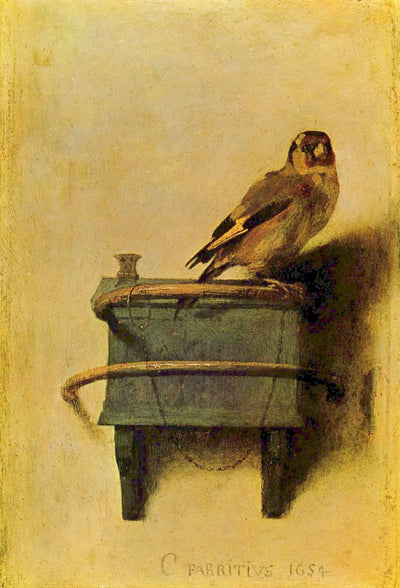
Among the dead was Carel Fabritius, 32 years old and the most inventive pupil Rembrandt ever trained. The small panel he had finished that same year, a chained goldfinch on its feeding box, came through. Most of his other work did not.
What happened in the Delft explosion of 1654
The powder was kept in the old convent of the Poor Clares, the Sint-Claraklooster, at the end of the Geerweg. It had been stored there since 1637, most of it underground, in a town that had simply grown up around it. Nobody knows exactly what set it off. The likeliest guess is a spark from Soetens's lantern.
What followed is easier to describe. More than two hundred houses were destroyed outright. The Verwersdijk, the Doelenstraat and the Geerweg were leveled, and so was the Schuttersdoelen, the militia's training ground. The stained glass in both the Oude Kerk and the Nieuwe Kerk blew out. No reliable death count survives; hundreds of people must have died, and about a thousand more were hurt.
There were small mercies. One of the stranger rescue stories is of a baby girl pulled out after 24 hours, still sitting in her high chair, still holding an apple.
Fabritius on the Doelenstraat
Fabritius was born in the Beemster polder north of Amsterdam and spent 1641–1643 in Rembrandt's Amsterdam workshop. By 1652 he was a member of the painters' guild in Delft, and he'd moved into a house on the Doelenstraat, a few minutes' walk from the arsenal. That address killed him.
That morning he was working on a portrait. His sitter was Simon Decker, the former sexton of the Oude Kerk. His mother-in-law and his brother were in the house, and so was his pupil, Mathys Spoors. When the magazine went, the house came down on all of them. Fabritius lay under the rubble for six or seven hours. He was dug out alive, carried to the Gasthuis, the town hospital, and died about fifteen minutes later.
His death became a local legend almost at once. Arnold Bon wrote an elegy for him, and its last lines are the ones people still quote:
"Thus did this Phoenix, to our loss, expire, / In the midst, and at the height of his powers, / But happily there arose out of his fire / Vermeer, who masterfully trod his path."
You don't need the poem to see the link. Vermeer, working in the same town, took a lot from Fabritius: the clear, cool daylight and the calm of a figure set against a pale wall. Benjamin Moser's long essay on him is the best short read on why.
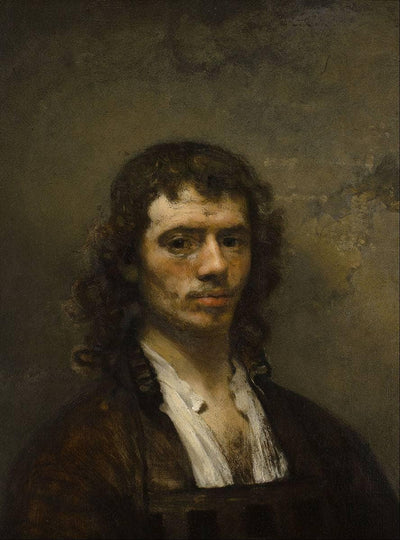
The worst damage to his reputation was done by the blast itself. Only about a dozen of his paintings survive. Two of them tell you what he looked like: a soldier-like self-portrait in a breastplate from his last year, and an earlier, bareheaded self-portrait with an open white collar and a wall of scuffed plaster behind him. If you want the rest of what little exists, the short list of Fabritius paintings doesn't take long to scroll.
How did The Goldfinch survive?

Honestly, nobody knows where the panel was that morning. It's dated 1654, so it was made in the last months of his life. Maybe it had already been sold. Maybe it hung in another house, out of the blast zone. It's small (33.5 × 22.8 cm, about 13¼ × 9 inches) and painted on wood, which is easier to carry out of a ruin than a canvas on a stretcher.
The picture may have started life as part of a birdcage, or as a cover for another painting kept in a case. That would explain the odd format and the heavy, almost sculptural shadow cast by the perch. Fabritius built the bird with a handful of quick strokes, and from a few feet away it reads as a live pet chained to the wall.
Is The Goldfinch a real painting?
Yes. It's oil on panel, signed and dated 1654, and it has been in The Hague since 1896, where it carries inventory number 605. People sometimes assume it was invented for a novel or a film. It wasn't. The bird is a goldfinch, kept as a house pet, painted roughly life-size and chained by the leg to its feeding box.
The painter who kept painting the ruins

Egbert van der Poel, born in Delft in 1621, was living on the Doelenstraat with his family when the powder went up. One of his daughters was buried in the Nieuwe Kerk on 14 October, two days later. Whether the explosion killed her isn't known.
He painted the wreckage over and over. More than 20 versions survive, each with the same buildings and a different cast of dazed figures picking through the debris. The London panel, 36.2 × 49.5 cm, carries the inscription "12 Octob 1654", the date of the disaster rather than the date of the painting. You can pick out the Nieuwe Kerk, the town hall tower, the Oude Kerk and the chapel of St George's hospital. In the middle sits a deep pool of water where the magazine used to be.
The same Nieuwe Kerk turns up in Fabritius's own tiny view of the town, painted before the blast. Put the two side by side and you're looking at one church, before and after. By November 1655 van der Poel had moved to Rotterdam.
What Delft built on the crater
Money came in from outside, including 100,000 guilders from the States of Holland and West Friesland. Claims were paid at a fraction of the loss: Vermeer's mother, Digna Baltens, ran the Mechelen inn on the market square and was awarded 60 guilders against 150 guilders of damage. The new powder house, designed by Pieter Post, went up outside the city walls, a cannon shot away from the houses. The flattened ground became the Paardenmarkt, the horse market, and that's the name it still carries.
A bird that outlived its painter
If the story stays with you, the painting can too. Art & See paints the goldfinch Fabritius left behind by hand in oil, alongside the other masterpieces people ask for by name. Hang it a little above eye level, where the trick of the perch and its shadow works best, and a bird from 1654 sits on your wall.