4.9/5
4.9/5


You found a gorgeous high-resolution scan of The Starry Night and you want to print it on tote bags. Or on a poster for your café. Or you just want to paint your own version. Before you do, you're asking the right question: are Van Gogh paintings public domain? Yes. Every painting Vincent van Gogh made is out of copyright, and nobody owns the right to stop you from copying it. The catch sits somewhere else, in the photograph you download and the rules of the museum that took it.
That second part is where most of the confusion on seller forums comes from. So here is how it works in practice, using the Van Gogh paintings people copy most as the examples.
(This is a plain-English explainer, not legal advice. If a lot of money rides on a product, talk to an intellectual property lawyer.)
Why the paintings themselves are free
Van Gogh died on 29 July 1890 in Auvers-sur-Oise, two days after shooting himself in a field near the village. Copyright is built around the author's life. In the United States, for works created after 1 January 1978, protection lasts for the life of the author plus 70 years, and older works fall under rules that expired even sooner. Run any version of that math on a painter who died in the 19th century and you get the same answer. The protection ended generations ago.
So the images on the canvases (the swirling sky, the sunflowers in their yellow vase, the blue bedroom in Arles) belong to everyone. You can copy them, adapt them, crop them and sell what you make.
The photo is a different object
Here's the part people miss. When you download a Van Gogh, you aren't downloading the painting. You're downloading a photograph of it, made by a museum or an image agency, and that photographer could, in theory, claim a copyright of their own.
In the US that claim is weak for a flat painting shot straight on. In 1999 a federal court in New York looked at an image library's color transparencies of public domain paintings and refused them protection. Judge Lewis A. Kaplan wrote that the library had labored to make exact copies, and while that took skill and effort, "there was no spark of originality," so "copyright is not available in these circumstances." You can read the full Bridgeman v. Corel opinion if you enjoy that sort of thing.
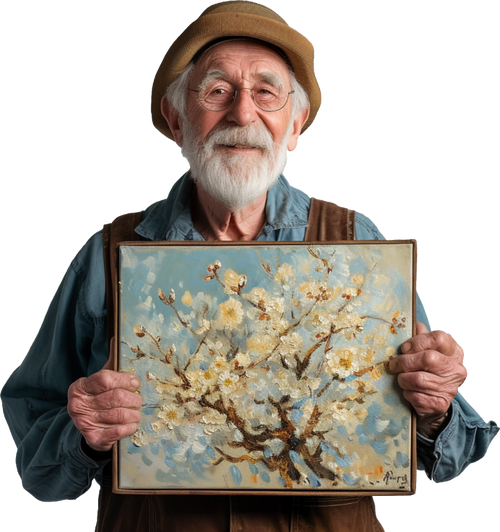
Europe went further in 2019. Article 14 of the EU copyright directive requires member states to make sure that a reproduction of a work of visual art whose protection has expired is not itself covered by copyright, unless the reproduction is original in its own right. A faithful museum photo of Almond Blossom doesn't meet that bar.
But copyright isn't the only thing a museum controls. It also controls access to its files, its website terms and its name. That's why the policies differ so much.
What the big collections actually allow
Four institutions hold a large share of the Van Gogh images people go looking for, and they take noticeably different approaches.
Van Gogh Museum, Amsterdam

The largest Van Gogh collection anywhere is also the most careful. Images on its website can be downloaded free for non-commercial use: research, private study, teaching, non-profit publications, personal websites, blogs and social media. You're asked to always include the full credit line, which for most works reads "Van Gogh Museum, Amsterdam (Vincent van Gogh Foundation)." Anything commercial goes through a written request to its rights department, and brands can apply to become licensing partners.
That doesn't mean the white almond branches against a blue sky are under copyright. It means the file Amsterdam hands you comes with conditions attached.
National Gallery of Art, Washington
The opposite end of the scale. The Gallery has made more than 60,000 images free to download, and works it believes are in the public domain can be used for any purpose, commercial or not, with no fee and no permission needed. Its open access program covers its Van Goghs. One request worth respecting: don't use the Gallery's logo or suggest it endorses your product.
Rijksmuseum, Amsterdam
The Rijksmuseum has run a de facto open data policy since 2012. Most images in its online collection come with a Public Domain Mark or a CC0 dedication, which means you can use them for personal and commercial projects. Its collection site explains how to find the download button on each object.
The Met and MoMA, New York
The Met releases data on more than 470,000 artworks under Creative Commons Zero and marks the objects whose images are free to reuse with a CC0 icon on each collection page. If a Van Gogh you want hangs at the Met, look for that icon before you look anywhere else.

MoMA is stricter. The night sky he painted from the asylum window hangs on the fifth floor there, and its collection entry sends anyone who wants MoMA's own photograph to a licensing section. The painting is free. That particular file is not handed out.
Can you sell prints or products with a Van Gogh on them?
In most cases, yes. The painting carries no copyright, so a mug or a canvas print of the café terrace under the stars isn't infringing anything by itself. What you need is an image you have the right to use: one from an open access program, one you photographed yourself, or one you licensed.
A few things can still trip you up:
- Terms of use. Downloading from a museum site that allows only non-commercial use, then selling the result, breaks the terms you agreed to, even where copyright wouldn't stop you.
- Names and logos. A museum's name and logo are protected separately. "Van Gogh" on your product is fine; implying a museum made or approved it is not.
- Other people's additions. A modern designer's remix, a restorer's digital recolor or a photo of the painting in its frame can carry fresh rights.
- Marketplace rules. Platforms apply their own policies on top of the law.
Can you paint your own copy?
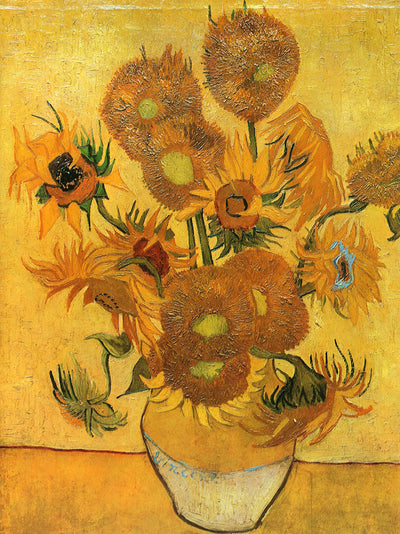
Absolutely, and people have done it for as long as the paintings have existed. Van Gogh copied his own work. He painted five large canvases of sunflowers in a vase, and after Gauguin asked for one he produced two loose copies. One of them, finished in Arles in January 1889, is in the Van Gogh Museum today.

A hand-painted copy, like a painted version of the fifteen sunflowers, is legal to make, own and sell. The one line you shouldn't cross is passing it off as an original. Sign it as a copy, don't forge Vincent's signature as if it were his, and describe it honestly when you sell. Anyone curious how often "lost originals" turn out to be real can read about the Van Goghs that surfaced in attics.
A short checklist before you use an image
- Find the museum that owns the painting and look for an open access or CC0 label on the object page.
- If the label reads non-commercial only, keep it non-commercial or request a license.
- Use the credit line the museum asks for, even when it's optional.
- Keep museum names and logos off your product unless you have permission.
Living with one of them
If what you really want is the painting on your wall rather than a file, a canvas painted by hand is the most satisfying route. The studio's full set of hand-painted Van Gogh copies covers his best-known canvases, and the masterpieces people ask for most spans the rest of art history.
Sources
- Van Gogh Museum: Use and Permissions of Collection Images
- National Gallery of Art: Free Images and Open Access
- Rijksmuseum: Information and Data Policy
- The Met: Open Access dataset
- U.S. Copyright Office: How long does a copyright last?
- EUR-Lex: Directive (EU) 2019/790
- Bridgeman Art Library v. Corel Corp. (S.D.N.Y. 1999)
- Van Gogh Museum: Vincent van Gogh's Death