4.9/5
4.9/5


Yes, a real Van Gogh painting found in an attic exists: Sunset at Montmajour, painted near Arles on July 4, 1888. Written off as a fake, it sat in a Norwegian attic for decades until the Van Gogh Museum confirmed it on September 9, 2013, the first full-size canvas of his confirmed since 1928. The famous garage sale "Van Gogh" didn't pass.
Finds like this are rare, because his work is so thoroughly documented that new pieces almost never get added. For most people, the Van Gogh paintings people actually hang at home are copies of the ones already in museums.
Which finds turned out to be real
| Work | Where it turned up | Went public | Outcome |
|---|---|---|---|
| A hidden canvas from 1889 | Under Ravine, MFA Boston | 2007 | Genuine, seen only by X-ray |
| Sunset at Montmajour | A Norwegian attic | 2013 | Confirmed |
| View of the Sea at Scheveningen and Congregation Leaving the Reformed Church in Nuenen | A Camorra villa, Italy | 2016 | Recovered |
| The Hill of Montmartre with Stone Quarry (drawing) | An art foundation | 2018 | Confirmed |
| Study for "Worn Out" (drawing) | A private collection | 2021 | Confirmed |
| A self-portrait | Behind cardboard, Scotland | 2022 | Genuine, seen only by X-ray |
| The Parsonage Garden at Nuenen in Spring | An Ikea bag, Amsterdam | 2023 | Recovered |
| Elimar | A Minnesota garage sale | 2025 | Rejected |
Decades in a Norwegian attic

The canvas stayed in Theo van Gogh's family collection until 1901, which makes sense once you know how little Vincent sold while he was alive: more than a couple of paintings, with the first going to the Paris paint dealer Julien Tanguy. After a Paris dealer sold it on, Norwegian industrialist Christian Nicolai Mustad bought it in 1908. Soon after, it was declared a fake and banished to his attic. The Van Gogh Museum itself turned it down in the 1990s, partly because it isn't signed.
Van Gogh's own letters and the canvas reversed that. He described the scene to his brother Theo the day after painting it, and its canvas and underpainting match The Rocks in Houston.
The Minnesota garage sale portrait
Elimar, a portrait of a white-bearded man mending a fishing net, cost an antiques collector under $50 at a garage sale in Minnetonka, Minnesota. In January 2025 its owner, LMI Group International, put its value at $15 million or more and called it a Van Gogh.
The museum had rejected it from photographs in 2019. After the new report it didn't budge: "we maintain our view that this is not an authentic painting by Vincent van Gogh," it said in 2025. Think you own one? Only accredited dealers and auction houses can submit a work to the museum now.
Hidden under paint, or stolen and returned

Ravine (1889) in Boston hides an earlier painting that X-rays revealed, most likely made that June at the asylum in Saint-Rémy. In 2022 conservators in Scotland found a self-portrait under glue and cardboard on the back of Head of a Peasant Woman (1885).
Two canvases stolen from the Van Gogh Museum in 2002 turned up in a Camorra villa in Italy in 2016. The Parsonage Garden at Nuenen in Spring (1884), stolen in 2020, came back in an Ikea bag in 2023 and, once restored, went back on the wall in Groningen.
What are Van Gogh's three most famous paintings?
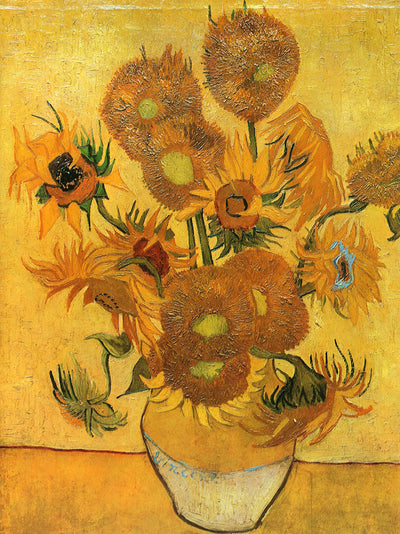
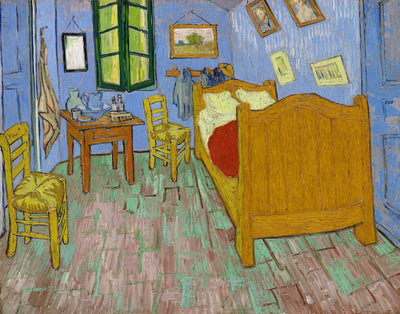
No official list exists, but the 1889 night sky over Saint-Rémy is the obvious first pick; MoMA in New York has owned it since 1941. For the other two, choose from the masterpieces NPR named in its 2013 story: the vase of fifteen sunflowers, the house he rented in Arles or his bedroom there. A fuller ranking of his best-known canvases goes deeper, and the paintings everyone recognizes, by any artist sit together in one place.
If you want one on your wall
The attic canvas is still in a private collection, and the garage sale portrait isn't his. A hand-painted copy is the realistic route: the rest of his work in the Art & See studio includes another Arles canvas from September 1888, the lamplit café on the Place du Forum.
Sources
- Van Gogh Museum, Authenticity
- Van Gogh Museum, How many paintings did Vincent sell?
- Museum of Fine Arts, Boston, A Missing Van Gogh Discovered
- NPR, Van Gogh painting found in a Norwegian attic (2013)
- NPR, hidden Van Gogh self-portrait (2022)
- Smithsonian Magazine, the garage sale painting (2025)
- Hyperallergic, Garage Sale Portrait Is Not a Van Gogh Original
- Smithsonian Magazine, the Parsonage Garden restored (2026)