4.9/5
4.9/5


Why is Caravaggio so famous? He changed how light works in a painting, and he lived like an outlaw. He lit saints and killers with one hard beam against black, cast them from people off the Roman street, killed a man in 1606 and died on the run in 1610, aged 38. Here are the seven reasons, roughly in the order they built his reputation.
1. One window, black walls: tenebrism

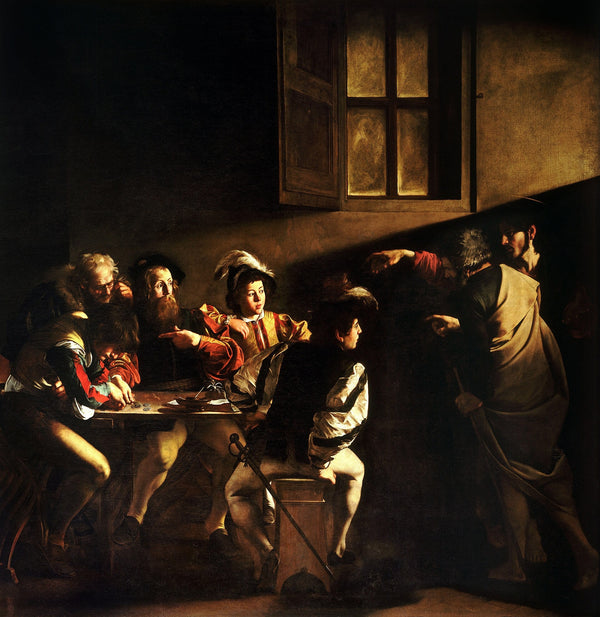
Stand in front of the Calling of Saint Matthew in San Luigi dei Francesi (1599–1600) and the first thing you notice is a shaft of light. It cuts across a dim room and lands on five men at a table. The bearded one points at his own chest, as if to ask "Me?"
The style is called tenebrism, from the Italian tenebroso, dark or gloomy: chiaroscuro pushed to violent contrasts, with darkness taking over most of the picture. Tintoretto and El Greco used hard shadows before him, but Caravaggio is the painter credited with inventing it. His recipe was simple. One strong light from a single high window, and walls painted black.
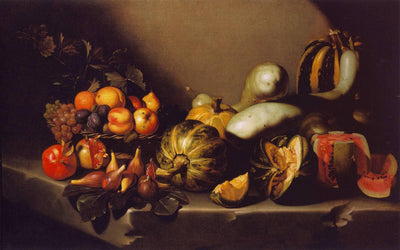
He may have gone further. Around the time he painted a still life of fruit on a stone ledge (about 1603), a landlady sued him for cutting a hole in the ceiling of his rented rooms, presumably to get that light. The melons in that picture sit in a beam falling from the top left.
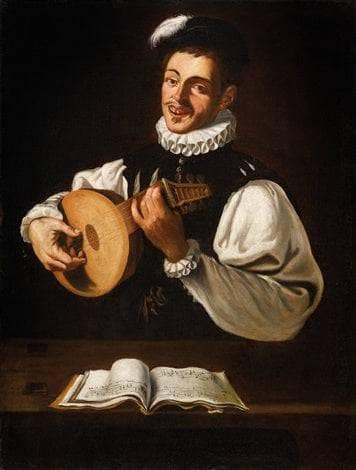
Look for the edge of the beam on the back wall. In the Calling, its upper limit seems to match the shutter of the window above the table, and the same room appears to turn up in his boy playing the lute. That beam is also the first thing a copyist has to get right, which is why every Caravaggio painted by hand lives or dies on its blacks.
2. Saints with dirty feet
The Madonna di Loreto (about 1604–1606), still in Rome's church of Sant'Agostino, shows the Virgin as barefoot as the two peasant pilgrims kneeling at her door. Its unveiling set off an uproar among ordinary Romans.
That rawness came from his method. He worked fast from live models and scored guide lines into the canvas with the end of his brush handle. Very few drawings by him survive. Some church clients found the results vulgar. Look for these details:
- Dirty legs. His first Saint Matthew and the Angel showed the saint as a bald peasant with dirty legs. It was rejected, and he painted a second version.
- A real woman as the Virgin. The Carmelites of Santa Maria della Scala turned down Death of the Virgin in 1606. The story went that the model was a well-known prostitute; others blamed Mary's bare legs.
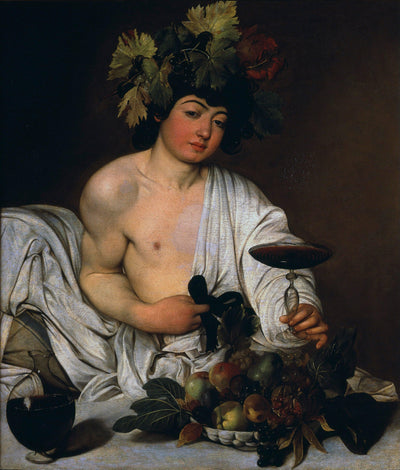
- A boy in costume. The tipsy young Bacchus in Florence is a model dressed up as the god, possibly the Sicilian painter Mario Minniti, beside a bowl holding a rotting apple.
- Insect holes. In the Basket of Fruit in Milan, a grape leaf is shriveled and the apple has two insect holes. Caravaggio told his patron Vincenzo Giustiniani that a good picture of flowers took him as much work as one of human figures.
3. Rome made him a star while he was alive

The Cardsharps (about 1596–1597), now at the Kimbell Art Museum in Fort Worth, Texas, made his name before any church did. Over 50 copies and variants by other painters survive. Cardinal Francesco Maria del Monte bought it and became his first important patron.
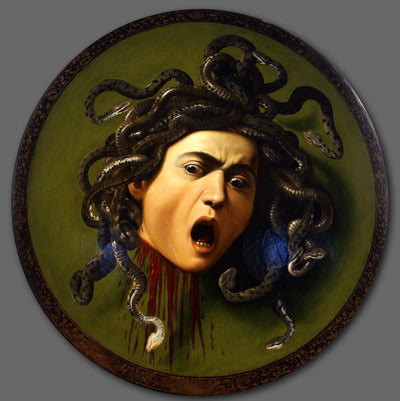
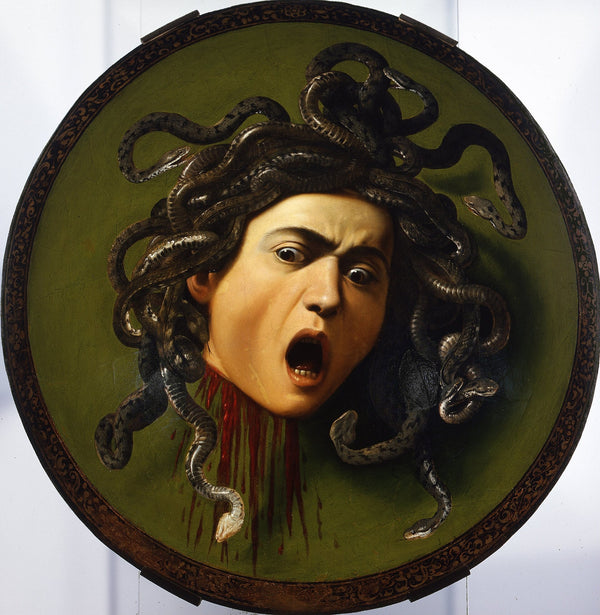
Caravaggio moved into del Monte's Palazzo Madama in 1596 and stayed five years. For the cardinal he painted the Medusa on a parade shield, a severed head on convex wood that del Monte gave to Ferdinando I de' Medici.
Then came the chapel. The Calling and The Martyrdom of Saint Matthew, contracted for the Contarelli Chapel in 1599, were delivered in 1600 and caused an immediate sensation. From then on he never lacked commissions or patrons, and young painters in Rome looked on his work as miracles. The Calling is still the picture most people name first when they think of him.
Even his rejects found buyers. Rubens praised the refused Death of the Virgin as one of Caravaggio's best works, and the Duke of Mantua bought it. Before it left Rome, the duke's ambassador showed it in his house on the Via del Corso on April 1–7, 1607. Copying was forbidden.
4. The split second of the kill

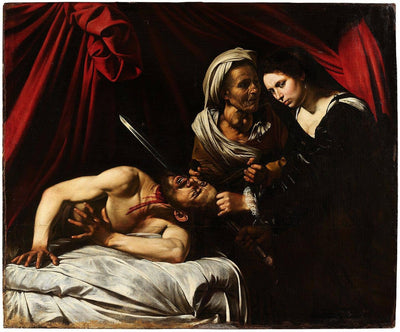
In his Judith cutting off the general’s head (about 1599–1602), Caravaggio picked the moment of greatest impact, the decapitation itself. The figures are lit from the side against an inky black background, and Judith's face mixes determination and repulsion. X-rays show he moved Holofernes's head as he worked and set it slightly apart from the body.
The model was probably the Roman courtesan Fillide Melandroni, and the blood may draw on what he saw at the public execution of Beatrice Cenci in 1599. The painting resurfaced in 1950, the Italian state bought it in 1971, and it hangs at Palazzo Barberini in Rome.
The Medusa in the Uffizi freezes a different second. The Gorgon's freshly severed head still looks conscious, eyes wide and mouth open, and the face is Caravaggio's own.
After 1606, with a death sentence over him, he painted severed heads again and again. In David with the Head of Goliath at the Galleria Borghese, the giant's head is his. If the picture was a gift to Cardinal Scipione Borghese, the papal official with the power to pardon him, it reads as a plea for mercy.
5. A generation of painters copied him
Artemisia Gentileschi, one of the most gifted of his followers, learned from his Judith, and her own Judith Slaying Holofernes shows it. She was far from alone.
Caravaggio never ran a workshop and had no school. It didn't matter. Once the Matthew canvases went up, his manner became what every ambitious young painter in Rome wanted, and his followers got a label: the Caravaggisti, also called tenebrosi, or "shadowists."
Hendrick ter Brugghen and Gerrit van Honthorst traveled from Utrecht to Rome and carried the style home. Rubens, who got to know his work in Rome in 1601, painted his own interpretation of Caravaggio's Entombment. Georges de La Tour took up the card-cheat theme of The Cardsharps. Even Vermeer and Rembrandt, who never visited Italy, show the effects, softened.
When the critic Roberto Longhi revived his reputation in the 1920s, he put it bluntly: "Ribera, Vermeer, La Tour and Rembrandt could never have existed without him."
6. Why is Caravaggio so famous now? Lost pictures keep turning up
The Taking of Christ hung in the Jesuits' dining room in Dublin from the early 1930s, taken for a copy by his Dutch follower Gerard van Honthorst. In 1990 it was recognized as Caravaggio's lost original.
Stories like that drive his fame today. Caravaggio was forgotten almost immediately after his death. His pictures were credited to less scandalous painters, and his first biographers were hostile. Longhi pulled him back in the 1920s, and in 1951 curated a ground-breaking exhibition at the Royal Palace in Milan. The discoveries haven't stopped:
| Year | Painting | What happened |
|---|---|---|
| 1913 | Bacchus | Found in the Uffizi storerooms and given to Caravaggio by Roberto Longhi |
| 1950 | Judith Beheading Holofernes | Rediscovered; bought by the Italian state in 1971 |
| 1969 | Nativity with St. Francis and St. Lawrence | Cut from its frame in Palermo on the night of October 17–18; on the FBI's Top Ten Art Crimes list in 2005; still missing |
| 1987 | The Cardsharps | Resurfaced in a Zürich private collection, lost since the 1890s |
| 2014 | A second Judith, found in Toulouse | Found in an attic; the Louvre turned it down at €100 million; its attribution is still disputed |
| 2021 | Ecce Homo | Offered in Madrid at €1,500 as a Ribera associate's work until the Spanish government halted the sale; at the Prado since May 27, 2024 |
| 2026 | Portrait of Monsignor Maffeo Barberini | Bought by the Italian state for €30 million |
The paintings that never went missing still pull crowds. The Caravaggio 2025 show at Palazzo Barberini opened on March 7, 2025, and drew more than 450,000 visitors, helped by loans from four American museums in Detroit, Kansas City, Hartford and Fort Worth.
Scarcity keeps the stakes high. Estimates of his surviving output run from 40–80 paintings; around sixty-five are securely attributed, with only three universally accepted portraits. In March 2026 the Italian state paid €30 million for one of those three.
7. A killing in 1606, and four years on the run

On May 29, 1606, Caravaggio killed Ranuccio Tomassoni, a gangster from a wealthy family, in a brawl or sword duel at Campo Marzio in Rome, possibly without meaning to. He was sentenced to beheading, and an open bounty meant anyone who recognized him could legally carry out the sentence.
It wasn't his first offense. His police records and trial transcripts run to many pages. A sample:
- 1600: beat a nobleman with a club.
- 1603: spent a month in Tor di Nona jail after the painter Giovanni Baglione sued him for libel.
- 1604: arrested several times for illegal weapons and for insulting the city guards, and sued by a waiter for throwing a plate of artichokes in his face.
- 1605: fled to Genoa for three weeks after wounding a notary with a sword.
He spent his last four years on the move. In Malta, where he arrived in 1607, Grand Master Alof de Wignacourt made him a Knight of the Order, and he painted The Beheading of Saint John the Baptist (1608), about 12 by 17 feet, the largest altarpiece of his career. He signed it, which he almost never did, in the blood running from the saint's throat: "f. Michelang.o."
By late August 1608 he was in prison after a brawl that left a knight seriously wounded. He escaped, and by December the Order had expelled him "as a foul and rotten member," in a ceremony held in front of that same painting.
In October 1609 an ambush in Naples left his face seriously disfigured. He died on July 18, 1610, in Porto Ercole, Tuscany, aged 38, with a fever. Syphilis, malaria, brucellosis and lead poisoning have all been proposed as the cause, and a 2018 study concluded he died of sepsis from a wound picked up in a Naples brawl.
Was Caravaggio a nice person?
Not by any record that survives. A notice published in 1604 describes him this way: "after a fortnight's work he will swagger about for a month or two with a sword at his side and a servant following him, from one ball-court to the next, ever ready to engage in a fight or an argument, so that it is most awkward to get along with him."
Take that with some salt, though. His first biographer, Baglione, was a rival with a vendetta who did a lot to build the legend of the violent genius. And Caravaggio kept friends: Mario Minniti toured Sicily with him, and Marzio Milesi wrote an epitaph that ranked him not with painters but with Nature itself.
Why is Michelangelo called Caravaggio?
Because Michelangelo really was his first name. He was born Michelangelo Merisi in Milan on September 29, 1571, and "da Caravaggio" means "from Caravaggio," the town 35 km (22 miles) east of Milan where the family moved in 1576 to escape a plague.
He's a different artist from Michelangelo Buonarroti (1475–1564), who painted the Sistine Chapel ceiling. Still, some scholars read Christ's outstretched hand in the Calling as an almost mirror image of Adam's hand in the older Michelangelo's Creation of Adam. Both men sit near the top of the short list of paintings everyone knows.
A Caravaggio on your own wall
If one of these pictures has stayed with you, the Caravaggio canvases the studio copies in oil include the Calling, the Judith and the Medusa, each painted by hand. Judge a copy the way you'd judge the original: look at how deep the blacks go, and at where the beam of light stops.