4.9/5
4.9/5


Search for a Paradise Lost painting today and most of what comes back is one picture made in this century: Raqib Shaw's Paradise Lost, 21 panels and more than 100 feet wide, which went on view at the Art Institute of Chicago in June 2025. That's a fair result, and a narrow one. John Milton's poem, first published in 1667, has been pulling painters into Hell for well over two hundred years, and the picture that comes closest to what Milton actually described is a canvas John Martin painted in 1841, now in Paris.
Martin's Pandemonium comes first here, because it's the image most people have in mind when they picture Milton's Hell. After it come the other artists who took the poem on, William Blake, Henry Fuseli and Gustave Doré, and finally Shaw, whose title borrows Milton's words for a very different story.
John Martin's Pandemonium

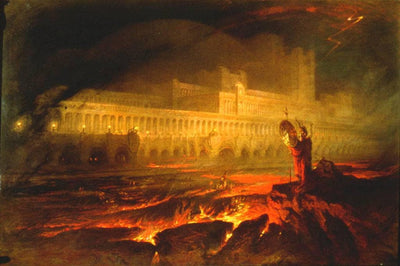
Milton gives the fallen angels a capital. In Book I, after the rebels have been thrown out of Heaven and come to on the burning lake, a palace pushes up out of the ground in a single scene:
Anon out of the earth a Fabrick huge
Rose like an Exhalation, with the sound
Of Dulcet Symphonies and voices sweet
Martin painted exactly that passage, Book I, lines 710–719. Look at the canvas and you find Satan second. He's a small red figure on a spur of rock at the lower right, shield up, arm raised, and the thing he has breathed into being takes up almost the whole width of the picture: a colonnade lit with torches, a long run of arches beneath it, and in front a river of lava where the other demons crowd below him. A thread of lightning splits the sky at top right. The building is the real subject. Milton names it Pandæmonium, the hall of all the demons, and Martin paints it as architecture first and theology second.
The canvas is 123 × 185 cm, and Martin designed its frame himself, with serpents and dragons worked into the gilding. He sent it to the Royal Academy in 1841 with a companion picture of the Celestial City, so visitors saw Heaven and Hell side by side. The Louvre bought it in 2006 with money from a bequest. Today it hangs in Room 713 of the Denon wing. Hell, it turns out, is on the first floor.
He had drawn this palace before
By 1841 Martin knew the subject cold. He signed his plate of Pandemonium in 1824 for an illustrated Paradise Lost that Septimus Prowett published in London in two volumes, with Martin both designing and engraving the pictures. You can see one of the 1827 impressions, just 25.4 × 35.6 cm, in London. The composition changed a lot in the seventeen years between print and painting, but the idea stayed put: a building so big that the angels who built it look like sparks.
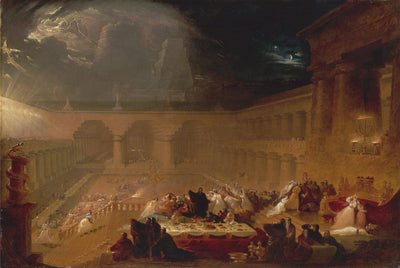
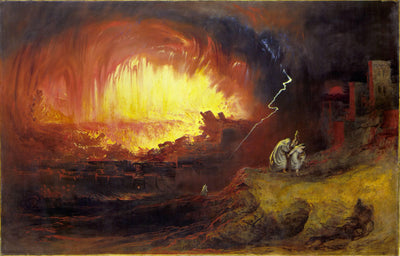
That idea made Martin famous. In 1834 the Westminster Review wrote that "no painter ever took so sudden and violent a hold upon the fancy of the public." He'd earned it with disaster on a huge scale, from the Babylonian banquet interrupted by writing on the wall to two cities burning under a red sky. Critics were less sure than crowds. One Edinburgh reviewer in 1829 called his work "something very like a piece of humbug."
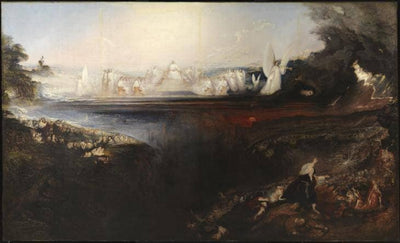
The crowds won. His last big project, a triptych built around his 1853 vision of the end of the world, went on tour in June 1853, months before he died in February 1854. Admission was usually sixpence, Glasgow alone drew 50,000 visitors, and the pictures kept travelling for decades, as far as Melbourne and Sydney by 1879. The central panel is on display at Tate Britain now. If you want to see how Pandemonium fits among the rest of John Martin's catastrophes, put it next to that triptych: the same lava light, the same tiny people, the same belief that the end of the world should be painted wide.
William Blake's beautiful devils

Blake read the same book and came out with the opposite picture. Where Martin shrinks Satan to a speck, Blake puts him dead center, naked, arms thrown up, and makes him handsome. Around him seven rebel angels crouch and sprawl on the rocks, metal bands on their wrists, painted in greys and browns with a lick of flame at the edges.
The sheet is the 1808 watercolour of Satan rousing his troops, 51.8 × 39.3 cm, one of a series Thomas Butts commissioned. Butts was a civil servant and one of Blake's most loyal patrons. The bodies come from classical sculpture and from Michelangelo, and that's the point: Milton's Satan is terror and power, but Blake's devils are beautiful, which is a more unsettling thing to hang on a wall.
It's a watercolour about the size of an open atlas, nothing like Martin's wall of lava. If Martin gives you the architecture of Hell, Blake gives you its people.
Henry Fuseli and the Milton Gallery
Fuseli went further than anyone. He painted enough Milton to fill a gallery and then opened one: the Milton Gallery, shown in London in 1799–1800. It was meant to rival Boydell's Shakespeare Gallery, which had done well. It didn't. The show was a financial failure.
A few of the pictures are easy to find. Painting no. 6 from the gallery, Satan and the birth of Sin, is in the Dallas Museum of Art, 142.56 × 118.75 cm, from Book II, lines 746–758, where Sin reminds Satan that she sprang, armed, out of his head. It's Fuseli at his most theatrical, all strained muscle and stage light.

The one to know, though, is gentler. At the very end of Book I, Milton compares the shrunken demons crowding into Pandæmonium to "Faerie Elves, / Whose midnight Revels, by a Forrest side / Or Fountain some belated Peasant sees." Fuseli took that throwaway simile and made the 1793 canvas with the fairy ring, oil on canvas, now at Tate. A shepherd sleeps with his dog; above him a circle of women link hands and spin in the dark. It's the same passage of the poem as Martin's palace, give or take seventy lines, and it couldn't look less like it.
Gustave Doré's engraved Hell
For most readers since the Victorian age, Paradise Lost looks like Doré. His illustrated edition came out in 1866 from Cassell, Petter and Galpin, a big folio about 15 inches tall; the Met holds a copy of the 1866 folio. Doré drew the designs and a team of craftsmen cut them into wood blocks, so what you see is a print, black and white, built from thousands of fine lines.
Doré's Hell has no color at all, only black ink and white paper doing the work of fire. One odd thing you notice once you look for it: his angels and his devils share nearly the same face and body. Only the wings tell you who is who, which is either a flaw or the most Miltonic thing in the whole book.
These are the images people usually mean when they say they've seen Paradise Lost illustrated. They were never paintings, though. If you want Milton's Hell in color and oil, Martin is still the name.
Is Raqib Shaw's giant painting about Milton?
Only in its title. Shaw was born in Calcutta, grew up in Kashmir and left as a teenager, first for New Delhi and then London, where he studied at Central Saint Martins. His Paradise Lost took him from 2009 to 2025 and runs across 21 panels, painted in automobile paint with detail so fine you have to stand close to read it.
The title points two ways, at Milton's 17th-century poem and at Kashmir's old reputation as paradise on earth. The story is Shaw's own, from a childhood in Kashmir through, in his words, "exile and rebellion, artistic awakening, emotional turmoil, and transformation that still continues." You won't find Satan's palace in it. You'll find a lost home.
That's why the search results look the way they do. The Chicago exhibition is scheduled to close on November 15, 2026, and it's worth the trip. But if you came looking for Milton, start with Martin.
Where to see each Paradise Lost painting
| Work | Artist | Year | Where it is |
|---|---|---|---|
| The Shepherd's Dream | Henry Fuseli | 1793 | Tate, London |
| Satan and the Birth of Sin (Milton Gallery no. 6) | Henry Fuseli | by 1799 | Dallas Museum of Art |
| Satan Arousing the Rebel Angels | William Blake | 1808 | V&A, London |
| Pandemonium (mezzotint) | John Martin | 1824, published 1827 | V&A, London |
| Pandemonium (oil) | John Martin | 1841 | Louvre, Paris, Room 713 |
| Paradise Lost (illustrated edition) | Gustave Doré | 1866 | The Met, New York |
| Paradise Lost | Raqib Shaw | 2009–2025 | Art Institute of Chicago |
Of all of these, Martin's is the one that shows Milton's Hell as a place you could walk into. If Milton is your way into the old masters, the paintings people ask for by name are a good next stop.
Hell, painted by hand
Art & See paints a hand-painted copy of Martin's burning palace by hand in oil on canvas, from the 1841 original. It's a dark, glowing picture of a palace on fire, and it wants a wall with some room around it, where the lava can catch the evening light. Pick the size that suits the room and the studio paints it to order.
Sources
- Louvre, Le Pandemonium, 1841
- V&A, Pandemonium, John Martin
- V&A, Satan Arousing the Rebel Angels
- Tate, Martin Myrone on the Last Judgement triptych
- Tate, The Shepherd's Dream
- The Met, Paradise Lost, 1866
- Art Institute of Chicago, Raqib Shaw: Paradise Lost
- Dartmouth Milton Reading Room, Paradise Lost Book 1