4.9/5
4.9/5


Vincent van Gogh (1853–1890) painted for just over a decade and died at 37, poor and nearly unknown. Most people know two things about him, the ear and the swirling night sky. The facts about Vincent van Gogh below fill in the rest, in the order he lived them, and a few of them upend the legend.
A late start
1. He was named after a stillborn brother
Groot-Zundert, March 30, 1853. He was given his grandfather's name and that of a brother stillborn exactly a year before his birth.
2. He worked for an art dealer at 16
The Hague, July 1869: the art dealers Goupil & Cie hired him, and later sent him to London and then Paris. There he came to resent how dealers commodified art, and he was dismissed in 1876.
3. He tried teaching and preaching first
Ramsgate, England, April 1876: unpaid work as a supply teacher. In January 1879 he became a missionary in Belgium's coal-mining Borinage. There he gave his lodgings to a homeless person and slept on straw in a hut.
4. He first painted in oils at 28
The Hague, January 1882. His second cousin, the painter Anton Mauve, introduced him to oil painting and lent him money for a studio. They fell out within a month.
5. His first major work is mostly brown
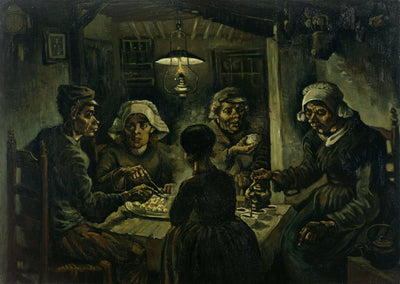
Nuenen, April–May 1885. The Potato Eaters, his peasant family at supper, came out of a two-year stay that produced nearly 200 oil paintings in somber earth tones. His friend Anthon van Rappard criticized it, yet Van Gogh went on thinking of it as his most successful picture. It's in the Van Gogh Museum, and it's one of the early Van Gogh paintings copied by hand today.
How he learned to paint
6. Art school lasted a few weeks
Antwerp Academy, January 18, 1886. He quickly clashed with its director, Charles Verlat, and by March he was in Paris. That winter likely produced a small skull with a lit cigarette clamped in its teeth, a joke about academic skeleton studies.
7. Paris brightened his palette
Paris, March 1886. He moved in with Theo in Montmartre and adopted a brighter palette. He collected hundreds of Japanese ukiyo-e prints and left in February 1888 with more than 200 Paris paintings done.
8. He painted more than 43 self-portraits
Between 1885 and 1889, often when he lacked models. The ones from Saint-Rémy show the side of his head opposite the damaged ear, because he painted his mirror image.
9. He signed his canvases "Vincent"
In a letter to Theo in March 1888, he asked to be listed in an exhibition catalog "the way I sign it on the canvases, i.e. Vincent and not Vangogh," because people "wouldn't be able to pronounce that name."
10. Most of his work came in two years
Around 860 oil paintings in just over a decade, most of them in the last two years of his life. Only a handful became household names, and a ranking of the ten people know best is a quick way to meet them.
11. Was Van Gogh an Impressionist?
No. He's a Post-Impressionist, one of the movement's principal artists with Paul Cézanne and Paul Gauguin. Post-Impressionism (roughly 1886–1905) kept Impressionism's vivid color but distorted form for expressive effect.
Arles and the Sunflowers
12. The Yellow House cost 15 francs a month
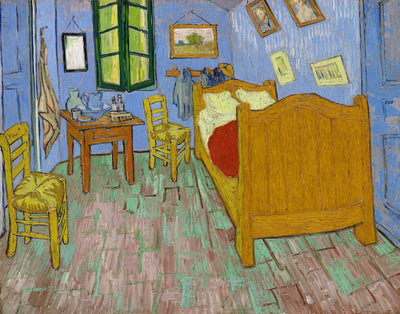
On May 1, 1888, he leased four unfurnished rooms at 2 Place Lamartine, and that September he painted the house itself. His room there became the bedroom he painted three times. A Rhône flood damaged the first version (October 1888, Van Gogh Museum), so he painted two more in September 1889, now in Chicago and Paris.
13. He painted starry skies before The Starry Night

September 1888: the lamplit café on the Place du Forum was his first painting with a starry background, and he painted it on the spot at night. That month he also set up on the bank of the Rhône for a second night sky, nine months before the famous one.
14. The Sunflowers were painted for Gauguin
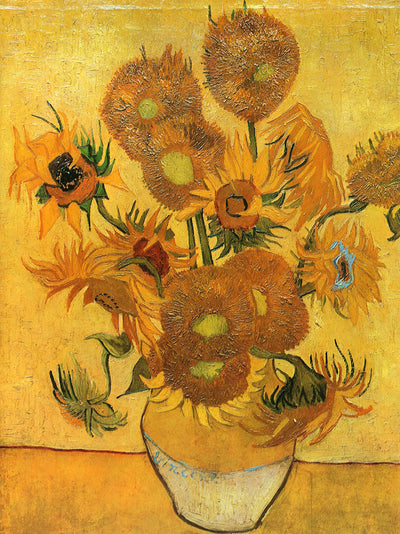
In August 1888 he wrote to Theo that he was "painting with the gusto of a Marseillais eating bouillabaisse." He painted four versions of Sunflowers in one week to get ready for Paul Gauguin, who arrived on October 23.
15. How many Van Gogh Sunflowers exist?

Eleven, across two series: four Paris canvases of cut flowers lying on the ground (1887) and seven Arles vases (1888–1889). One vase was destroyed in an air raid on Ashiya, Japan, on August 6, 1945, so six vases survive.
| Sunflowers | Painted | Where it is now |
|---|---|---|
| 3 | August 1888 | Private collection |
| 5 | August 1888 | Destroyed, Ashiya, 1945 |
| 12 | August 1888 | Neue Pinakothek, Munich |
| 15 | August 1888 | National Gallery, London |
| 12 | January 1889 | Philadelphia Museum of Art |
| 15 | January 1889 | Van Gogh Museum, Amsterdam |
| 15 | January 1889 | Sompo Museum of Art, Tokyo |
So the 12 sunflowers are in Munich and Philadelphia. The January repeats exist partly because Gauguin wanted one of the originals, and Vincent wasn't shy about the subject: "I have the sunflower, in a way," he wrote in the same letter that agreed to repeat one.
16. How much are Van Gogh's Sunflowers worth now?
There's no public price: five surviving vases are in museums and one is private. The benchmark came on March 30, 1987, when Yasuo Goto paid the equivalent of $39,921,750 at Christie's London for a vase of fifteen sunflowers, then a record for any artwork.
The last two years
17. Accounts differ on how much ear he cut off
On December 23, 1888, he cut off his left ear, wholly or in part, and took it to Gabrielle Berlatier, a 17-year-old cleaning girl at a brothel. Theo and Paul Signac described only the earlobe; the policeman and Dr Félix Rey described the entire outer ear. Gauguin never saw him again.
18. He dismissed The Starry Night as a failure

Saint-Rémy asylum, June 1889. The view from his east-facing window shows the hills just before sunrise, plus an imaginary village. By late November he was calling it a failure in a letter to Émile Bernard.
19. He painted the hills around the asylum again and again
In May 1889 he compared the local cypresses to an Egyptian obelisk, and a wheat field framed by them followed in July. He also painted at least 15 olive groves, one of them under a yellow sky and sun in November 1889, now in the Minneapolis Institute of Art.
20. Almond Blossom was a gift for his nephew

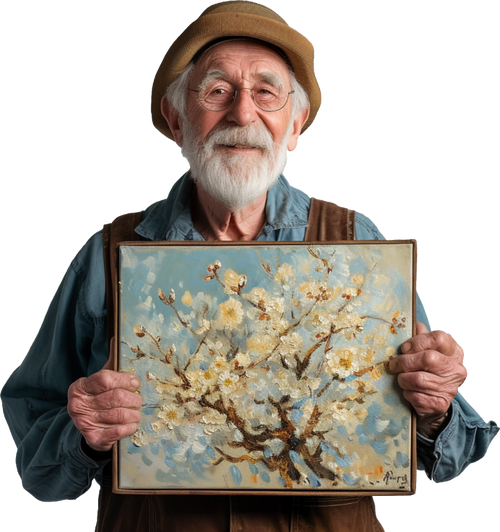
Theo and Jo's son, Vincent Willem, was born on January 31, 1890. Vincent started right away on white almond branches against a blue sky for the couple's bedroom. The baby later founded the Van Gogh Museum, which opened in 1973.
21. About 70 paintings in about 70 days
Auvers-sur-Oise, May–July 1890, near Theo and Dr Paul Gachet: roughly one oil a day. June brought the portrait of Gachet and the village church, the second now in the Musée d'Orsay.
22. He died at 37, and Theo six months later
July 27, 1890: he shot himself in the chest and died two days later. Theo died on January 25, 1891. Since 1914 the brothers have lain side by side in Auvers.
After 1890
23. Only one painting he sold is known by name
The Red Vineyard, bought for 400 francs by the Belgian painter Anna Boch at the Les XX show in Brussels in 1890. It's now in Moscow's Pushkin Museum. He also traded work; Gauguin took two Paris sunflower canvases in an exchange.
24. His sister-in-law built his fame
Theo's widow, Jo van Gogh-Bonger, was left with about 200 then-valueless works and Vincent's letters to Theo, more than 600 of which survive. She published the letters in three volumes in 1914, and his fame first peaked in Austria and Germany before World War I.
25. The 1990 record stood for 32 years
Portrait of Dr Gachet made $82.5 million in 1990, and its whereabouts haven't been made public since 1996. The record finally fell when Orchard with Cypresses went for $117,180,000 at Christie's New York on November 9, 2022.
A copy for your own wall
If one of these canvases stayed with you, the rest of his work, painted by hand in oil is a good place to look, from the Nuenen browns to the last Auvers fields. And if your taste runs past Van Gogh, there's a longer list of the paintings people ask for most.