4.9/5
4.9/5


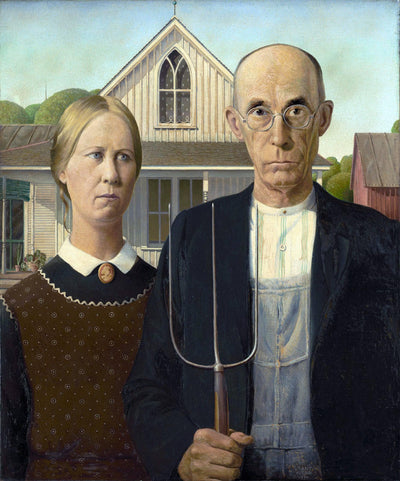
Most people picture the farmer and the pitchfork first. Look again and the real subject is behind them: a small white farmhouse with one pointed window in the gable, the kind of window you'd expect on a country church. That building is the American Gothic House, and it still stands in Eldon, a town in southeast Iowa, on the same patch of ground where Grant Wood saw it in the summer of 1930.
It's a modest place, two stories and a front porch, and Wood saw it only in passing. Yet it became the backdrop for the stern couple in front of that gabled window, a painting so widely copied and parodied that the house now draws visitors from far outside Iowa who want to stand where the painter stood.
Here's what the house is, how it got into the picture, and what you'll find if you drive out to see it.
Where the house stands
Eldon is in Wapello County, about two hours from Des Moines by car. The house is on a slight rise above the town, on a street now named for it. The visitor center next door is at 300 American Gothic Street, and the house itself is run by the State Historical Society of Iowa as a historic site.
Don't expect a museum campus. You park, you walk up a short path, and there it is, smaller than you imagined. The first reaction is almost always about scale.
The window that stopped Grant Wood

In the summer of 1930 Wood, who lived in Cedar Rapids, was being driven around Eldon by a local artist. The upstairs front window caught his eye. It reminded him of the cathedral windows he had seen in France, and he found it funny to see that shape pinned onto a plain wooden farmhouse. His first biographer, Darrell Garwood, recorded that Wood thought the window was "a structural absurdity." Jane Smiley traces that trip in a long Smithsonian profile of Wood, and it's worth reading for how offhand the whole thing was.
Wood made a quick oil study of the house on the spot. That sketch survives: a small two-sided panel, oil on paperboard, roughly 12 5/8 by 14 5/8 inches, with a landscape on one side and the house on the back. It now belongs to the Smithsonian American Art Museum, and you can see his first study of the Eldon house in its online collection.
His original idea was bigger than one canvas. He planned a pair: one couple in front of the Gothic window, and a different couple in front of a Mission-style bungalow. The bungalow picture never happened. The Gothic one he took home to Cedar Rapids and painted on Beaver Board that same year.
Who built it, and who lived there
Charles and Catherine Dibble built the house in 1881–82, which is why you'll still hear locals call it the Dibble House. The style is Carpenter Gothic, the rural American habit of borrowing church details (steep roofs and gables, carved porch railings, pointed-arch windows) and cutting them out of lumber with a jigsaw instead of stone.
What most visitors miss is that there are two Gothic windows, not one. The famous one faces the front; a twin faces the back. Both are hinged, and the reason is practical rather than decorative. The staircase inside is so steep and narrow that the only way to get a bed or a dresser to the upper floor was to swing the window open and pass the furniture through. The windows are believed to have come out of a Sears, Roebuck catalog.
The house changed hands many times over the following century. It was listed on the National Register of Historic Places in 1974, still under the Dibble name. In 1991 its owner, Carl E. Smith, donated it to the State Historical Society of Iowa. For the next stretch, 1991–2014, the Society rented it to tenants who lived there and looked after the place, which meant that for more than two decades someone was cooking dinner behind the most recognized window in American painting while strangers took photos on the lawn.
What the painting changed
Wood took liberties with reality. Stand in front of the house with the painting on your phone and you'll look for a barn that isn't there; he added it. And the scene itself never took place: no couple ever stood on that lawn for him.
His models were his sister, Nan Wood Graham, and his dentist, Dr. B.H. McKeeby, and the two never posed together during the drawing or painting. Wood sketched each of them separately and built the pair in the studio. People have argued for decades over whether they're husband and wife. In a rare explanation, Wood called them father and daughter. He described them as looking like "tintypes from my old family album."
The finished picture is small too: oil on Beaver Board, 30 3/4 by 25 3/4 inches. It made its debut at the Art Institute of Chicago's 43rd annual exhibition of American painting and sculpture, which ran Oct. 30–Dec. 14, 1930, and the museum bought it before the year was out. It has hung in Chicago ever since, which is the first thing to know if you were hoping to see it in Eldon. You won't. What you'll find in Iowa is the building; the canvas is in Gallery 263 in Chicago.
Many viewers read the painting as a joke at the expense of rural Midwesterners. The Art Institute's reading is the opposite: Wood meant it as a positive image of rural values at the start of the Great Depression. Standing in Eldon, looking at a house built by a family with a jigsaw and a mail-order window, the second reading feels closer to the truth. If you want to see where he went next, the rest of Grant Wood's Iowa scenes keep returning to the same farms, hills and plain buildings.
Visiting the American Gothic House
The house and the American Gothic House Center next to it work as one stop. The Center opened in June 2007. It's a building of about 2,500 square feet with an exhibit gallery, a media room and a gift shop, run by the Wapello County Conservation Department on land owned by the City of Eldon. More than 12,000 people come through each year, both walk-ins and bus groups. The Center's exhibits and costume room are the reason most of them stay longer than ten minutes.
Because the costumes are the real draw. Admission includes the costumes, so you can dress as the pair and stand in front of the house and restage the painting. Almost everyone does. It's a little silly and completely worth it.
Can you go inside?
Usually not. The exterior is open any time, and you can walk right up to the porch. The interior opens only for prearranged group tours of 10 or more, depending on availability, and even then only the ground floor, because the stairs to the second story are steep, winding and have no handrail. The rooms are small and mostly unfurnished; the kitchen has been updated with red cabinets and the bathroom is closet-sized. If you're coming alone or as a couple, plan on the outside and the Center.
Hours and admission
The Center is open year-round, Wednesday through Saturday 10 a.m.–4 p.m. and Sunday 1–4 p.m., closed Monday and Tuesday, with last entry at 3:50 p.m. It closes for a handful of holidays, including Thanksgiving and Christmas. Admission is $5 for ages 13–59, $4 for 60 and older, and free for children 12 and under and for Wapello County residents. The current hours and holiday closures are posted by the Center, and in bad weather it's smart to call ahead at (641) 652-3352.
If you're making a day of it, Wood country stretches north. A road trip built around American Gothic can link Eldon with Cedar Rapids, where Wood lived and painted.
Why a small house holds up
The American Gothic House works on visitors because it's so ordinary. Nothing about it announces itself. Wood saw one odd window on a plain house and understood that it said something about the people who'd choose it. The story of the Dibble family's house is short, and it fits in one visit. Then you drive away and see Gothic windows on farmhouses all over Iowa. The painting belongs on the same short list as the paintings nearly everyone can name, and the house is the rare case where you can still walk up to the real backdrop.
The couple, the window, your wall
If the trip to Eldon left you wanting the picture itself, Art & See's artists paint a hand-painted oil copy of American Gothic on canvas, working from the 1930 original. The two long faces, the pitchfork and that pointed window are all done with a brush, so the little Dibble house you stood in front of can end up on your own wall.
Sources
- American Gothic House Center, The House
- American Gothic House Center, The Painting
- State Historical Society of Iowa, American Gothic House
- Smithsonian American Art Museum, Sketch for house in American Gothic
- Art Institute of Chicago, American Gothic record
- Smithsonian Magazine, In Search of the Real Grant Wood