4.9/5
4.9/5


The best height to hang pictures is with the center of the artwork 57 inches (145 cm) above the floor. Not the top edge, not the nail: the center. That single number works on almost any open wall, for a small print or a large canvas, and it keeps every piece in a room on the same invisible line. The exceptions are real, though, and they're where most walls go wrong.
Below is the math, the room-by-room numbers in inches and centimeters, and the handful of situations where you should ignore 57 on purpose. The method is the same whether you're hanging a framed poster or a hand-painted reproduction of a museum piece.
What the 57-inch rule means
Measure 57 inches up from the floor and make a light pencil mark. That mark is where the middle of your picture goes. Many galleries and museums hang to this line or close to it, because it sits near the eye level of a standing adult.
The arithmetic backs that up. The average American man is 68.9 inches tall and the average woman 63.5 inches. Your eyes sit a few inches below the top of your head, so a center line at 57 lands in front of most people's gaze without anyone tilting their chin.
It wasn't always this way. When the Royal Academy held its first exhibition in 1769, pictures went up floor to ceiling, frames nearly touching. The prized spot was "on the line," with the bottom edge of the painting eight feet from the ground, and the artists nobody had heard of were "skied" up near the ceiling where visitors could barely make them out. Most museums now hang a single row near eye level, and that's the habit home decorators copy.
Finding the nail: the math in four steps
Most questions about how high to hang pictures come down to this arithmetic. Here's a real example. Van Gogh's Irises, the 1889 canvas in Los Angeles, measures 29 1/4 inches (74.3 cm) tall without its frame. Say a copy of the same size is going on your wall.
- Measure the height of the piece, frame included. Here, 29 1/4 inches.
- Divide by two: 14 5/8 inches.
- Add that to 57. The top edge of the picture belongs at 71 5/8 inches (182 cm).
- Pull the hanging wire taut toward the top of the frame and measure how far it drops. If it's 3 inches, the nail goes at 68 5/8 inches (174 cm).
Step four is the one people skip, and it's why so many pictures end up two or three inches higher than planned. A sawtooth hanger or D-rings have their own drop too; measure from the top of the frame to wherever the hook will actually catch. If the piece is heavy, the hardware matters as much as the height, and anchors that hold in drywall or plaster are worth sorting out before you drill.
The 60-inch rule and other variants
Some framers and designers work from 60 inches (152 cm) instead of 57, and a few quote a range up to 62. Framebridge suggests 60 to 66 inches in hallways, where people only ever see the wall while walking past.
My view: start at 57 and move up only for a reason you can name. A household of tall people is a reason. So is a narrow corridor. "It looked low" usually isn't, because pictures almost always look low while you're standing on a step stool with a pencil, and fine once you're back on the floor.
Best height to hang pictures, room by room
The 57-inch line is for open wall. Once furniture is involved, the furniture sets the height, and you measure up from it instead of up from the floor.
Above a sofa
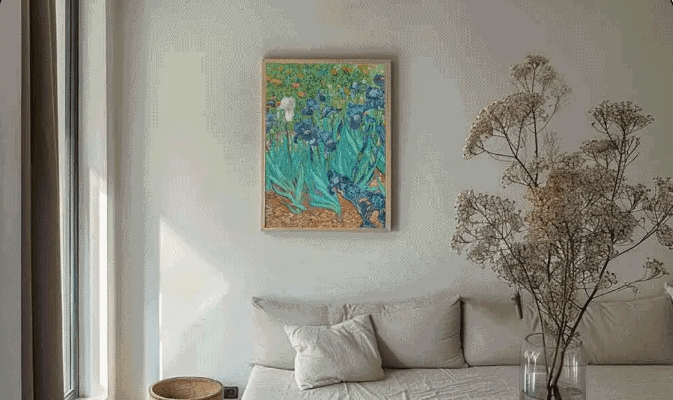
Leave about 7 to 10 inches (18–25 cm) between the top of the sofa back and the bottom of the frame. Closer than that and the picture looks pinned to the cushions; much higher and it floats off on its own, disconnected from the seating it's supposed to belong to. On a low sofa this often puts the center well below 57, which is fine. The piece and the sofa read as one group.
If you're still choosing what goes there, width matters as much as height; more on that under the 2/3 rule below. And if you're looking through the paintings almost everyone recognizes, measure the wall first and let the sofa decide the size.
Above a bed
With a headboard, the bottom of the art goes about 6 to 10 inches above the headboard (15–25 cm). Without one, aim for 14 to 16 inches (36–41 cm) above the mattress. Skip glass over the bed if you can; a stretched canvas is lighter and has no edge to worry about at 3 a.m.
Above a mantel
Keep 6 to 8 inches (15–20 cm) between the mantel shelf and the bottom of the frame. People tend to hang art over a fireplace far too high, because the mantel itself is already tall. Push the painting up and it drifts toward the ceiling; keep it close and the fireplace and picture work as one composition.
In a dining room
This is the room where hanging a little lower pays off, because everyone looks at the walls while sitting down. The Smithsonian's exhibition guidelines put the eye level of a man seated in a wheelchair at 43 to 51 inches (109–130 cm) off the floor. A dining chair puts you in roughly the same place, well below the standing line.
A long, low composition over a sideboard suits this room. Think of a copy of Leonardo's supper scene: Leonardo painted the original on the north wall of the friars' dining hall in Milan between about 1494 and 1498, and used perspective so the table seemed to continue the room. A version at home works the same way when it hangs low over the sideboard, close to the people eating, rather than high above them.
Hallways and stairs
Hallways can go a bit higher, as above. On stairs, keep the 57-inch rule but measure up from the step directly below each picture, not from the landing. The centers then climb in a diagonal that follows the stair rail, and every piece is at eye level for someone standing on the step in front of it.
How high to hang a picture with 8-foot or 9-foot ceilings
On an 8-foot ceiling (96 inches, 244 cm), a center at 57 leaves 39 inches (99 cm) of wall above the middle of the picture. That's plenty. Don't move the line.
On a 9-foot ceiling (108 inches, 274 cm), you have 51 inches (130 cm) above the center, and a small picture at 57 can start to feel like it's sinking. Some designers raise the center to somewhere between 60 and 68 inches on high ceilings. I'd go no higher than about 60 for a single piece. A better fix is scale: hang something taller, so the top edge climbs while the middle stays where eyes are. On double-height walls the same logic holds. Stack pieces upward as a group, and keep the lowest row near eye level.
The 2/3 rule, explained
The 2/3 rule sets width. A picture over a piece of furniture should be about two-thirds as wide as the furniture beneath it. On an 84-inch sofa, that's a piece (or a group) roughly 56 inches wide. Over a fireplace, measure the whole surround, not only the firebox.
Go much narrower and the art looks like an afterthought. Go wider than the sofa and it starts to crowd the lamps and side tables. Two-thirds is a starting point, and anything between two-thirds and three-quarters of the furniture's width tends to look right.
Should all pictures in a room be at the same height?
On open walls, yes: keep every center on the 57-inch line. That shared line is what makes a room look finished, even when the frames are different sizes. Tops and bottoms will vary. The middles won't.
Pictures above furniture are the exception, since they take their height from the sofa, bed or console. A group of frames counts as one big picture: find the center of the whole arrangement and put that at 57. The gaps between frames in a gallery wall are a separate set of measurements, and worth getting right before the first nail.
When a big canvas breaks the rule
Very large art doesn't fit the formula. A canvas five feet tall, centered at 57, would start 27 inches off the floor, which on most walls means crashing into the furniture. In that case, set the bottom edge first, 6 to 12 inches above the furniture or comfortably clear of the baseboard on an open wall, and let the center land where it lands.

Scale also changes the viewing distance. You look at a big canvas from across the room, the way you would with a painting like the wheat field Van Gogh painted in 1889, and from that distance a slightly higher center doesn't bother anyone. Small pieces are the opposite. They belong at eye level or a touch lower, where you can see the brushwork without stepping forward.
A painting for the spot you just measured
Once the pencil mark is on the wall, you know what fits: the height from the formula, the width from the 2/3 rule. That's a good moment to choose the picture itself. Art & See paints oil copies of well-known paintings, brushed by hand, so bring your measurements along when you browse and pick a canvas that suits the wall.