4.9/5
4.9/5


Klimt garden paintings look like nothing else he made: square canvases packed edge to edge with flowers, with almost no sky, painted on summer holidays by the Attersee in Upper Austria. Before the list, clear up one naming trap. Bauerngarten and Flower Garden are the same painting, the 1907 farm garden that print shops sell under both titles, so you never need two of them. It opens this list, and eight more follow, each with where it is now and how it behaves on a wall at home.
These pictures sit a little apart from the gold portraits most people picture when they hear his name. If you browse copies of Klimt's paintings, the gardens are the ones that read as color first and subject second, which is why they work in rooms where a gilded couple would feel like too much.
Klimt garden paintings, from Litzlberg to Lake Garda
Klimt spent his summers on the Attersee in 1900–1916: at Litzlberg on the north shore until 1907, at the Villa Oleander in Kammerl in 1908–1912, and in a rented forester's lodge at Weissenbach in 1914–1916. The village houses had cottage gardens, and he walked around them with square viewfinders cut out of cardboard, hunting for a patch worth painting.
That little frame explains the look. Standing close, he cut away the horizon, so the garden fills the canvas like a tapestry. Almost every garden here is a square of about 110 cm, or 43 inches, a side. Keep that number in mind; it matters when you pick one for a wall.
| Painting | Year | Where it is |
|---|---|---|
| Bauerngarten (Flower Garden) | 1907 | Private collection |
| Cottage Garden with Sunflowers | 1906 | Belvedere, Vienna |
| Sunflower | 1907–1908 | Belvedere, Vienna |
| Roses under the Trees | about 1905 | Returned to the Stiasny heirs in 2022 |
| The Park | 1909–1910 | Museum of Modern Art, New York |
| Orchard with Roses | 1912 | Private collection |
| Farm Garden with Crucifix | 1912 | Burned in 1945 |
| Italian Garden Landscape | 1913 | Kunsthaus Zug, Switzerland |
| Garden Path with Chickens | 1916 | Burned in 1945 |
1. Bauerngarten, or Flower Garden (1907)

This is the one people mean when they search for a Klimt garden. Look for the column of white blooms at the top center and the small cluster of deep blue flowers below it, with a wide wash of orange on the right. There's no path, no fence, no sky. Just flowers, then more flowers, then a band of green hedge.
It's also the garden with a price tag. Bauerngarten sold in London in March 2017 for £47.9 million, or $59.3 million, then the third highest price paid for any artwork in Europe. It has stayed in private hands since.
On your wall: the warmest of the nine. Orange and red dominate, so it holds a room with white or gray walls and fights with busy wallpaper.
2. Cottage Garden with Sunflowers (1906)

Sunflowers stand across the top like a row of heads at a parade, and underneath them Klimt piled up dahlias, marigolds, asters and flame flowers with no depth at all. The canvas hangs in the Upper Belvedere, which bought it in October 1939. Technical study shows he painted some sunflower heads and then covered them with leaves while he worked.
The critic Hermann Bahr compared pictures like this to "painted carpets," and standing in front of it you understand why. On a wall it reads as pattern from across the room and as flowers only up close. It's cooler and greener than Bauerngarten, a safer choice for a bedroom.
3. Sunflower (1907–1908)
One plant, one flower, dead center. The bloom tilts slightly, and its leaves curl down over a bed of small summer flowers at its feet, which is why people keep seeing a figure in it. Ludwig Hevesi called it a "fairy in love." Look closely at the hedge behind: Klimt scattered tiny flecks of gold, platinum and brass there, and nowhere else in the picture.
The painting came to the Belvedere as a bequest in 2012, so Vienna has both of his sunflower gardens in one building. At home, this is the most portrait-like of the gardens, good for a narrow wall where a single upright shape looks right.
4. Roses under the Trees (about 1905)
Fruit trees, a tangle of rose bushes, and green in every direction. The pink roses are small, low and easy to miss; the trunks and leaves do most of the work.
Its history is heavier than its subject. The painting belonged to Viktor Zuckerkandl, then to his niece Nora Stiasny, who was forced to sell it in August 1938 and was murdered in the Holocaust. The French state bought it in 1980 for the Musée d'Orsay. In 2021 France agreed to give it back, and it went to her heirs on March 23, 2022, after a special law of February 21, 2022 cleared it out of the national collections.
5. The Park (1909–1910)
If you live in the United States, this is the garden you can actually visit. It's at MoMA in New York, and it's almost all foliage: a wall of dotted green with a thin strip of lawn and tree trunks along the bottom. Of all the gardens, it's the calmest to live with, close to a green abstract from across a room.
6. Orchard with Roses (1912)
Rose bushes stand among fruit trees, and the garden feels planted and looked after, a tidier place than the wild beds of 1907. It sits in a private collection. Look for the roses standing like small trees between the trunks. Good in a dining room, where its order suits a table and chairs.
7. Farm Garden with Crucifix (1912)
A wayside crucifix rises out of a crowded farm garden, the only garden in the group with a human-made object as its focus. The painting was confiscated from the Lederer collection and burned in the castle fire of May 8, 1945 at Schloss Immendorf, along with Garden Path with Chickens and other Klimt works. What survives are photogravures from 1917–1918 and color prints from 1931.
So a painted copy is the only way this picture exists on anyone's wall. That's worth knowing before you choose: the colors in a copy follow those old reproductions, not a canvas anyone can check today.
8. Italian Garden Landscape (1913)

The one garden Klimt didn't find by the Attersee. He spent a summer on Lake Garda from July 31 to September 10, 1913, with Emilie Flöge, and came back with this: oleander, roses and lavender running diagonally up the canvas, a house nearly swallowed by plants, and a scrap of lake in the upper left corner. It belongs to the Kamm collection at the Kunsthaus Zug in Switzerland.
Pinks and silvery greens make it softer than the Austrian gardens. It's the pick for a living room with light wood and pale fabric.
9. Garden Path with Chickens (1916)
Painted in 1916, this is a narrow path running up between tall flowers, with chickens scratching at the bottom of the picture. It burned at Immendorf with the crucifix garden, and it survives through a 1931 color print. It's the most playful of the nine and, like number 7, one you can only own as a copy.
Which one suits your wall
Start with size. The originals are about 110 cm square, and a copy near that size fills the space above a sofa or a bed without crowding it. Go much smaller and the dotted brushwork turns to mush, because these pictures depend on seeing hundreds of separate touches of paint.
Then pick the temperature. Bauerngarten and Italian Garden Landscape are warm; Cottage Garden with Sunflowers and The Park are green and cool. Sunflower is the upright one. The two burned gardens are for people who like owning something no museum can show them.
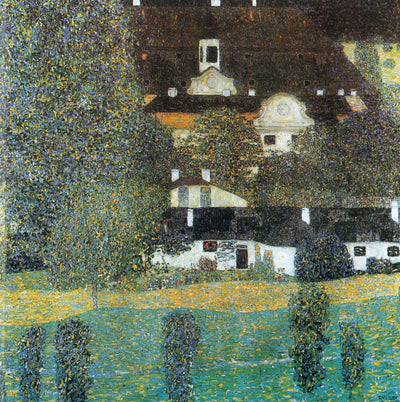
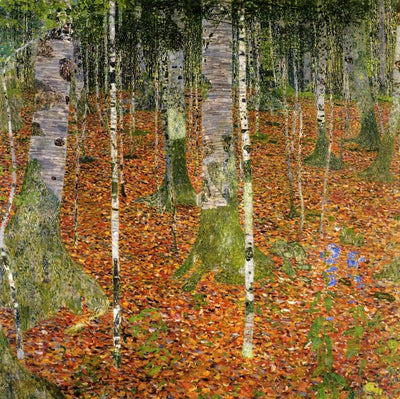
If you want the same summers without the flowers, the lake pictures sit well next to the gardens: the castle over the water in the 1909 Kammer painting, or a 1903 view deep into a birch wood from his Litzlberg years. They share the square format, so a pair hangs evenly.
How much is a Gustav Klimt painting worth?
The originals trade in the tens and hundreds of millions of dollars. Bauerngarten's $59.3 million was the Klimt auction record until Birch Forest reached $104.6 million at Christie's in New York in November 2022. Then, at a New York sale on November 18, 2025, the Portrait of Elisabeth Lederer fetched $236.4 million, the highest price paid at auction for any work of modern art. Two Attersee landscapes in the same sale made a combined $154.3 million, one of them Blooming Meadow from 1908.
Private deals run just as high: in 2006 the gold portrait of Adele Bloch-Bauer was bought for the Neue Galerie in New York for $135 million. A hand-painted copy of a garden costs a tiny fraction of any of this and lets you pick the size.
What is Gustav Klimt's most famous piece?
The Kiss, painted about 1907–1908 and shown at the 1908 Kunstschau as Lovers. The Austrian state bought it that year for 25,000 crowns, and it has hung in the Belvedere ever since. It's a garden picture of sorts, too: the couple in The Kiss kneel at the edge of a meadow of flowers, a gold cousin of the flower beds he was painting in those same years. If you want the gardens next to the pictures everyone recognizes, start with the paintings the whole world knows by heart.
Flowers that never fade
Art & See paints every copy by hand in oil on canvas, which suits Klimt's gardens better than a print: the dotted brushwork has real texture, and you choose the size, square included. Start with the full Klimt collection and pick the garden, or the lake view, that fits the room you have in mind.
Sources
- Belvedere, Cottage Garden with Sunflowers
- Belvedere, Sunflower
- CBS News (AP), Klimt painting sells for $59 million in London
- The Art Newspaper, France to return Klimt painting to heirs
- MAK Vienna, Gustav Klimt, das MAK und Schloss Immendorf
- Klimt Foundation database, Expressive Blaze of Colors
- Klimt Foundation, Gustav Klimt at Lake Attersee
- Sotheby's, The New York Sales, November 2025