4.9/5
4.9/5


A major oil from Van Gogh's last three years now sells for more than $50 million, and the auction record is $117.18 million. So if you're wondering how much is a Van Gogh painting worth, the real answer is a spread: under a million dollars for an early drawing, tens of millions for a canvas from the South of France, and nothing at all for most of the "Van Goghs" that surface at estate sales. A hand-painted copy sits at the far end of that scale, at a few hundred dollars. Here are the actual prices, what pushes them up, and what you pay to hang one of the Van Gogh paintings people copy most on your own wall.
The record: an orchard in spring, $117 million
On 9 November 2022, three bidders on the phones at Christie's in New York chased Orchard with Cypresses, a picture Van Gogh painted in Arles in April 1888. The hammer came down at $102 million. With fees, the anonymous buyer paid $117,180,000.
The painting belonged to Microsoft co-founder Paul Allen, who bought it in 1998 from the heirs of the collector Joan Whitney Payson, and the whole evening of his collection brought in $1.5 billion. The detail I like best is older, though. In 1935 the same canvas sold at auction for $15,000. You can read about the night the orchard sold in full.
That sale broke a Van Gogh record that had stood since 1990. Nine other paintings by him have also passed $50 million, and they're ranked one by one in the ten biggest Van Gogh sales, so there's no need to list them again here. What matters for your question is the pattern behind them.
How much is a Van Gogh painting worth? It depends on when he made it
Nine of the ten highest prices ever paid for his work went to canvases painted between April 1888 and June 1890. The tenth came from Paris, late 1887. Date and medium explain most of the gap between a $700,000 lot and a $70 million one.
Late oils: $50 million and up
This is the top of the market, and it's thin. Labourer in a Field, painted in September 1889, made $81 million at Christie's in New York on 13 November 2017. Wooden Cabins among the Olive Trees and Cypresses, from October 1889, brought $71 million in November 2021. When a canvas from this stretch appears, the estimate usually starts in the tens of millions, and the price often climbs past it.
The Paris years: a new record at $62.7 million
For a long time the paintings from his Paris years sold for less. That changed on 20 November 2025, when Sotheby's New York sold Parisian Novels, a still life of stacked yellow books with roses in a glass, for $62.7 million with fees. The estimate had been about $40 million. The previous record for a Paris picture was $33.2 million, paid at Christie's in May 2024 for Corner of a Garden with Butterflies, so the new price nearly doubled it.
The painting has a good story behind it. It went from Vincent to his brother Theo, then to Theo's widow Johanna van Gogh-Bonger, and it hung in the Indépendants exhibition in Paris in 1888 as number 658. Details like that, a clean line of owners back to the artist's family and a public showing in his lifetime, are what bidders pay for. The canvas is 28⅞ × 36¼ inches, and you can see the still life of stacked novels and its full provenance on the lot page.
Drawings: under $1 million to $11.2 million
Works on paper are where Van Gogh prices come down to earth, relatively speaking. The record for a drawing is $11.2 million, set at Sotheby's New York on 18 November 2025 by Sower in a Wheatfield with Setting Sun, from July 1888. It beat the $10.4 million paid at Christie's in 2021 for La Mousmé, drawn a month later.
That same week, Public Garden with Benches in Place Lamartine, from April 1888, sold for just under $3 million. Fisherman with Basket on his Back, from the start of 1883, went for $698,500 at Christie's. Same artist, same week, both drawings, and one made more than four times the other. The main reason is five years: the fisherman comes from his beginnings in The Hague, the benches show the garden just outside his Yellow House in Arles. The Art Newspaper covered the week two Van Gogh records fell, with every price.
Early peasant studies
The peasant heads he painted early on are the entry point for a genuine Van Gogh oil. A Head of a Peasant Woman, Left Profile came up in Hong Kong with an estimate of HK$3–5 million. You can follow his recent lots at Sotheby's to see how these early pieces are priced next to the late ones.
What pushes the price up
Four things show up again and again in the big results.
- The period. Bright work from Arles, Saint-Rémy and Auvers beats the sombre Dutch pictures every time.
- The owners. A line back to Theo and Johanna, or a famous recent owner like Allen, adds confidence and glamour.
- Freshness. Pictures that haven't been offered for decades draw more bidders than ones that were flipped recently.
- Who's buying. About half of all Van Gogh paintings sold now end up with collectors in Asia, which keeps demand deep at the top.
Resale can still be spectacular. The Avenue of Les Alyscamps, painted in November 1888, sold at Christie's for $12 million in 2003. Twelve years later, on 5 May 2015, it made $66 million at Sotheby's in New York.
One more thing when you read auction results: the headline price includes the buyer's premium. On the orchard, the hammer fell at $102 million and the fees added another $15.18 million. Estimates, on the other hand, are quoted without fees, which is part of why Parisian Novels looked like it cleared its $40 million estimate by such a wide margin.
Do Van Gogh paintings keep rising in value?
Mostly, yes. Sotheby's tracked 47 of his works that were resold at auction between 2003 and 2017: 93.6% of them rose in value, with an average compound annual return of 10.1%.
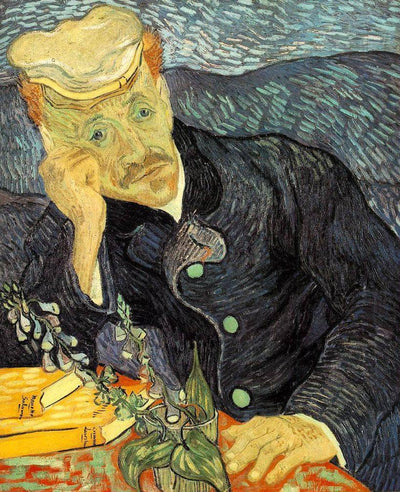
There's a catch in the headline numbers, though. Adjusted for inflation, the 2022 record isn't the most anyone has paid. The $83 million for the Gachet portrait in 1990 is roughly $210 million in current dollars, and Irises, which sold for about $54 million at Sotheby's in 1987, works out to around $160 million. In real terms, the Gachet sale of 1990 is still the high point.

The Gachet portrait, the record nobody got to see

On 15 May 1990 the first version of the doctor resting his head on his hand sold at Christie's in New York for $82.5 million. The estimate had been $40–50 million. It was the highest price paid for any painting at auction up to then, and it stayed the Van Gogh record for more than 30 years.
The buyer was the Japanese businessman Ryoei Saito. After his death in 1996 the painting was sold privately, passed through the hands of an Austrian investment manager, and ended up with a private collector in Switzerland, out of public view. If you want the portrait in person, the second version Van Gogh gave to Dr Gachet himself is at the Musée d'Orsay in Paris. The full trail of where the first version ended up reads like a thriller.
Who decides whether a Van Gogh is real?
An attribution is worth everything here. A picture accepted as his can fetch millions; the same canvas labelled "circle of" or "after" is worth a sliver of that.
The Van Gogh Museum in Amsterdam is the authority most buyers trust. Its opinion is free, but you can't ask for it directly anymore: the request has to come through an accredited art dealer or auction house acting for the owner. Most works are judged from photographs, and if the answer is no, the museum doesn't explain why. His output is very well documented, and new works are rarely added.
If you think you own one, start with the paperwork before you think about the museum: a receipt, an old exhibition label, a letter from a previous owner. Without a history leading back toward his family or an early dealer, the odds are long. If the history holds up, an accredited dealer can take it from there, and the rules for that step are on the authentication page in Amsterdam. For the rare times it worked out, read the stories of pictures found in attics, and keep your expectations modest.
What he thought they were worth
He knew. On 25 October 1888, from Arles, he wrote to Theo: "I can do nothing about it if my paintings don't sell. The day will come, though, when people will see that they're worth more than the cost of the paint and my subsistence, very meagre in fact, that we put into them." You can read the whole of his letter from late October 1888 in the complete letters edition. He was right by a margin he couldn't have pictured.
What a hand-painted copy costs
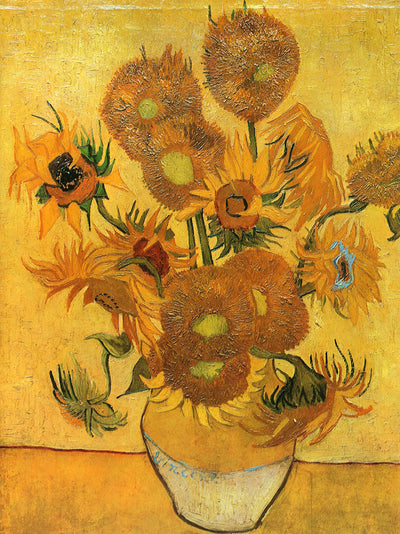
A hand-painted oil copy of a Van Gogh costs $299.95 at 16 × 20 inches and $1,299.95 at the largest size, 48 × 72 inches. The price ladder is the same across his best-known titles, from the swirling night sky over Saint-Rémy to the café glowing under the stars in Arles, a vase of fifteen sunflowers and almond branches against a pale blue sky.
| Size (inches) | Size (cm) | Price |
|---|---|---|
| 16 × 20 | 40.6 × 50.8 | $299.95 |
| 20 × 24 | 50.8 × 61 | $359.95 |
| 24 × 30 | 61 × 76.2 | $449.95 |
| 30 × 40 | 76.2 × 101.6 | $549.95 |
| 36 × 48 | 91.4 × 121.9 | $649.95 |
| 40 × 60 | 101.6 × 152.4 | $849.95 |
| 48 × 72 | 121.9 × 182.9 | $1,299.95 |
Put the two ends of this article side by side and the numbers get silly: the $117.18 million paid for the orchard would buy about 90,000 of the largest copies.
Why hundreds of dollars and not thirty? Because someone has to paint it. A print reproduces the image. A hand-painted copy reproduces the surface too, the ridges of paint in a cypress, the thick dabs of yellow in a star, and that takes a trained painter's hours. The price ladder mostly tracks that: a bigger canvas means more paint and more time.
A few things are worth checking before you order any copy, from anyone:
- Hand-painted or printed. A real copy is oil paint on canvas, built up stroke by stroke, with the raised texture you see in his originals. A print on canvas is flat, however it's described.
- Size against the original. His canvases are smaller than people expect. Parisian Novels is 28⅞ × 36¼ inches, so a 30 × 40 inch copy is already a little bigger than that original. Go bigger if the wall calls for it, but know you're choosing that.
- How it arrives. Rolled unframed canvas is cheapest to ship and lets you pick a local framer. Stretched or framed is ready to hang.
- Which version. Van Gogh often painted a subject more than once, the sunflowers and the Gachet portrait included. Make sure the copy follows the version you actually love.
If you'd rather hang one than bid on one
At Art & See, each Van Gogh is painted by hand in oil on canvas, in seven sizes, and you can choose unframed, stretched or framed. Browse every Van Gogh the studio paints to order, or start from the masterpieces people ask for most if you're still deciding.
Sources
- The Art Newspaper: the ten most expensive Van Gogh paintings
- The Art Newspaper: Orchard with Cypresses record
- The Art Newspaper: two Van Gogh records, November 2025
- Sotheby's: Piles de romans parisiens, lot page
- Sotheby's: Vincent van Gogh results
- Van Gogh Museum: authenticity
- Van Gogh Letters: letter 712 to Theo
- UPI Archives: Dr Gachet sale, 1990